

Audio By Carbonatix
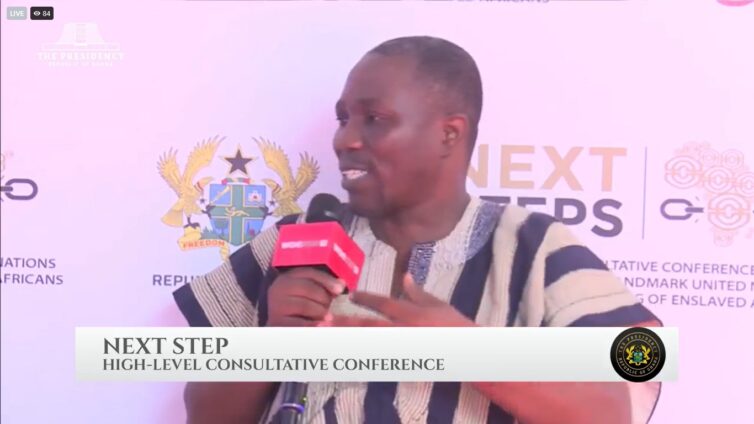
A researcher and historian at the University of Ghana, Legon, Accra, Kweku Darko Ankrah, has argued that Europe’s economic transformation and industrial advancement were significantly driven by the enslavement and forced labour of Africans.
Speaking on the sidelines of the ongoing Next Steps Conference on Reparatory Justice in Accra, Mr Ankrah said historical evidence suggests that Africa was economically advanced prior to European contact, particularly before the onset of the transatlantic slave trade.
He contended that African societies were largely self-sustaining, with families able to meet their basic needs and maintain stable livelihoods before external disruption through enslavement and colonial expansion.
According to him, European economies at the time faced internal social and labour challenges, but later experienced rapid growth after millions of Africans were forcibly transported and made to work on plantations and in domestic service, forming what he described as a key foundation of European wealth accumulation.
""When the slave trade occurred, what happened was that the African strong men who ought to work in the agrarian sector, because Africa's economy was highly propelled by the agrarian sector, were taken to Europe, that labour was used in the farms and plantations in Europe, and as a result, it boosted the economy of these Western places while they were able to get the consumable outcomes from their sweat," he noted.
Mr Ankrah argued that this system of forced labour played a critical role in transforming European agriculture and industry, enabling economic expansion at the expense of African societies.
He further referenced historical records and publications from the Gold Coast era, which he said documented comparative conditions between Africa and Europe prior to colonial rule, reinforcing claims of Africa’s earlier economic strength.
The historian made the remarks in the context of growing global conversations on historical accountability and reparatory justice, which have gained momentum following the adoption of UN Resolution A/RES/80/250.
The Accra conference, convened under the auspices of President John Dramani Mahama, continues to serve as a platform for scholars, policymakers and global stakeholders to examine the legacy of slavery and its continuing socio-economic impact on Africa and the diaspora.
Latest Stories
-
The GIPA Act: Resetting Ghana’s investment framework
43 minutes -
GIPA secures investor leads at Invest Fest 2026
49 minutes -
Ghana’s missing billions: What 16 years of Auditor-General reports show
49 minutes -
Police disown viral flyer on AirPods, earphones use while driving
51 minutes -
Stop using media to challenge judicial decisions – Thaddeus Sory to lawyers
52 minutes -
The next generation expects more than degrees from universities
56 minutes -
Ebenezer Dwomoh to stage fourth stand-up comedy special in Kumasi
59 minutes -
Central Regional Minister urges traditional leaders to hold public officials accountable
60 minutes -
Ada Traditional Council suspends four members for defying cancellation of 2026 Asafotufiami durbar
1 hour -
Association of Small-scale Industries, GEA strengthen artisans through mentorship, coaching
1 hour -
Two arrested over alleged galamsey activities in Tanoso
1 hour -
Ghana rises to sixth-largest gold producer globally after record 2025 output
1 hour -
Five injured in road crash at Ahwerase
1 hour -
Ghana needs copyright protection for Kente designs – Agortime-Ziope MP
2 hours -
BDCs lobby NPA for regional fuel depots amid concerns over BOST’s role
2 hours