

Audio By Carbonatix
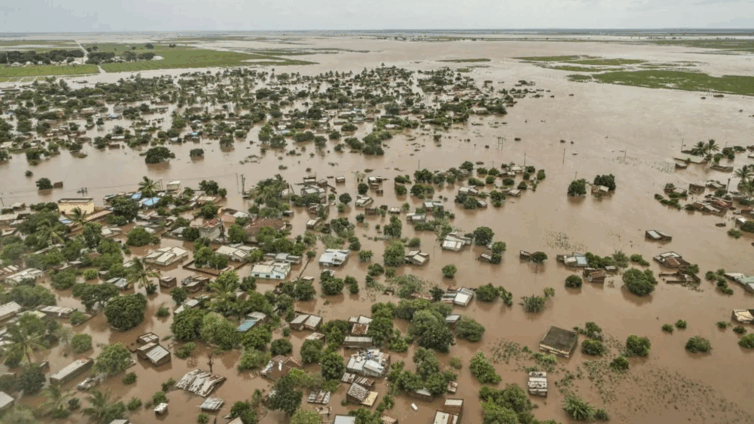
The Ghana Association of Public Health Technical Officers (GAPHTO) has called on the government to immediately reinforce public health safety measures, including compulsory handwashing and the use of face masks, to reduce the risk of disease outbreaks in communities affected by the recent floods.
The National President of the association, Joseph Owusu Asante, said although emergency response efforts were rightly focused on rescue operations and relief for flood victims, equal attention must now be given to preventing secondary public health emergencies.
Speaking on JoyNews' The Pulse, Mr Owusu Asante stressed that floodwaters often carry a cocktail of disease-causing organisms capable of triggering outbreaks of cholera, typhoid fever, diarrhoeal diseases, leptospirosis and other waterborne infections if adequate preventive measures were not enforced.
"I think we would want to entreat government that in doing all this we also have to ensure that there's a bit of policy behind what is going on."
He proposed that some of the public health measures adopted during the COVID-19 pandemic be temporarily revived in flood-hit communities.
"One of them is the hand washing and the others like the use of nose masks must be introduced and made as one of the major community barriers to make sure that pathogens that are mixed up do not get a chance to thrive and cause outbreaks within these times."
Danger of contaminated floodwater
Mr Owusu Asante also cautioned residents against using floodwater to wash household items or clean their homes, describing the practice as highly dangerous because the water is heavily contaminated.
His comments follow reports and video footage showing some residents in flood-affected communities using stagnant floodwater during cleanup exercises after Monday's torrential rains inundated several parts of Accra and other communities.
He explained that floodwater contains sewage, industrial waste, chemicals and numerous microorganisms capable of causing serious illness.
"Not at all. Not at all. And I think providing water is one of the basics."
He emphasised that even hands that appear clean can harbour harmful microorganisms, making visibly polluted floodwater an even greater health hazard.
"In fact, even your hands that do not appear dirty carry pathogens or disease-causing organisms. How much more floodwater that is obviously looking turbid and seriously contaminated, and would carry so much to harm your life."
Protective equipment
The public health expert urged authorities to provide adequate personal protective equipment (PPE) for sanitation workers and volunteers engaged in post-flood cleanup operations.
He said where residents had no option but to participate in cleaning exercises, they should wear protective clothing and observe strict hygiene practices to minimise exposure to contaminants.
"We must get people PPEs to be doing this work. Otherwise, if you have to do that at home, then you must observe a high level of hygiene practice."
Mr Owusu Asante warned that relying on contaminated floodwater for cleaning could expose survivors to serious health complications even after escaping the immediate effects of the disaster.
"You want to use the contaminated water for your cleaning. You just trying to make the worst happen to you after you have survived the disaster. That is not advisable."
Heightened health surveillance
The appeal comes as health authorities intensify surveillance following Monday's devastating floods, which claimed lives, displaced hundreds of residents and submerged homes, businesses and major roads across the Greater Accra Region.
Public health experts have repeatedly warned that the days immediately after flooding present the greatest risk for disease outbreaks due to contaminated water sources, damaged sanitation facilities and increased exposure to infectious pathogens.
They have therefore urged the public to consume only safe drinking water, maintain proper hand hygiene, avoid contact with contaminated floodwater where possible and promptly report symptoms of diarrhoea, vomiting or fever to the nearest health facility.
Latest Stories
-
Two lorry station masters arrested over alleged plot to kill creditor over ₵91k debt
10 minutes -
SIGA’s claim on highest audited proportion inaccurate – Bright Simons
11 minutes -
Money bouquets, spraying and dancing on cash unlawful – BoG warns
37 minutes -
Sam George pushes for nationwide 4G upgrade of rural telephony sites
37 minutes -
Local Government Ministry to support MMDAs to deliver gov’t agenda
48 minutes -
At least five killed in Sudan’s South Kordofan in attack by rebel group
59 minutes -
“Music is so stressful” – Headless YouTuber on why he won’t return
60 minutes -
Cleveland police chief proud of force but being ‘let down’ by funding
1 hour -
Black Sherif drops new 6-track EP ‘Sun Sherif’
2 hours -
GTA partners Africa’s Brain Bank for Medical City groundbreaking
2 hours -
How to check 2026 WASSCE results on mobile phone
2 hours -
President Mahama is a professional comedian – DKB
3 hours -
Final day of Joy FM Back-to-School Fair: Come shop, save and prepare for the new school year
3 hours -
GSE showed strong performance in August 2026 despite recording more stock losses
5 hours -
If CJ needs ethics law to know SOE comments were wrong, he may not be worthy of office – Arthur Kennedy
6 hours