

Audio By Carbonatix
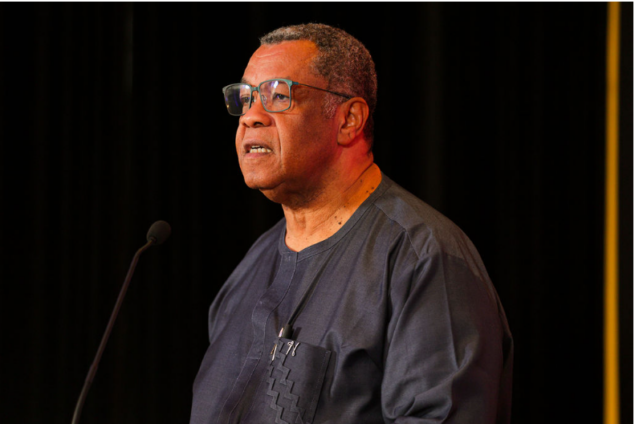
Presidential Advisor and veteran National Democratic Congress (NDC) comrade Goosie Tanoh has called on African countries to take advantage of the growing global demand for critical minerals by building industries, creating decent jobs, and strengthening peace on the continent.
He said the future of Africa’s mineral resources must not be defined by the export of raw materials but by the continent’s ability to add value, develop local industries, and create opportunities for its people.
Mr Tanoh made the call at the opening of a high-level conference on Governance, Critical Minerals and conflict in Africa organised by the Open Society Foundations in Accra.
The conference, organised by the Open Society Foundations, brought together government officials, civil society organisations, researchers, mining communities, development partners and private sector representatives to deliberate on the governance of Africa’s critical minerals.
In his remarks, Mr Tanoh said the diversity of participants at the forum reflected the reality that critical minerals were not merely geological or mining matters but issues that raised deeper questions about governance, development, and political choices.
"The diverse backgrounds of all of us gathered here today give validation and credence to the reality that critical minerals are not simply geological or mining issues," he said.
"They pose fundamental questions of political choice. Who decides? Who benefits? Who bears the environmental costs? And what remains when the mines are closed, and the precious resources are exhausted?"
Africa’s mineral opportunity
Mr Tanoh said the world would continue to depend on Africa’s minerals, but the central question was whether the continent would use its resources to build its own industries or continue exporting raw materials while others captured the greater value.
"The question is whether Africa will use them to build its own industry, create decent jobs, and strengthen peace, or be a collaborator and bystander in the century-old systematic depletion of its finite resources for the benefit of other peoples and other economies, whilst Africa remains impoverished and crisis-ridden," he said.
He explained that critical minerals had become strategic assets because modern economies and essential technologies depended on them, while supply chains remained vulnerable to disruption.
According to him, Africa’s green mineral strategy has identified key minerals linked to future industrial development, including lithium, graphite, cobalt, nickel, manganese, phosphate, and vanadium, as well as copper and aluminum.
He said these minerals were essential for technologies such as electric vehicles, renewable energy systems, solar panels, semiconductors, fibre optics, medical equipment, and advanced manufacturing.
Need for value addition
Mr Tanoh said the growing global transition towards cleaner energy presented Africa with an opportunity to become a major industrial player, but only if the continent moved beyond the extraction of raw materials.
He noted that although Africa holds a significant share of the world’s critical mineral reserves, it has not yet translated that advantage into dominant positions in global mineral value chains.
"These are commanding positions in individual minerals. They have not yet become commanding positions in the industrial value chains of these minerals," he said.
He pointed out that Africa continues to export raw materials while importing finished products made from those same resources.
He pointed out that in 2025, the leading refining country controlled an average of about 72 percent of the market across key energy minerals, while China produced more than 80 percent of the world’s lithium-ion phosphate cathode materials used in battery storage and electric vehicles.
"Africa still exports bauxite and imports aluminum products, exports copper and imports wires and cables, and exports lithium, cobalt, manganese, and graphite while importing battery cells and storage systems," he said.
Mr Tanoh said Africa must decide whether it would take advantage of this opportunity through beneficiation and value addition or remain on the margins of the emerging industrial transformation.
"And so, we must ask ourselves, will Africa seize the industrial opportunity offered through the beneficiation and value addition of these minerals as China has done, or will we remain at the margins of the new industrial revolution?" he said.
Mr Tanoh said this structural challenge must be addressed through deliberate policies, regional cooperation, and investments in processing, technology, and skills.
"The rest of this 21st century must be about more than exporting ore. It must include beneficiation, value addition, the production of alloys, battery-grade chemicals, and manufactured products," he stated.
AfCFTA must drive industrial transformation
Mr Tanoh stressed that Africa’s mineral transformation would require stronger regional integration, arguing that no single African country could build complete mineral value chains alone.
He described the African Continental Free Trade Area (AfCFTA) as critical to Africa’s industrial ambitions.
"Africa, however, together has most of the basket. The African Continental Free Trade Area has therefore become our industrial backbone and not another failed treaty of words without deeds," he said.
He said Africa needed competitive regional value chains that connect mines to refineries, refineries to component plants, and factories to African and global markets.
According to him, regional cooperation would allow countries to combine their resources and capabilities to develop industries that can compete globally.
24-hour economy and industrial development
Mr Tanoh linked Ghana’s 24-hour economy agenda to the broader objective of building an economy capable of producing more, adding value, and reducing dependence on imported goods.
He explained that a 24-hour economy was not simply about working at night but about creating reliable systems that support continuous production.
"A 24-hour economy is not merely about working at night. It is about productive systems that function reliably around the clock," he said.
He said such a system required dependable energy, transport networks, ports, digital infrastructure, finance, maintenance services, and efficient public systems.
Mr Tanoh said investments in renewable energy could create opportunities beyond electricity supply by supporting local manufacturing, assembly, maintenance, and recycling capabilities.
Governance and communities must remain central
Mr Tanoh cautioned that industrial ambition must be matched by strong governance, transparency, and accountability.
"Industrial ambition does not excuse weak governance. It makes good governance even more urgent," he said.
He said every critical mineral project must answer important questions around what would be processed locally or regionally, what opportunities would be created for African businesses, what skills and technology would remain, and what would happen to land, water, and communities after production ends.
He called for transparent licensing and contracting processes, fair taxation systems, ownership disclosure, environmental impact assessments, mine closure financing, supply-chain traceability, and stronger public reporting mechanisms.
“Communities must be involved before major decisions are made, not consulted after the fact,” he stressed.
He further called for greater inclusion of artisanal and small-scale miners, women, and young people not only as workers, but also as suppliers, researchers, entrepreneurs, and decision-makers.
“Peace, environmental protection, and industrialisation must move forward together in tandem and in partnership,” he said.
Measuring Africa’s mineral success differently
Concluding his remarks, Mr Tanoh said Africa must redefine how it measures success in the mineral sector.
"The measure of success must be different. How much value is added in Africa? How many decent jobs are created? How much technology is transferred? How do communities share in the benefits? And how responsibly the land has been and will be restored?" he asked.
He said Ghana was ready to work through AfCFTA with African governments, communities, responsible investors, universities, and development partners to build competitive regional value chains.
"Africa must enter the current and ever-present future not only as a source of minerals but as a producer of materials, components, equipment, knowledge, and standards," Mr Tanoh said.
He called on African leaders to harness the opportunities presented by the African Continental Free Trade Area (AfCFTA) to establish regional mineral value chains that drive local processing, boost industrial development, and increase trade among African countries.
Latest Stories
-
Amin Adam calls for review of fuel taxes as diesel prices remain above GH¢18
9 minutes -
World Vision Ghana, Ahafo districts sign MoU for universal WASH coverage
39 minutes -
When the gold engine stutters: What Ghana’s Cedi and reserves are telling us about the new economic architecture
56 minutes -
Two reportedly die after being trapped in mining pit at Juaboso
1 hour -
Petrosol cleans up Wa Municipal Hospital, to donate medical equipment
1 hour -
KiDi brings the hits to London in sold-out UK headline concert
2 hours -
The last goodbye of Ghanaian shot dead in the US
2 hours -
MCC opens door to Ghana again as MiDA revives development partnership
2 hours -
CSIR moves to turn scientific research into jobs, national growth
2 hours -
More patrons troop in as 3rd Republic Bank-JoyNews Habitat Fair clinic enters final day stretch
2 hours -
‘If NPP was ‘insensitive’ over fuel prices, NDC must accept same description now’ — Amin Adam
2 hours -
German, Russian foreign ministers hold rare talks amid rising tensions
2 hours -
Gov’t to develop policy for Ghanaian Sign Language in education
3 hours -
Accra Academy defend ODADEƐ ’90 5-a-side title
3 hours -
Ghana risks EU gas market access over methane emissions – Expert warns
3 hours