

Audio By Carbonatix
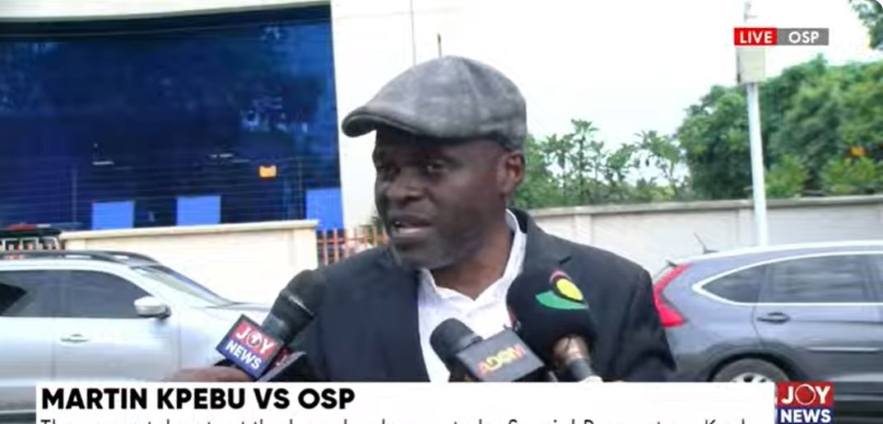
Private legal practitioner Martin Kpebu says the Supreme Court's unanimous ruling on the prosecutorial powers of the Office of the Special Prosecutor (OSP) has firmly established that the Attorney General (AG) retains supervisory authority over the anti-corruption body and can intervene where necessary to prevent any abuse of prosecutorial powers.
Reacting to the judgment on JoyNews' The Pulse on Wednesday, July 29, Mr Kpebu said the ruling should not be viewed simply as preserving the OSP's prosecutorial powers, but rather as clarifying that those powers are exercised under the constitutional authority of the Attorney General.
"The decision is a good one," he said. "But the fight was not just about retaining the prosecutorial powers. The fight was whether the OSP should always seek authorisation or permission in starting every case."
He noted that while the Supreme Court did not expressly state in its summary that the OSP must obtain fresh authorisation for every prosecution, the justices made one point abundantly clear—that the Constitution vests the power to prosecute in the Attorney General.
"There's a key part that the Supreme Court held: it's only the Attorney General who has the power to prosecute. So the responsibility for prosecution lies with him," Mr Kpebu explained.
According to him, the implication is that the Attorney General can direct the OSP to discontinue or stay away from any prosecution if circumstances warrant such intervention.
"It means that at any point, the Attorney General can write to the OSP and tell him, 'I hear you're doing this case; stay off it.' And if the OSP refuses, the Attorney General can go to court to stop it," he said.
Mr Kpebu argued that the ruling settles the long-running dispute over whether the Special Prosecutor operates independently of the Attorney General.
"This lawsuit arose because the Special Prosecutor would not obey the Attorney General. He believed the office was totally independent of the Attorney General, and that is what triggered the whole lawsuit," he stated.
He maintained that the Supreme Court has now "put the Special Prosecutor in his right place" by affirming that the office remains subject to the Attorney General's constitutional supervision.
"So now, if you see anything the OSP is doing that is untoward, you can report it to the Attorney General, who is his boss, and the Attorney General can put him in his right place. That's very important," he added.
Mr Kpebu also referred to an earlier High Court decision involving the OSP, arguing that concerns about the possible abuse of prosecutorial powers underscore the need for effective oversight.
He expressed confidence that Attorney General Dr Dominic Ayine would exercise his supervisory authority fairly where complaints arise against the Office of the Special Prosecutor.
"The abuses are what we want to check," he said, adding that the Supreme Court's ruling provides a constitutional mechanism for ensuring accountability while preserving the OSP's role in the fight against corruption.
The Supreme Court on Tuesday unanimously dismissed a constitutional challenge to the OSP's prosecutorial powers, affirming the legality of the Office's mandate while holding that the Attorney General retains the Constitution's exclusive authority over criminal prosecutions. The full written judgment is expected to provide further clarity on the extent of the Attorney General's supervisory role over the anti-graft agency.
Latest Stories
-
Five-member committee to search for new Black Stars coach after Sports Ministry-GFA meeting
23 minutes -
Pinktober: Breast cancer survival exceeds 90% when detected early – Breast Society of Ghana
30 minutes -
TCDA to adopt Upper West’s MATCO mango farm as northern prototype, issues warning against felling shea trees
40 minutes -
Fear delegates tag: Afoko touts genuineness among delegates ahead of NPP delegates conference
42 minutes -
John Boadu: The leader our party needs at this time – Amb. Edward Akwasi Boateng
48 minutes -
Baffour Awuah: EOCO effected an arrest, detained MP after hours of waiting, questioning – Afenyo-Markin
1 hour -
EOCO court warrant authorised search of Baffour Awuah’s law firm, not residence – Afenyo-Markin
1 hour -
NPP delegates conference: 3,000 to 4,000 police personnel deployed for security in Kumasi – Anthony Karbo
1 hour -
KGL Foundation commits $200,000 to support juvenile football for the next two years
2 hours -
UNDP invites Mahama Ayariga to Northern Peace Conference in Tamale
2 hours -
Afoko can give NPP ‘new identity’ ahead of 2028 to overcome NDC – Political scientist, Dr Amakye-Boateng
2 hours -
2 injured amid gunshots during raid at Nawara Mining office at Nsuapemso
2 hours -
St Augustine’s College retains 2026 National Investment Quiz title
2 hours -
KNUST Nursing and Midwifery School staff recognised at 2026 Health Ministry Excellence Awards
2 hours -
JoyNews’ Esther Esi Nkrumah selected for UK Media Excellence for Emerging Technology Fellowship
2 hours