

Audio By Carbonatix
United Nations Special Representative Hannah Tetteh has urged African countries to carefully reassess their strategic positioning as the global system undergoes significant changes.
She said the world is moving away from the previous belief that deeper global integration and globalisation were inevitable, with even powerful nations beginning to question the benefits of the existing economic order.
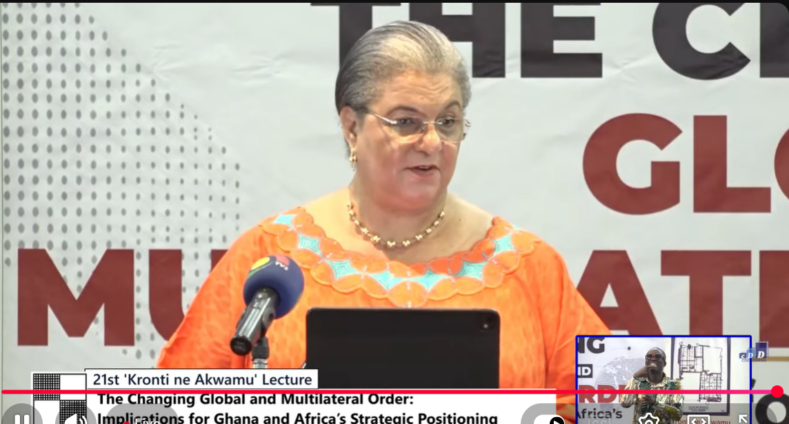
Speaking at the 21st Kronti ne Akwamu Public Lecture, Mrs Tetteh said the changing global environment requires Africa to develop stronger strategies to protect its interests.
She explained that for several decades, globalisation was viewed as a pathway to increased prosperity, with countries encouraged to embrace economic integration and governance systems aligned with international cooperation.
However, she noted that recent developments suggest a shift in thinking among some major global powers, who increasingly view aspects of global integration as risks to their national interests.
“Previously, globalisation was seen as inevitable,” she said, adding that the current environment reflects a significant departure from the assumptions of the past four decades.
Mrs Tetteh said growing concerns over supply chain vulnerabilities, economic inequality and national security considerations have influenced how some countries approach global cooperation.
She warned that changes in global politics and economics could have significant implications for developing countries, including those in Africa.
According to her, African nations must strengthen cooperation among themselves and maximise opportunities presented by institutions such as the African Union and regional economic communities.
She also stressed the importance of defending international frameworks that provide smaller states with platforms to influence global discussions.
Mrs Tetteh said the principles of sovereign equality and international cooperation remain critical for countries that cannot rely solely on unilateral action to protect their interests.
She encouraged African policymakers to approach the changing global order with strategic foresight, ensuring that the continent is not only responding to global shifts but actively shaping conversations about its future.
The lecture formed part of discussions on Ghana and Africa’s role in navigating emerging global political, economic and security realities.
Latest Stories
-
Interest payments to average a high 20% of government revenue over next 4 years
1 hour -
Strategy of accumulating foreign reserves, gold carries high fiscal cost – S&P Global
1 hour -
Weak institutional arrangements, high debt servicing constrain Ghana’s rating – S&P
1 hour -
Bond market: Turnover declined by 28% to GH¢1.56bn
2 hours -
Volta Region National Public Speaking contest advances drug prevention conversation
2 hours -
New health training facility at Ampoma-Jema to address admission shortfalls, but Minister flags missing amenities
2 hours -
Black Challenge unveiled with sights set on Amputee World Cup glory
3 hours -
Pay striking teachers before expressway spending, Dr Kingsley Agyemang tells government
4 hours -
Customs intercepts assault rifle, two pistols and 610 rounds of ammunition at Tema Port
4 hours -
PKO boxers secure wins at Odwira Festival
4 hours -
South Tongu Records Rise in Teenage Pregnancy
4 hours -
Cabinet threw out US health compact faster than anything I’ve seen – Mahama
4 hours -
MoFA urges Finance Ministry to reverse World Bank food programme withdrawal over GH¢643m commitments
4 hours -
NAGRAT demands signed timelines before calling off strike
5 hours -
National Investment Quiz: West Africa SHS, St. Louis SHS advance to semi-finals
5 hours