

Audio By Carbonatix
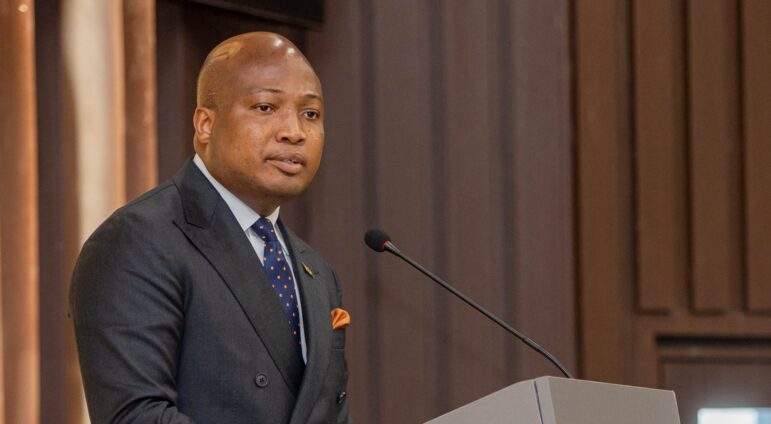
Foreign Affairs Minister Samuel Okudzeto Ablakwa says Ghana intends to leverage the changing global geopolitical order to reduce its dependence on external support and strengthen control over its natural resources.
According to him, the current global tensions present Ghana and other African countries with an opportunity to develop home-grown solutions, negotiate more beneficial agreements and pursue greater resource sovereignty.
“We see this as an opportunity to look within and find home-grown solutions to our challenges,” Mr Ablakwa said.
He argued that Africa, despite its vast natural and human resources, could no longer afford to remain dependent on external assistance.
With a median age of 19 and a population of about 1.4 billion, Africa is projected to account for one in every four people globally by 2050.
Mr Ablakwa said this demographic potential, coupled with the continent’s abundant oil, gas, lithium, cobalt, cocoa and bauxite resources, should position Africa as a major global economic force.
He maintained that African countries must harness these resources to create wealth and improve the lives of their citizens instead of continuing to rely on external handouts.
The Foreign Affairs Minister disclosed that Ghana recently rejected a health financing package worth less than $200 million due to concerns about the conditions attached to it.
According to him, the conditions included access to Ghana’s health and pathogen data, as well as information affecting the privacy of citizens.
“We refused. But we found the resources within,” he said.
Mr Ablakwa said the decision demonstrated the importance of building domestic resilience and strengthening national capacity without compromising the country’s strategic interests in exchange for external financing.
“Smart leaders must take advantage and create new wealth for Africans. That’s how we see it,” he added.
Ghana targets end to raw material exports by 2030
Mr Ablakwa also disclosed that Ghana has set a target of ending the export of raw materials by 2030 as part of efforts to industrialise the economy and retain more value from its natural resources.
“By 2030, we are no longer going to export any raw material. Not one,” he stated.
He cited cocoa, gold and bauxite among the resources the government intends to process locally before export.
The Foreign Affairs Minister said the government was also seeking to renegotiate resource agreements to secure better returns for the country.
He argued that previous arrangements had left Ghana with a relatively small share of the wealth generated from its resources.
Mr Ablakwa cited gold mining agreements under which Ghana holds a 10 per cent interest, while the remaining 90 per cent goes elsewhere. He said the country’s interests in the oil and gas sector must also be reassessed.
“We have a new framework where we are negotiating hard and smart,” he said.
He added that technological advancements, including artificial intelligence and other generative tools, offered Ghana an opportunity to build local expertise and strengthen its capacity to manage its natural resources.
Ghana explores new global partnerships
Speaking about the emerging global order and the growing importance of cooperation among countries of the Global South, Mr Ablakwa said Ghana was looking beyond its traditional alliances.
He said the country would pursue partnerships based on mutual interests, fairness and tangible benefits for citizens.
Mr Ablakwa cited Ghana’s role in championing a recent United Nations resolution declaring transatlantic enslavement the greatest crime against humanity. According to him, the resolution received the support of 123 countries.
He said such voting patterns could help Ghana identify countries with which it could establish closer diplomatic and economic relations.
The minister further stated that Ghana was preparing to assume the chairmanship of the African Union and intended to deepen cooperation with international blocs such as BRICS and the Caribbean Community (CARICOM).
He also highlighted Ghana’s role as host of the African Continental Free Trade Area Secretariat, describing the agreement as having the potential to create the world’s largest trading market if barriers to intra-African commerce were removed.
Mr Ablakwa expressed concern that intra-African trade currently accounts for only about 14 per cent of the continent’s overall trade, stressing the need for African countries to trade more among themselves.
He also disclosed that Cabinet had recently considered Ghana’s potential membership of BRICS and was taking a positive view of the bloc.
According to him, Ghana’s foreign policy will increasingly be guided by the national interest rather than historical relationships.
“This business of these are my traditional allies, these were colonial masters, these are the people who have been with us — it doesn’t work,” he said.
“We are looking at those who are willing to create win-win partnerships. Negotiate fairly, no exploitation, no arm-twisting, no conditionalities.”
Mr Ablakwa said Ghana would not hesitate to explore alternative partnerships whenever existing arrangements failed to advance the country’s interests.
He maintained that governments had limited time to fulfil their electoral promises and must, therefore, move beyond nostalgia and historical relationships to pursue partnerships capable of delivering concrete results for their citizens.
Latest Stories
-
Is Ghana losing the fight to protect children online?
3 minutes -
Ghana Institution of Surveyors pushes for Governing Council Bill, conference reforms
3 minutes -
Professional collaboration key to Ghana’s land, property development – Western Regional Minister
14 minutes -
UPSA holds first session of 18th Congregation.
19 minutes -
Why demand another country’s medical records? – Mahama on Ghana’s rejection of ‘humiliating’ US health compact
23 minutes -
Mentorship critical to survival and growth of MSMEs – Sinapi Aba Trust
23 minutes -
Nsawam Adoagyiri MP joins residents to oppose Agbogbloshie waste relocation to his constituency
36 minutes -
New monitoring system rolled to step up fight against child labour in Ghana
37 minutes -
Patrick Donkor
38 minutes -
GHS, Oxfam sensitise young people in Ekon on contraception, reproductive health to mark World Contraception Day
39 minutes -
Let private sector drive economic transformation – Alan Kyerematen
43 minutes -
GoldBod changes gold assay regime, makes XRF testing definitive from October 1
47 minutes -
Ghana sees geopolitical tensions as opportunity to end dependence – Ablakwa
49 minutes -
Empower community radio stations to strengthen public engagement – Former Sports Minister
57 minutes -
La Dade-Kotopon MP calls for Ga language programmes in schools and on radio
58 minutes