


Audio By Carbonatix
For decades, Ghana’s financial system has operated largely within a conventional framework, with interest-based banking dominating financial intermediation, investment and credit creation. That landscape, however, is approaching an important turning point.
As Ghana prepares to introduce non-interest banking into the mainstream financial system, the country is not simply creating another banking product.
It is opening the door to a global financial industry that has grown into a multi-trillion-dollar ecosystem, with increasing relevance to banking, capital markets, insurance, investment management, infrastructure financing and financial inclusion.
The significance of this development becomes clearer when Ghana’s emerging non-interest finance architecture is placed against the latest global evidence from the Islamic Financial Services Board (IFSB).
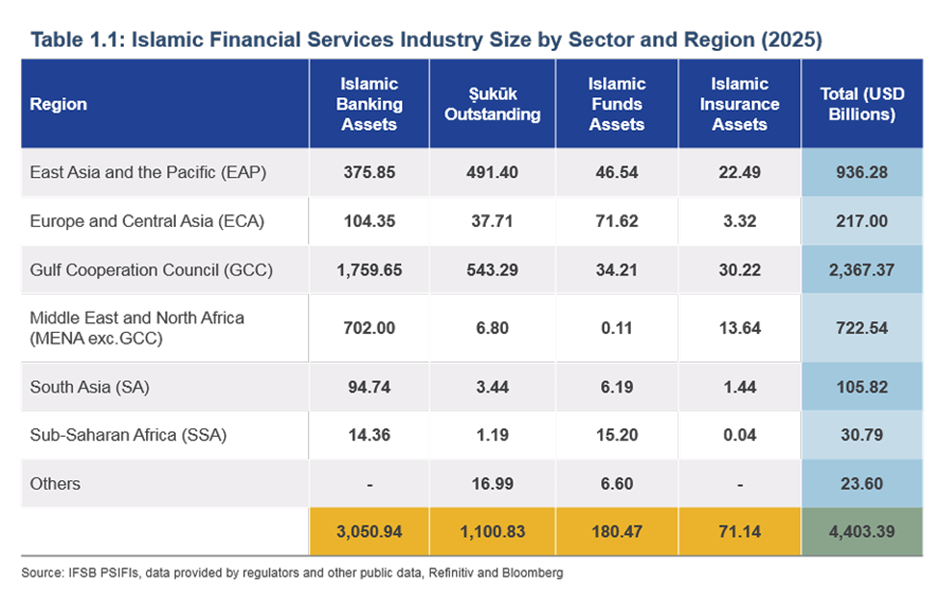
According to the latest IFSB report, the global Islamic financial services industry reached US$4.4 trillion in total assets in 2025, demonstrating that what was once regarded as a niche segment of the global financial system has increasingly become an important component of mainstream finance.
In several major markets, Non-interest finance has moved from being a parallel financial offering to becoming part of the broader domestic financial system and national economic transformation agenda.
The IFSB report shows that this transition has been supported by developments across banking, non-interest bond (Sukuk), insurance and investment funds, with non-banking segments in particular recording strong growth.
The numbers tell an important story. Non-interest banking recorded year-on-year growth of 9.7 percent in 2025, compared with 14.9 percent in the previous year. Non-interest bond (Sukuk)outstanding expanded by 21.8 percent, although this was lower than the 25.6 percent recorded in 2024.
Takaful, or non-interest insurance, grew by 13.9 percent, compared with 16.9 percent in the previous year. Perhaps most strikingly, non-interest funds expanded by 25.6 percent in 2025, compared with only 9.2 percent in 2024.
These figures demonstrate that the global non-interest finance industry is no longer dependent on banking alone; capital markets, insurance and investment funds are becoming increasingly important engines of growth.
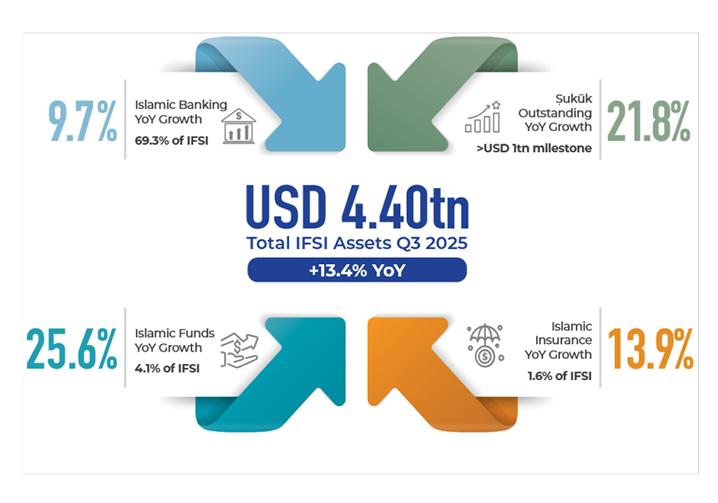
Over the five-year period to 2025, the Islamic financial services industry maintained a strong growth trajectory, recording an annual growth rate of 13.4 percent in 2025 and a compound annual growth rate of 10.3 percent between 2020 and 2025.
Across its four principal sectors non-interest banking, non-interest bond (Sukuk), non-interest (Islamic) funds and Takaful (insurance) the industry added approximately US$1.7 trillion in assets over the period.
From a niche concept to a global financial industry
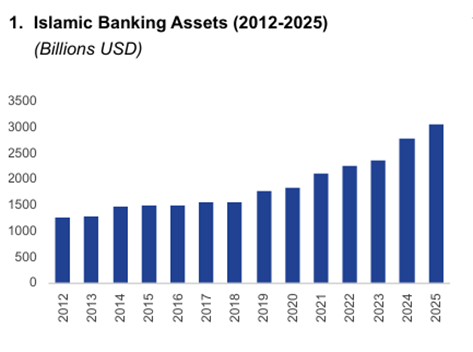
Non-interest banking remains the largest component of the global Islamic financial services industry, accounting for approximately 69 percent of total industry assets. Although growth moderated compared with 2024, the sector continued to expand across different regions.
The IFSB reports that Islamic banking assets recorded a global five-year compound annual growth rate of 10.6 percent. The significance of this growth is not simply the size of the market. It is the geographical direction of that growth.
Established non-interest finance markets remain important, particularly in the Gulf Cooperation Council and East Asia-Pacific regions, but emerging and frontier markets are increasingly recording stronger growth rates.
This is particularly relevant to Ghana because it suggests that a country does not need to have a long history of non-interest banking to participate meaningfully in the industry. Appropriate regulation, market infrastructure, institutional capacity and consumer awareness can provide the foundation for rapid development.
The IFSB report also points to an important structural development within non-interest banking. On the asset side of banks' balance sheets, non-interest bond (Sukuk) holdings and interbank financing have expanded faster than financing portfolios in some regions.
This suggests that non-interest banks are becoming increasingly integrated into wider financial markets rather than operating solely as institutions that collect deposits and provide financing to customers.
On the liability side, interbank funding and non-interest bond (Sukuk) issuance are increasing in many jurisdictions, further demonstrating the growing interaction between Non-interest banks and capital markets.
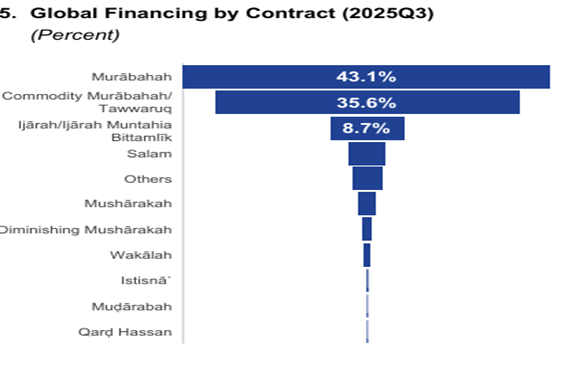
The dominant financing structures remain Murabahah and commodity Murabahah, which account for a significant share of financing contracts globally. At the same time, the industry continues to develop a broader range of instruments capable of supporting investment, trade, infrastructure and capital-market activities.
The concentration of Non-interest banking assets is also noteworthy. Sixteen domestic systemic importance markets account for approximately 93 percent of global Islamic banking assets.
This concentration reflects the depth of the industry in established markets but also highlights the potential space available to emerging markets that are developing their regulatory and market infrastructure.
What does this mean for Ghana?
Ghana's entry into non-interest banking should therefore not be understood simply as the introduction of an alternative deposit or financing product. It should be seen as the beginning of a broader financial ecosystem.
The immediate impact will likely be felt within the banking sector. Non-interest banking can provide additional options for deposit mobilisation and financing while introducing new contractual structures into the Ghanaian banking market.
Customers who, for religious, ethical or personal reasons, have traditionally been uncomfortable with conventional interest-based banking may have greater confidence in participating in the formal financial system.
But the opportunity extends well beyond customers who specifically seek faith-based financial products. Non-interest finance is increasingly attracting customers and investors based on principles such as risk-sharing, asset-backing, ethical investment, transparency and responsible financing. Consequently, the market should be positioned as an inclusive financial system capable of serving Muslims and non-Muslims alike.
This distinction is critical for Ghana. Non-interest banking should not be presented as a financial system exclusively for Muslims. It should be communicated as another form of financial intermediation available to every Ghanaian, just as conventional financial products are available to people of different religious backgrounds.
The introduction of non-interest banking could therefore deepen competition within the banking industry.
Conventional banks may respond by developing their own non-interest windows or subsidiaries, while new entrants may seek licences to operate dedicated non-interest banking institutions. The resulting competition could encourage innovation in products, pricing, customer service and digital delivery.
The bigger opportunity may be in Ghana's capital market
Perhaps the most transformative opportunity lies outside banking itself.
The global growth of non-interest bond (Sukuk) provides Ghana with another potential instrument for mobilising domestic and international capital. Non-interest bond (Sukuk) outstanding globally grew by 21.8 percent in 2025, demonstrating the increasing importance of the instrument within the international capital market.
For a country such as Ghana, which requires substantial financing for infrastructure, energy, transport, housing, agriculture and other development priorities, the ability to diversify funding sources is strategically important.
Non-interest bond (Sukuk) can potentially provide an additional avenue through which governments, financial institutions, corporates and infrastructure projects can access capital.
Properly structured and supported by a credible regulatory framework, non-interest bonds (Sukuk) could help connect Ghana to investors in the Gulf, Southeast Asia, Africa and other international markets where demand for non-interest principles and ethical investment instruments is expanding.
This could be particularly relevant for pension funds, insurance companies, investment managers and other institutional investors. As the Ghanaian capital market develops, the introduction of additional asset classes could deepen the market and broaden investment opportunities.
The emergence of non-interest finance could therefore strengthen the relationship between Ghana's banking sector and capital market. Banks could participate in non-interest bond (Sukuk) issuance and distribution, while investment managers could develop non-interest investment products and institutional investors could diversify their portfolios.
Takaful could open another financial frontier
The insurance industry is another area where Ghana could benefit.
Globally, Takaful continues to expand at double-digit rates. The IFSB reports that the global non-interest insurance sector is increasingly expanding into emerging and frontier markets, with growth momentum becoming more significant in regions including Sub-Saharan Africa.
This has direct relevance for Ghana. Insurance penetration remains an important policy concern, and the introduction of Takaful could provide another mechanism for bringing previously underserved segments of the population into the insurance market.
The opportunity is not limited to personal insurance. Takaful could potentially support corporate insurance, health-related schemes, family protection, general insurance and other areas of risk management.
The growth of Takaful also creates opportunities for professionals in actuarial science, accounting, investment management, risk management, auditing, regulation and insurance brokerage. As the sector develops, Ghana will require professionals who understand both conventional financial practices and the distinctive operational and contractual features of non-interest finance.
The investment-fund opportunity
The most dramatic growth among the four major segments of the global Islamic financial services industry in 2025 was recorded by non-interest funds, which grew by 25.6 percent, compared with 9.2 percent in 2024.
This should command the attention of Ghana's asset-management industry.
The development of non-interest investment funds could create opportunities for collective investment schemes, pension-related investments, mutual funds and other investment vehicles that can attract both domestic and international investors.
Ghana's investment-management industry could therefore become an important beneficiary of the new ecosystem. Fund managers who understand the requirements of non-interest investment could potentially develop products targeted at investors seeking ethical, asset-backed or non-interest investment opportunities.
This also creates an important role for Ghana's accountants and auditors. The development of non-interest finance will require professionals who understand the accounting, reporting, governance and disclosure requirements associated with these instruments.
A new opportunity for professional services
The introduction of non-interest banking will create demand far beyond bankers.
Lawyers will need to understand the contractual structures underlying Cost plus (Murabahah), Leasing (Ijarah), Partnership (Musharakah), Venture Capital (Mudarabah), Agency (Wakalah) and non-interest bond (Sukuk) transactions.
Accountants and auditors will need to understand the relevant financial reporting requirements. Investment professionals will need to appreciate the characteristics of non-interest investment products. Risk managers will need to understand the different risk profiles created by asset-backed and partnership-based transactions.
Regulators will also require specialised capacity to supervise institutions and products effectively.
This is why Ghana's move into non-interest finance should be accompanied by significant investment in human capital. The success of the industry will depend not only on legislation and regulation but also on the availability of competent professionals capable of implementing the framework.
What Ghana could look like by the end of the year
If Ghana successfully commences non-interest banking by the end of 2026, the country will enter what could become a new phase in the development of its financial system.
The immediate outcome will be the availability of another form of banking and financial intermediation. However, the more important long-term development could be the gradual construction of a complete non-interest financial ecosystem encompassing banking, non-interest bond (Sukuk), Takaful, investment funds and related professional services.
Ghana could become one of the important emerging markets for non-interest finance in Sub-Saharan Africa if the necessary regulatory, institutional and market conditions are properly established.
The country already has several advantages. It has a relatively developed financial system, an established securities market, banking and insurance institutions, a growing investment-management industry and a regulatory architecture that can be adapted to accommodate new financial products.
Ghana's position within West Africa could also provide a strategic advantage. A successful domestic market could eventually serve as a platform for regional expansion and cross-border investment.
However, the country should not expect the market to develop automatically.
The introduction of non-interest banking will require effective public education, strong regulatory supervision, credible governance arrangements, adequate liquidity-management mechanisms, appropriate tax treatment, accounting and auditing capacity, qualified professionals and a clear understanding among market participants of the difference between conventional and non-interest financial contracts.
Market awareness will be particularly important. A poorly understood product can create reputational and operational risks. Customers need to understand what they are buying, while financial institutions need to understand the contractual and risk implications of what they are offering.
Regulation will determine the credibility of the market
For policymakers and regulators, the most important lesson from international experience is that non-interest finance requires more than simply allowing banks to avoid charging interest.
It requires a comprehensive regulatory and supervisory framework that addresses licensing, governance, liquidity, capital adequacy, risk management, consumer protection, financial reporting, investment restrictions and the appropriate governance arrangements for non-interest products.
Ghana's regulatory authorities therefore have a critical role to play in ensuring that the emerging framework is robust enough to protect financial stability while allowing innovation.
The experience of other jurisdictions demonstrates that the strongest markets are those where non-interest finance is incorporated into the broader financial architecture rather than treated as an isolated or exceptional segment.
The IFSB's global findings reinforce this point. The industry's expansion has been supported by regulatory and market developments across banking, insurance and capital markets, while emerging and frontier markets have continued to grow rapidly as their institutional frameworks develop.
Ghana must avoid viewing non-interest finance through a narrow lens
There is also a need to change the narrative around non-interest finance.
The biggest mistake Ghana could make would be to reduce the conversation to whether the country is introducing “Islamic banking”. That framing is too narrow for the economic opportunity available.
The more appropriate conversation is about financial diversification, inclusion, ethical investment, capital mobilisation and economic development.
The global evidence demonstrates that non-interest finance has moved beyond its traditional markets. It is now a global industry worth US$4.4 trillion. Its banking segment accounts for the majority of assets, but non-interest bond (Sukuk), Takaful and investment funds are expanding rapidly and creating a broader financial ecosystem.
For Ghana, therefore, the question should not be whether non-interest finance is relevant. The more important question is how Ghana can position itself to capture a meaningful share of the opportunities created by this growing global industry.
A potential new source of capital for national development
Ghana's development needs require significant capital. The country must finance infrastructure, expand productive capacity, support small and medium-sized enterprises, develop agriculture, strengthen housing finance and create opportunities for private-sector investment.
No single source of finance can meet these needs.
Non-interest finance will not replace conventional finance, nor should it be expected to. Its strategic value lies in providing additional channels for mobilising capital and attracting investors who may otherwise have limited opportunities to participate in Ghana's financial markets.
This is where the connection between non-interest banking and Ghana's broader economic transformation becomes important.
A successful non-interest bond (Sukuk) market could potentially attract international investors. A competitive non-interest banking sector could broaden financial inclusion. Takaful could deepen insurance penetration. Non-interest investment funds could provide new opportunities for collective investment. Together, these developments could contribute to a more diversified and resilient financial system.
The opportunity is significant, but execution will matter
The global growth figures provide a compelling reason for optimism, but Ghana should also learn from the challenges experienced by other markets.
The IFSB notes that the global Islamic financial services industry remains highly concentrated, with the GCC and East Asia-Pacific regions accounting for about 75 percent of global assets. This means that while the industry is globalising, the strongest ecosystems remain those with deep institutions, strong regulation, developed markets and significant investor bases.
Ghana therefore needs to build the ecosystem, not merely launch the product.
That ecosystem must include regulators, banks, investment managers, insurers, pension funds, accountants, auditors, lawyers, academics, rating agencies, market infrastructure providers and professional training institutions.
Universities and professional bodies will also have an important role to play in developing local expertise. Without sufficient human capital, the industry could become dependent on foreign expertise, increasing transaction costs and limiting Ghana's ability to develop indigenous capacity.
A strategic opportunity for Ghana
The arrival of non-interest banking could ultimately prove to be much more significant than the establishment of another category of banking licence.
It could mark the beginning of Ghana's participation in a global financial ecosystem that has reached US$4.4 trillion and continues to expand. The global industry recorded 13.4 percent year-on-year growth in 2025 and a five-year compound annual growth rate of 10.3 percent, while its four major segments continue to provide different avenues for financial-sector development.
The challenge for Ghana will be to translate this global opportunity into local economic value.
If properly implemented, non-interest banking could bring new customers into the financial system, strengthen competition among banks, expand investment choices, create a domestic non-interest bond (Sukuk) market, support infrastructure financing, deepen the insurance sector, encourage the development of investment funds and create new professional opportunities.
More importantly, it could position Ghana as an emerging centre for non-interest finance in West Africa.
The arrival of non-interest banking should therefore be viewed not as the end of a regulatory process, but as the beginning of a much larger economic journey.
For policymakers, the task is to build an enabling environment. For regulators, it is to maintain financial stability while encouraging innovation. For banks and other financial institutions, it is to develop credible and competitive products.
For the capital market, it is an opportunity to diversify instruments and attract new pools of capital. For accountants, lawyers, auditors and other professionals, it is a call to develop new competencies. For investors, it is the emergence of another asset class and another avenue for diversification.
And for Ghana as a whole, it could be the beginning of a new chapter in financial development.
The question, therefore, is no longer whether Ghana can participate in the global non-interest finance industry. The real question is whether Ghana will move quickly enough, strategically enough and intelligently enough to capture the opportunity.
With the global industry already standing at US$4.4 trillion, the window of opportunity is open. Ghana's task now is to ensure that when the country enters the market, it does not merely become another participant, but develops the capacity to become a credible regional player.
Author
Executive Director for Islamic Finance Research Institute of Ghana, IFRIG, Dr. Shaibu Ali
Latest Stories
-
Refugees in South Africa face mounting tensions as September 30 deadline looms
11 minutes -
At least 12 dead, dozens missing after vessel capsizes in DR Congo
15 minutes -
Two dead, 14 rescued after accident on Kpetoe-Sarakope road
42 minutes -
AFCON 2027Q: Moroccan referee Mustapha Kechchaf to officiate Ghana-Gambia match
52 minutes -
Our mental health is restored – How Medical Trust Fund is giving doctors hope again
54 minutes -
2027 budget to provide for grain silos – Agric Minister
55 minutes -
Damongo Communique: Democracy Not For Sale
57 minutes -
Yusif Sulemana pushes community benefits, national systems in Global Forest Finance Debate
1 hour -
Todays Front pages: Monday, September 28, 2026
1 hour -
WAFU B U-17 Girls Cup: Black Maidens finish tournament with 4-0 win over Cote d’Ivoire
1 hour -
2026 Women’s Super Cup: FC Savannah to face Epiphany Warriors in final on September 29
2 hours -
Ghana’s second chance: How President Mahama’s return offers historic opportunity for transformation
2 hours -
AFCON 2027Q: Alexander Djiku ruled out of clash against Gambia
2 hours -
RCI Immanuel Temple donates supplies to Motherly Love Orphanage
3 hours -
Ghana calls for predictable, people-centred financing to protect tropical forests
3 hours