

Audio By Carbonatix
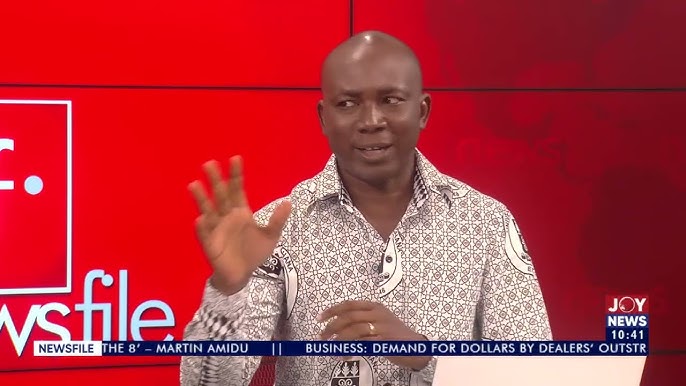
Economist Professor Godfred Bokpin has warned that the operations of the Ghana Gold Board (GoldBod) are imposing significant losses on the Bank of Ghana’s balance sheet, raising concerns about the true fiscal cost of the government’s domestic gold purchasing programme.
Prof Bokpin acknowledged that GoldBod has helped bring more foreign exchange into the formal system by purchasing gold from artisanal and small-scale miners. However, he argued that the programme was scaled up without sufficient consideration of the full cost across the gold value chain.
He said the losses do not immediately appear in Ghana’s public debt figures because the country does not currently account for debt using a general government approach.
“This cost manifesting in losses will not accrue immediately as part of our public debt. So we get to report a lower debt-to-GDP ratio because we are not adopting a general government approach to accounting for our debt stock.”
He said the resulting liabilities instead accumulate on the books of the central bank and could eventually require government recapitalisation.
“Meanwhile, huge debt will then sit on the books of Bank of Ghana, which will later require recapitalisation for the same fiscal size. This is what we have been doing.”
Prof Bokpin expressed particular concern about the role of the Bank of Ghana in financing and backstopping GoldBod’s operations.
He said the central bank had effectively become the residual risk claimant in the domestic gold purchasing arrangement, exposing its balance sheet to technical, economic and valuation losses.
“To the extent that Bank of Ghana has backstopped it virtually in terms of the intermediary role, providing the financing, being the residual risk claimant of this whole domestic gold purchasing arrangement, that also manifests in some losses.”
He argued that without the quasi-fiscal activities undertaken by the central bank in support of GoldBod, some of the losses would instead have appeared on the books of GoldBod or the Ministry of Finance.
The economist recalled the International Monetary Fund's earlier estimate of about US$214 million in losses associated with GoldBod's domestic gold purchasing operations.
He said both GoldBod and the Bank of Ghana initially rejected the estimate.
“The response from Gold Board was quite instructive. What was the response? ‘There are no such losses.’ They were quite categorical.”
Prof Bokpin said the Bank of Ghana also questioned the IMF's estimate at the time, arguing that the figures should be verified after the accounts had been audited.
He said this suggested policymakers had recognised the potential foreign exchange gains from the programme but had not adequately anticipated its full financial cost.
Despite his criticism, Prof Bokpin said GoldBod's intervention had produced measurable benefits.
He pointed to indications that the gap between Ghana's reported gold exports and the gold imports recorded by destination countries has been narrowing, which he attributed partly to GoldBod's operations.
“So it's a good intervention, but the question is, should it have come at this higher cost?”
He argued that a more comprehensive value-chain analysis before GoldBod was operationalised could have helped minimise the losses.
According to him, broader consultation and greater transparency could also have improved the design of the programme.
Prof Bokpin criticised what he described as a lack of humility in policymaking, arguing that government could become too focused on defending a policy once its costs begin to emerge.
“In Ghana, we allow pride, arrogance, and a certain lack of humility to cloud policy judgment.”
He cautioned against emphasising the macroeconomic gains from GoldBod while downplaying the costs being incurred elsewhere in the financial system.
Prof Bokpin said the IMF has consistently recommended that the Bank of Ghana be shielded from direct financial exposure to GoldBod.
He said the Fund was not necessarily opposed to the continuation of GoldBod's operations but wanted mechanisms put in place to ensure that losses from the programme do not weaken the central bank's balance sheet.
GoldBod CEO Sammy Gyamfi has rejected claims that the institution has incurred losses, describing such assertions as false.
Mr Gyamfi has cited GoldBod's audited 2025 financial statements, which he says recorded an operational surplus of GH¢907 million and an overall surplus of GH¢5.4 billion for the 2025 financial year.
The Minority in Parliament, however, has maintained its claim that GoldBod has suffered significant losses. Minority Leader Alexander Afenyo-Markin has accused management of using what he described as “accounting gimmicks” to present the institution as profitable.
The conflicting assessments have intensified scrutiny of GoldBod's finances and the extent to which its operations may be creating financial exposure for the Bank of Ghana and, ultimately, the state.
Latest Stories
-
Ghana must move from participation to ownership in petroleum sector – Jinapor
9 minutes -
Government moves to restore investor confidence as Ghana seeks to revive oil production
12 minutes -
Kingsley Agyemang calls for legally protected fund to tackle Africa’s flood risk
14 minutes -
Andre Ayew Backs Grassroots Sports as Ghana-Anhui Chamber Donates 2,120 Items for Constituency Games
18 minutes -
Hostel Owners Association accuse Rent Control of threats, unfair treatment to operators
24 minutes -
NSA opens special desk to resolve Ghana Card, school biodata mismatches
25 minutes -
Ghana hosts Kenya, Netherlands, South Africa for talks on turning climate plans into action
43 minutes -
‘Now it’s action, no talking’ – Rent Control cracks whip on hostel operators
46 minutes -
GACC, Save Our Environment Foundation train Tano South residents on corruption and accountability
47 minutes -
MOGMusic to headline Ransomed Ministries Ghana’s Total Worship 2026
51 minutes -
Multimedia Group pays courtesy call on Petrosol ahead of GSE listing
1 hour -
Gov’t acknowledges unresolved grievances over mining damage, displacement
1 hour -
Joy FM to host maiden Back-to-School PrayerFest ahead of new academic year
1 hour -
Ghana must legislate minimum community development obligations for mining companies – Mireku Duker
1 hour -
GoldBod costs could have been minimised with better planning – Prof. Bokpin
1 hour