

Audio By Carbonatix
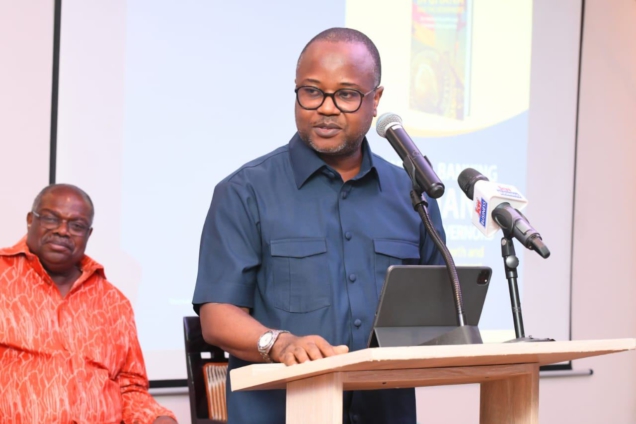
A former First Deputy Governor of the Bank of Ghana, Dr. Maxwell Opoku-Afari, has stated that Ghana’s Eurobond borrowings over 2007-2021 were used for budget financing, mostly on recurrent expenditure.
According to him, this led to escalating fiscal deficits, amplified by the impact of COVID-19, effects of the Russian-Ukraine war, sharp episodes of currency depreciation, and the loss of market access in 2022.
In an article titled “How not to Miss a Crisis: Lessons from Ghana”, Dr. Opoku-Afari who is a Non-Resident Fellow of Finance for Development Lab said Ghana’s public debt had surged from about 63% of Gross Domestic Product (GDP) in 2019 to about 93% by the end of 2022 at the time of the IMF-supported programme approval in 2023, adding, the headwinds of fiscal and balance of payments made it difficult for the government to service its debt and forced technical default.
“In December 2022, Ghana declared a unilateral suspension of debt service payments on Eurobonds, most bilateral loans, and commercial term loans, effectively defaulting on most of its external public debt. This move followed years of sustained borrowing (both domestic and external) to close annual budget financing gaps. Ghana borrowed US$15.59 billion from the international capital market over the period 2007-2021 (nine issuances) to close budgetary financing gaps. These Eurobond borrowings did not go specifically to “self-repaying projects”; instead, they were used for budget financing, mostly spent on recurrent expenditure”.
IMF Programme Over 2015-2019
Dr. Opoku-Afari who was a mission chief at the International Monetary Fund continued that the IMF-supported programme over 2015–2019 did not fundamentally alter Ghana’s underlying fiscal and structural constraints despite narrowing of trade and budget deficits.
Between 2010 and 2019, Ghana was widely regarded as one of Africa's strongest eight economic performers The economy recorded sustained, albeit volatile, growth, successfully completed an IMF-supported reform programme, modernised a Public Financial Management framework anchored by fiscal rules, strengthened debt management institutions, and consistently received Debt Sustainability Analyses from the IMF and World Bank that did not signal an imminent sovereign debt crisis. At the same time, the government articulated the ambitious vision of a "Ghana Beyond Aid", signalling confidence that the country had laid the foundations for sustained macroeconomic stability and self-reliant development.
Yet, within only a few years, these favourable conditions gave way to one of the most severe sovereign debt crises in Ghana's history. By December 2022, the country had suspended payments on most of its external debt and entered a comprehensive debt restructuring programme.

The former First Deputy Governor of the Bank of Ghana said this sharp reversal raises important questions that extend beyond Ghana's experience alone. “How could a country that appeared to possess the institutional safeguards associated with sound fiscal management nevertheless descend into debt distress? Why did strong economic growth, internationally endorsed fiscal reforms, fiscal rules, and repeated macroeconomic surveillance fail to prevent the accumulation of vulnerabilities? Were the warning signals fundamentally misunderstood, systematically underestimated, or obscured by headline macroeconomic indicators?”
He added that these questions also prompt a reassessment of the underlying philosophy that guided Ghana's economic strategy during the period.
Ghana Beyond Aid
“Was the "Ghana Beyond Aid" an illusion or an ambition of the political class that had become detached from Ghanaian reality?”, he questioned.
Equally, he asked, did the design of the 2015–2019 IMF programme place greater emphasis on achieving short-term fiscal consolidation than on embedding the deeper institutional reforms required for long-term fiscal resilience?
“More broadly, did both domestic institutions and international partners, including those responsible for debt surveillance, fail to identify emerging risks in time?”
He again asked, “Was Ghana’s high growth from 2010 to 2019 truly balanced, or did it mask underlying weaknesses? To what extent did “hidden debt” and contingent liabilities—particularly in the energy, cocoa, and financial sectors—amplify the crisis?”
Latest Stories
-
Prince Harry and Meghan moving back to UK
7 minutes -
Ghana’s output expansion largely driven by labour, capital rather than innovation – Opoku-Afari
9 minutes -
Ghana is ready for nuclear power adoption – Gov’t affirms
14 minutes -
GJA@77: Media-government partnership vital to Ghana’s democracy – Shamima Muslim
27 minutes -
LUV FM High School Debate: Opoku Ware and St. Hubert Seminary book quarterfinal spots
33 minutes -
Stronger research, industry linkages needed to build a competitive digital economy – Deloitte Technology Senior Manager
34 minutes -
Economy experience high but unbalanced growth from mid-2000 to 2022 debt crisis – Former 1st Deputy Governor
50 minutes -
Tell Your Story: Political, business and industry leaders to share journey with young Ghanaians
59 minutes -
‘Gold cannot save you at 2am’ – Obuobia Darko challenges mining giants to invest in healthcare
1 hour -
Wontumi’s incarceration will not stop his chairmanship bid – Palgrave
1 hour -
Eurobond borrowings over 2007-2021 used for budget financing; Ghana borrowed US$15.59bn – Opoku-Afari
1 hour -
Newborn baby found in dustbin at Kasoa Main Station toilet
1 hour -
Ghanaian skincare brand KAEME wins DHL ESG Excellence Exporter of the Year award
2 hours -
Ho Communique: Democracy Not for Sale
2 hours -
National Health Insurance Levy Uncapped: The Game Changer
2 hours