

Audio By Carbonatix
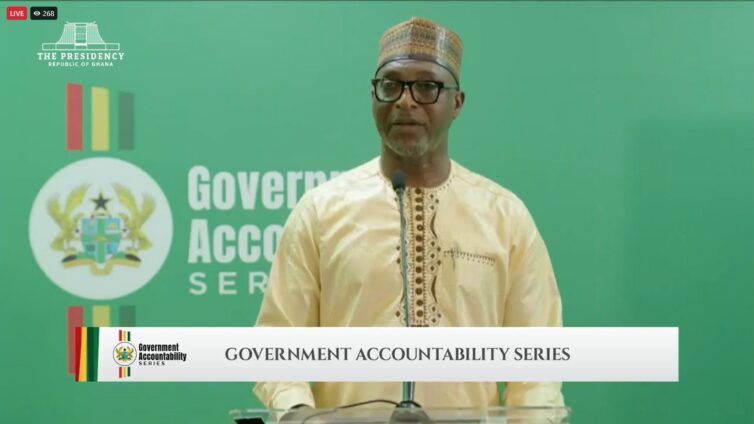
Interior Minister Muntaka Mohammed-Mubarak says the government’s intensified fight against illicit drugs has resulted in 217 arrests and the initiation of 165 prosecutions in the period under review.
Speaking at the Government Accountability Series, Mr Muntaka commended the Director-General of the Narcotics Control Commission (NACOC) and his team for what he described as a bold and decisive approach to tackling the country’s illicit drug problem.
He said the efforts had been carried out in collaboration with the Ghana Police Service and other security agencies.
“One of the major challenges that confronts us continues to be the illicit drug fight,” Mr Muntaka said.
According to him, more than 8,500 kilogrammes of narcotics have been seized as part of the ongoing operations, alongside about 45.4 million tramadol tablets.
He described the scale of tramadol seizures as particularly worrying, stressing the growing threat posed by synthetic drugs.
“One of the biggest challenges now is the use of these synthetic drugs, and Narcotics Control has intensified its effort,” he said on Monday, August 24.
“Imagine, in less than two years, over 45 million tablets of tramadol were seized or intercepted.”
Focus on drug proceeds and assets
Mr Muntaka said the government’s strategy was not limited to arresting drug users but also targeted individuals and networks involved in the trafficking and financing of illicit drugs.
He said intelligence-led operations had resulted in the recovery of 73 tainted assets within about 20 months.
He added that more than 19 kilogrammes of gold had also been seized in suspected drug-money laundering cases.
According to the minister, cash and other assets believed to be associated with persons involved in the illicit drug trade had also been restrained.
He cited approximately GH¢6.9 million and US$440,000 in cash as having been restrained in connection with suspected drug-related activities.
Mr Muntaka said the approach was intended to ensure that the government went beyond apprehending individuals to disrupting the financial networks that sustain the illicit drug trade.
He said the security agencies would continue to rely on intelligence-led operations to identify those involved in the trafficking of narcotics and trace and seize assets suspected to have been acquired through the proceeds of the trade.
Education and prevention
The Interior Minister stressed that the fight against illicit drugs was not solely focused on enforcement but also included education and prevention.
He said NACOC had conducted more than 2,000 educational programmes across the country to raise awareness about the dangers and consequences of drug abuse.
The programmes, he said, had targeted different groups and institutions, including 1,153 first-cycle schools, 185 second-cycle schools, and 41 tertiary institutions.
Education and sensitisation activities had also been carried out in 187 faith-based institutions, 147 communities, and 235 workplaces.
“We have intensified education to try to let people understand the effect and how this thing can be devastating,” Mr Muntaka said.
He explained that the preventive component was necessary to help young people and other vulnerable groups understand the risks associated with illicit drugs and discourage them from becoming involved in drug use or trafficking.
Rehabilitation remains a challenge
Despite the progress made in enforcement and public education, Mr Muntaka identified rehabilitation as a major gap in Ghana’s response to drug abuse.
He noted that the country does not have a dedicated national rehabilitation center of its own to adequately support people struggling with drug dependence.
Latest Stories
-
Asos hackers took more personal details than first revealed, BBC finds
3 hours -
Fort Hood shooter’s execution by firing squad will be livestreamed, Pentagon says
4 hours -
Chrysler Building to get its crown restored after being sold
4 hours -
Infantino re-election boost as Concacaf chief will not stand
4 hours -
Everton’s Sherif fined for breaching betting rules
4 hours -
Suspended fine for Xhaka over Covid-19 certificate
4 hours -
Businessman dragged to court over GH¢480,000 fraud
4 hours -
Pregnant woman and husband found dead in a room at Anloga-Kportorgboe
5 hours -
Man, 87, jailed 20 years for defiling nine-year-old girl at Ofankor
5 hours -
Maresca says ‘feeling is fantastic’ among Man City squad
5 hours -
Sam George warns FBI Director against taking sole credit for Ghana cybercrime operation
5 hours -
Foreign capital no passport to Ghana’s informal retail market – GIPA CEO
5 hours -
E&P model should be seen as a blueprint for building local mining giants – GIPA Boss
5 hours -
Govt’s decision to reduce nurse training long overdue – GRNMA
5 hours -
Ghana needs emergency health fund to respond swiftly to outbreaks – SEND Ghana
5 hours