

Audio By Carbonatix
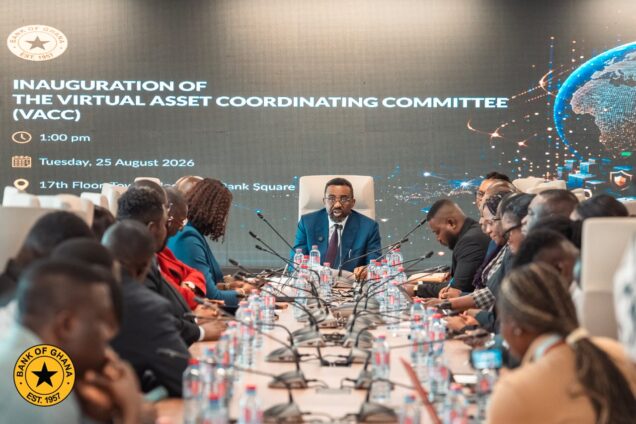
The Bank of Ghana Governor, Dr Johnson Asiama, has called for stronger and more coordinated oversight of Ghana’s virtual asset sector to safeguard financial stability, protect consumers and address emerging risks.
Speaking at the inauguration of the *Virtual Assets Coordinating Committee*, Dr Asiama said the rapid evolution of virtual assets and digital finance leaves regulators with little room for a passive approach.
He said the committee would provide the statutory platform for coordinated regulatory and supervisory action among relevant institutions under the *Virtual Assets Service Providers Act, 2025 (Act 1154)*.
“The pace at which virtual assets and digital finance are evolving globally leaves us little room for a passive approach,” Dr Asiama said.
He stressed the need for effective coordination, timely information sharing and a shared commitment among regulatory institutions to safeguard the integrity of Ghana’s financial system.
According to him, the committee will facilitate the harmonised implementation of the Act and its subsidiary regulatory instruments, while strengthening information sharing and inter-agency cooperation.
It will also support coordinated responses to emerging risks, including *money laundering, terrorist financing, cybersecurity and consumer protection*.
Dr Asiama noted that the multi-faceted nature of virtual assets requires close coordination not only among domestic regulators and competent authorities but also with foreign counterparts and governments.
Committee Membership
The committee comprises representatives from key institutions involved in financial regulation, security and economic policy.
The *Bank of Ghana* is represented by Elhanan Owureku Asare* and Philip Kwaw Sebuabe, while the Securities and Exchange Commission (SEC) is represented by Emmanuel Mensah Thompson* and Richard Kwame Dusi*.
Ghana targets 1,200MW new thermal capacity by 2029 – Jinapor
The government is pursuing the procurement of 1,200 megawatts of combined-cycle thermal power capacity, with the project expected to be completed by 2029, Minister for Energy and Green Transition John Abdulai Jinapor has disclosed.
According to Mr Jinapor, the initiative forms part of efforts to secure reliable electricity supply while reducing the cost of power generation for the country.
Speaking at the Future of Energy Conference, he said the government had taken an ambitious decision to procure the additional thermal capacity using the country’s own resources.
“We have taken an ambitious policy to procure 1,200 megawatts of thermal capacity with combined cycle on our own as a country so that it can reduce the cost of power,” he said.
The Minister said government was confident the project would be completed by 2029 and described it as a potential “game-changer” for Ghana’s energy sector.
Mr Jinapor, however, noted that Ghana would still require additional power between now and the completion of the project, saying government was therefore working on arrangements to bridge the supply gap during the transition period.
He said the additional capacity would ultimately help reduce the burden of expensive power on consumers while supporting the country’s industrialisation agenda.
The Minister stressed that Ghana’s energy sector must provide not only sufficient electricity but also reliable and affordable power capable of supporting businesses and industries.
He said government would continue to pursue reforms and investments aimed at building a more financially sustainable and competitive electricity sector.
Latest Stories
-
NUTE must strengthen 49 colleges, not become another public university – Eduwatch
2 minutes -
Awal Mohammed files for Nasara Organiser, vows to rebuild NPP Nasara structures ahead of 2028
15 minutes -
IERPP demands answers as GoldBod reports disappear from website
31 minutes -
Country music legend Dolly Parton dies
37 minutes -
Kwaku Antwi-Boasiako writes: UK’s £39bn social housebuilding programme – Any lessons for Ghana?
37 minutes -
Ghana targets 1,200MW new thermal power capacity by 2029 – Jinapor
39 minutes -
Ghana targets universal electricity access by 2030 as coverage nears 90%
44 minutes -
Titus-Glover files nomination to contest NPP National Organiser position
53 minutes -
NPP women’s organiser aspirant pledges 30% female representation
55 minutes -
GIPA explains key changes to Ghana’s investment regime to prospective investors in Atlanta
56 minutes -
Ghana targets 1,200MW new thermal capacity by 2029 – Jinapor
58 minutes -
SYPALA 2026: CSOs must give young people power to lead, control resources – WACSI
59 minutes -
SYPALA 2026: Rule of law, not military intervention, key to enforcing discipline – Kofi Bentil
60 minutes -
GSA defends decision to allow importation of vehicles up to 15 years old
1 hour -
Sammy Gyamfi distracting Ghanaians from ‘BoG-GoldBod’ losses with extortion allegations – Oppong Nkrumah
1 hour