

Audio By Carbonatix
Parliament’s Appointments Committee has recommended the approval of three nominees for appointment to the Supreme Court, following a dramatic vetting process that was disrupted by a walkout by the Minority Caucus.
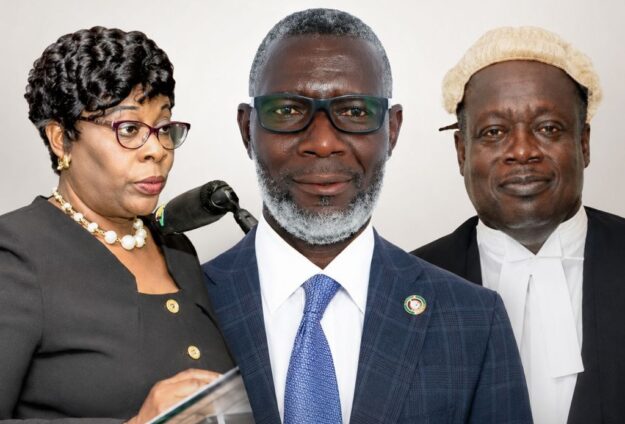
The nominees are Justice Sophia Rosetta Bernasko Essah, Justice Edward Amoako Asante and private legal practitioner Anthony Forson Jnr. Their approval would increase the number of justices on Ghana’s apex court from 18 to 21.
The committee’s recommendation followed a tense sitting on Thursday, August 27, during which the Minority Leader, Alexander Afenyo-Markin, raised a preliminary objection to the procedure and timetable adopted for the vetting.
Minority objects
Mr Afenyo-Markin argued that the process had been unduly compressed, particularly because the Supreme Court currently has no vacant seat requiring immediate replacement.
He said the three nominees were being considered to expand the membership of the court rather than fill vacancies caused by retirement, death or removal, and questioned the justification for rushing their consideration during Parliament’s five-day emergency recall.
The Minority maintained that the nominations had only been referred to Parliament at the beginning of the emergency sitting and that the public had not been given the usual opportunity to submit memoranda on the nominees.
The Minority Leader stressed that his objection was not directed at the qualifications or personalities of the nominees, but at the procedure being used to process their nominations.
The Minority subsequently walked out after the committee chairman, Bernard Ahiafor, rejected the objection and ruled that the committee could proceed with the vetting. Mr Ahiafor described the Minority’s grounds as “flimsy”, “hollow” and “baseless”, according to reports of the sitting.
The walkout left the Majority side to continue with the process.
Three nominees
The nominees bring extensive legal and judicial experience to the proposed expanded bench.
Justice Sophia Rosetta BernaskoEssah is a Justice of the Court of Appeal with considerable experience within Ghana’s Judiciary.
Justice Edward Amoako Asante, also a Court of Appeal Justice, previously served as President of the ECOWAS Court of Justice for three terms, totalling six years, before returning to Ghana’s judiciary. His regional judicial experience has included work on human rights and other areas of international law.
Anthony Forson Jnr, the nominee from private legal practice, is a former President of the Ghana Bar Association and has had a long career in the legal profession.
The nominations were made by President John Dramani Mahama in consultation with the Judicial Council, as required under the constitutional framework for appointments to the Supreme Court. The Council of State subsequently informed the President that it considered the nominees qualified and suitable for the positions.
Emergency recall sparks controversy
The controversy over the judicial nominations is linked to Parliament’s emergency recall, which runs from August 24 to August 28.
Speaker Alban Kingsford Bagbin said the recall followed a request from President Mahama to deal with a number of urgent matters, including the consideration of two ministerial nominees, the three Supreme Court nominations and the Banks and Specialised Deposit-Taking Institutions (Amendment) Bill.
The Speaker had referred the three judicial nominations to the Appointments Committee for consideration and a report to the House within the period of the recall.
The Minority, however, maintained that the emergency nature of the sitting should not be used to dispense with the level of scrutiny ordinarily expected of Supreme Court nominees.
From committee to the House
The committee’s recommendation now clears the way for the three nominations to be presented to the full House for consideration.
If Parliament approves them, the three nominees will subsequently take the required oath before assuming office on the Supreme Court bench.
The episode has nevertheless introduced a political dimension to what is constitutionally a process of scrutinising presidential nominations, with the Minority insisting that the speed of the exercise risks undermining parliamentary and public scrutiny, while the Majority has proceeded on the basis of the mandate given to the committee during the emergency recall.
Latest Stories
-
Africa targets 3 million more health workers by 2035 – WHO explains what it could mean for patients
39 seconds -
Maintain January 2027 deadline for Styrofoam ban – Zanetor urges EPA
17 minutes -
Key moments in trial of Lindsay Clancy, the mother accused of murdering her three children
19 minutes -
Collapsed glacier likely caused deadly Nepal-Tibet floods, scientists say
59 minutes -
The Cyrus Lesson: Why Ghana must look beyond religion in choosing its next leader
1 hour -
I have no problem with public tribunals; they’re constitutional – Anthony Forson
1 hour -
GRA boss supports mothers’ hostel, donates pickup to Upper Denkyira East Police
1 hour -
NSMQ 2026: St. John’s School beat Benkum SHS, Nandom SHS to secure quarter-finals spot
1 hour -
Minifootball Association of Ghana unveils women’s national team ahead of inaugural AFCON
2 hours -
Appointments Committee recommends approval of three Supreme Court nominees
2 hours -
NSMQ 2026: St. Hubert Minor Sem. reclaims lost seed, sends Mawuli School packing to book quarter-final spot
2 hours -
Beyond “what do you bring to the table?”: Rethinking what partners bring to relationships
2 hours -
NSMQ 2026: Mfantsiman Girls’ back in the quarter-finals after 10 years, snatches spot from St. James
2 hours -
Education Ministry to amend law to restore faith-based representation on GES Council
2 hours -
Teacher unions demand automatic salary placement for newly promoted teachers
2 hours