

Audio By Carbonatix
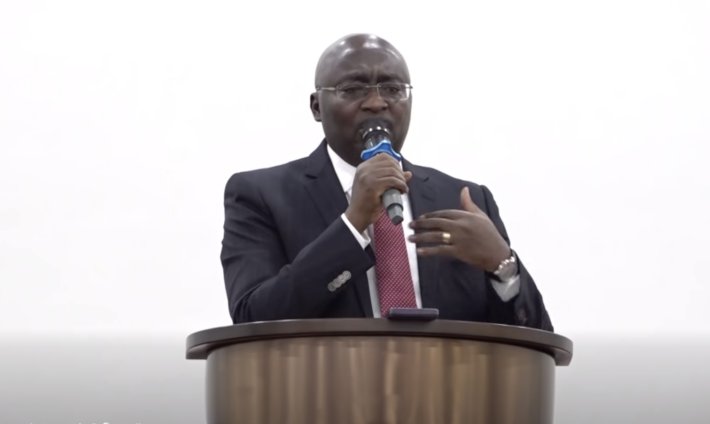
Flagbearer of the New Patriotic Party (NPP), Dr Mahamudu Bawumia, has revealed that the idea behind Ghana’s gold-for-oil and gold-for-reserves programmes came to him while exercising one morning.
According to him, the initiative was born out of the need to address Ghana’s severe foreign exchange constraints after the Russia-Ukraine war disrupted access to international capital markets.
Speaking at a public event in a video posted on his Facebook page, Dr Bawumia said Ghana had traditionally relied on raising about $3 billion annually from international capital markets to support economic management.
However, the disruption to global financial markets left Ghana unable to raise the funds it needed, triggering a balance of payments crisis and putting further pressure on the cedi.
“We were really constricted in terms of availability of foreign exchange. At the same time, the cedi was depreciating almost on a daily basis. And we had to think about how to deal with this problem,” he said.
Dr Bawumia said he became particularly concerned after observing the economic crisis in Sri Lanka, where shortages of foreign exchange contributed to difficulties in importing essential goods.
He said the situation prompted him to consider how Ghana could leverage its position as a major gold producer to address its foreign exchange challenges.
“I was exercising one morning when the idea came,” he said.
Dr Bawumia said Ghana was then Africa’s leading gold producer and among the largest producers globally, yet the country’s gold reserves at the Bank of Ghana stood at only about 8.7 tonnes in 2021.
“I said this cannot be right,” he recalled.
He explained that because Ghana produces gold locally, the country could use cedis to purchase the commodity and convert it into a national reserve asset without first having to obtain foreign exchange.
“The thing about gold for us is that because we produce gold, we can use our cedis to buy the gold. We don't need to export cocoa or diamonds to get dollars to go out there and buy gold,” he said.
He described the proposal as unconventional, saying it was not based on an established economic textbook model.
“There was no textbook in economics that would tell you about the gold and reserves problem. It was out-of-the-box thinking,” he said.
According to Dr Bawumia, the Bank of Ghana subsequently spent almost a year studying the proposal before concluding that it could be implemented.
“And this is really how the domestic gold purchase program started,” he said.
Dr Bawumia said the programme enabled Ghana to purchase about $5 billion worth of gold within two years, helping to strengthen the country's foreign exchange reserves.
He also linked the accumulation of reserves to Ghana’s increased capacity to intervene in the foreign exchange market.
He said that by the end of 2024, the International Monetary Fund had removed a restriction that had limited the Bank of Ghana to a maximum of $80 million in monthly foreign exchange market intervention.
“Since then, the Bank of Ghana has been able to put at least $1 billion a month into the market,” he said.
Dr Bawumia argued that the increased supply of foreign exchange should help ease pressure on the cedi through basic demand-and-supply dynamics.
“From $80 million maximum to $1 billion a month. What does economics tell you? When you have an increase in supply, what will happen to price? It comes down,” he said.
He maintained that the gold-based initiatives represented an unconventional response to the foreign exchange crisis Ghana faced following the loss of access to international capital markets.
Latest Stories
-
BCI urges women to prioritise breast health to reduce cancer cases and deaths in Ghana
16 minutes -
Give us a share of state security’s uniform contracts – Northshore Apparel CEO tells gov’t
20 minutes -
Jobs, not guns, are the most durable answer to insecurity in Northern Ghana — Northshore CEO
23 minutes -
Northshore Apparel plans fabric mill, cotton outgrower scheme as part of expansion – CEO
24 minutes -
Bawumia defends Gold-for-Reserves programme as answer to Ghana’s forex crisis
31 minutes -
NSMQ 2026: Boa Amponsem pulls off late heist to unseed Abetifi Presby and storm quarterfinals
37 minutes -
World’s youngest reigning traditional monarch dies aged 34
38 minutes -
Akosua Manu pushes for national emergency response to maternal deaths
43 minutes -
Bawumia feared Sri Lanka-style food crisis as Ghana battled forex shortages
50 minutes -
RTI Commission announces September activities to mark 2026 RTI Month
51 minutes -
Gold programmes helped build Ghana’s reserves and support cedi – Bawumia
1 hour -
Mahama announces plans for net metering to allow businesses to sell excess solar power to national grid
1 hour -
AU condemns deadly attack on UN peacekeepers in South Sudan
1 hour -
“Coach is already working” – Kurt Okraku reveals progress on new Black Stars coach appointment
1 hour -
Canada, UN strengthen peacekeeping capacity through military observer training in Ghana
1 hour