

Audio By Carbonatix
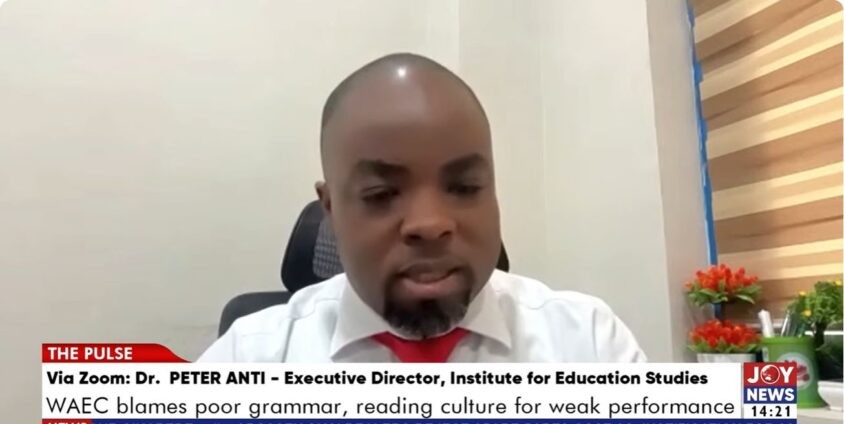
The Executive Director of the Institute for Education Studies (IFEST), Dr Peter Anti, says Ghana’s latest performance in English Language and Mathematics examinations is a clear indication of persistent challenges with literacy and numeracy in the country’s education system.
According to him, the situation, particularly at the basic education level, requires urgent attention from education managers to prevent students from carrying foundational learning gaps into higher levels of education.
Speaking on JoyNews’ The Pulse, Mr Anti noted that about 55,000 Basic Education Certificate Examination (BECE) candidates were unable to qualify to progress to the next level because they failed English Language, Mathematics or both subjects.
He said although the Ministry of Education has provided some flexibility for affected students, the figures should serve as a wake-up call for stakeholders.
“It’s a clear indication that we have had serious challenges with English Language and Mathematics,” he said.
Dr Anti also pointed to the performance of candidates in the West African Senior School Certificate Examination (WASSCE), noting that while there has been some improvement in Mathematics, the failure rate in both Mathematics and English remains a major concern.
He believes the persistent difficulties in the two core subjects demonstrate weaknesses in the development of foundational competencies among pupils.
“For me, it’s a clear message to the education managers that we are losing out on literacy, English Language and Mathematics,” he said.
Dr Anti stressed that efforts to address the problem must begin at the basic education level, where pupils acquire the foundational skills needed to succeed throughout their academic journey.
“If we want to work on that, we need to start at the basic level. That is where they build the competency, and that will carry them through the Junior High School to the Senior High School,” he explained.
He therefore called for a renewed focus on foundational literacy and numeracy, arguing that improving students’ performance at the basic level would have a significant impact on outcomes at the secondary and tertiary levels.
His comments come amid renewed concerns over examination performance and the number of students struggling to meet the minimum requirements to progress through Ghana’s education system after the release of results of the Basic Education Certificate examination and West African Senior School Certificate Examination.
Latest Stories
-
29 Players to commence Black Starlets preparations ahead of 2026 WAFU U-17 Championship
10 minutes -
U-20 Women’s World Cup: Sampson demands response after ‘cheap’ goals cost Ghana
15 minutes -
Ghana had no budget for South Africa evacuation but had to act – Ablakwa
15 minutes -
Here’s the breakdown of the GH¢49.7m spent on evacuating Ghanaians from South Africa
23 minutes -
GIGS commends Armed Forces for Accra-Kumasi Expressway progress
24 minutes -
Ibrahim Mahama’s Engineers & Planners contributed GH¢16m as gov’t spent GH¢33.72m on SA evacuation
38 minutes -
Errand boy linked to murder of Dr Jesse Amuah, wife deported from Dubai
45 minutes -
New cost-sharing model for Digital TV broadcasters to take effect in 2027
1 hour -
Poor English, Maths performance shows Ghana’s literacy crisis – Dr Peter Anti
1 hour -
Xenophobic attacks: 1,964 Ghanaians evacuated from South Africa – Ablakwa
1 hour -
Ghana’s SIM registration history from 2010 to the new biometric verification system
2 hours -
Police arrest dozens, recover weapons in nationwide anti-robbery operations
2 hours -
Parents cautioned against fraudsters promising SHS placement changes
2 hours -
Selecting schools after results a backward approach – Abuakwa MP
2 hours -
Ransford-Yeboah Königsdörffer scores on emotional return as Mainz hammer Hamburg 5-0
2 hours