

Audio By Carbonatix
Indonesia reopened five key aviation hubs past midnight after a powerful volcanic eruption paralysed regional transit for two days. Mount Anak Krakatau began erupting late on Friday, generating dramatic lava fountains and blanketing Jakarta and the Lampung province in thick volcanic ash.
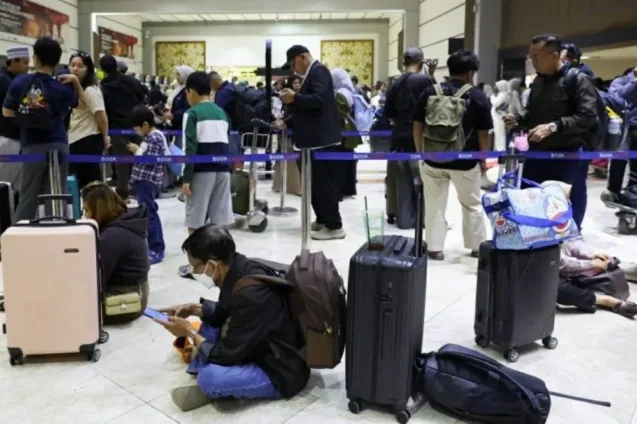
The volcano maintained high seismic activity throughout the weekend, forcing authorities to ground nearly 3,000 flights. This sweeping operational shutdown left more than 340,000 passengers stranded across various terminals. Jakarta's Soekarno-Hatta International Airport initiated the flight suspensions on Sunday morning and kept operations grounded until resuming service at 00:30 local time on Tuesday.
Passenger Experiences and Travel Chaos
Departure halls at major terminals filled with massive crowds as travelers scrambled for information and ticket refunds. Finna planned to fly home to Jakarta from Malang on Sunday morning, but watched helplessly as departure schedules dissolved into confusion. "It was very crowded because passengers from the morning flights had piled up, while those scheduled for later departures still didn't know what would happen," she noted, adding that "We were all glued to the flight information screens." Seeking an alternative, the 46-year-old abandoned her flight plans and spent the night travelling across intercity trains to reach Jakarta by early Monday.
Other travellers faced entirely different logistical hurdles. Jo Shaw visited the region with conservation workers from Save the Rhino International, which forced her team to scrap plans for field research in Java's Ujung Kulon National Park after alert levels escalated. "Being stranded in an airport hotel is a relatively minor inconvenience to be resolved in a few days hopefully," Shaw observed, shifting focus to personnel tracking wildlife on the ground.
Meanwhile, a newlywed Malaysian couple found their post-honeymoon return delayed until September 11. Amir Hamzah expressed disbelief at the extended delay after exhausting their trip budget. "What are we going to do here for another five days? We only prepared enough money for our honeymoon and [were supposed] to go home yesterday," he explained. "We thought we would just sleep at the airport for a few hours and then take the morning flight home [on Monday]. We never thought we would end up being stuck here for days," the 29-year-old added, capturing the frustration felt by thousands. Additional travellers voiced similar concerns, noting that "Everyone seems to be racking their brains [figuring alternative transportation options]," as terminal seating areas overflowed.
Meteorological Data and Scientific Assessments
Government agencies tracked massive atmospheric ash plumes spreading outward from the crater. Volcanic ash soared as high as 6,000 meters on the Java side and reached up to 15,000 meters on the Sumatra side, heavily affecting parts of Banten province. Indonesia's Geological Agency issued a stern warning on Monday, stating that "the probability of further eruptions in the coming periods remains high". Transport Minister Dudy Purwagandhi addressed the unpredictable nature of the crisis during daily briefings. "We cannot ascertain when this will end due to the dynamic weather," Dudy stated, explaining that aviation officials conducted safety evaluations every 30 minutes "to anticipate whether the ash spread is widening or subsiding".
Geographical Context and Hazard Zones
Anak Krakatau sits directly within the Sunda Strait between Java and Sumatra, occupying a historically volatile volcanic zone. The name translates to Child of Krakatoa, reflecting its origins within the caldera left by the cataclysmic 1883 eruption. The cone collapsed during a violent event in December 2018, generating a destructive tsunami that killed more than 400 people and displaced coastal communities.
Current emergency measures prohibit public access within a three-kilometer radius of the active crater, and marine authorities have banned ships from entering the designated maritime exclusion zone. Officials confirmed that current seismic activity has triggered no tsunami warnings. The wider region remains anchored to the Pacific Ring of Fire, a 40,000-kilometer tectonic arc containing roughly 75 per cent of all active volcanoes on Earth and accounting for 90 per cent of global seismic activity.
Global Aviation Resilience and Ongoing Recovery
As regional carriers work through massive flight backlogs and authorities monitor shifting atmospheric patterns, the crisis underscores the profound vulnerability of Southeast Asian transit corridors to sudden geological disruptions, prompting international aviation bodies to reevaluate rapid-response protocols for volcanic ash hazards.
Latest Stories
-
John Boadu best positioned to return NPP to power in 2028 – Wontumi campaign
24 seconds -
B5 Plus urges import bans on goods Ghana can produce
1 minute -
Ballon D’or: Three Africans make 2026 Men’s Goalkeeper of the Year shortlist
8 minutes -
Tuesday downpour causes extensive damage to properties in Berekum Municipality
8 minutes -
Music Beef: When rivalry sells, fans fight, and the industry pays
13 minutes -
Mahama calls for stronger support for women’s football
14 minutes -
‘No Ghanaian should pay’ – Health Minister warns health workers against charging for Free Primary Healthcare
14 minutes -
Weija Dam spillage begins a day earlier than announced as GWL responds to rising water levels
14 minutes -
Renewed gunshots reported in Bunkpurugu as Regional Security Council meets
15 minutes -
Highest paid world leader to get salary increase of $1 million
17 minutes -
Como chiefs giving up seats to older fans for Champions League debut
17 minutes -
CSSPS should restrict unqualified students from choosing Category A schools – Divine Kpe
18 minutes -
Cybersecurity purchase letter is fake – EOCO Investigator tells court as prosecution closes case
22 minutes -
Ga Mantse’s Fetu Afahye entry: A proud Ga moment
31 minutes -
Zijin Mining boss praises Ghana’s business environment, pledges deeper investment
33 minutes