

Audio By Carbonatix
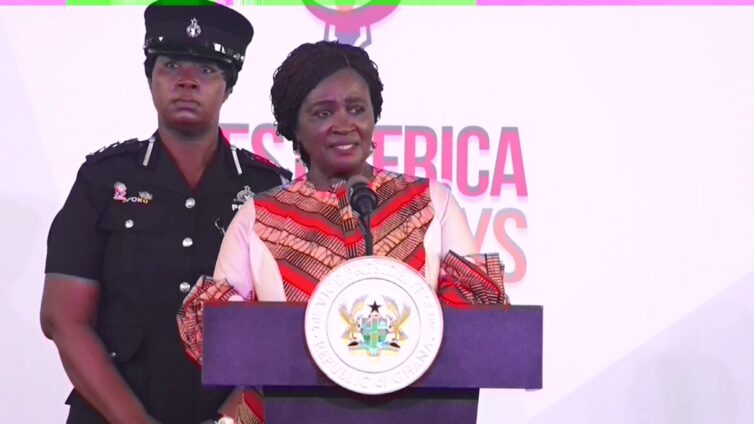
Vice President Professor Naana Jane Opoku Agyemang has urged Catholic youth across West Africa to take an active role in building peaceful and prosperous societies, saying the region’s young population has a critical role to play in shaping its future.
Speaking at a gathering of Catholic youth in Accra, Professor Opoku Agyemang said young people represented a significant source of energy, creativity and potential for West Africa.
She noted, however, that the region’s youth were growing up amid insecurity, violent extremism, economic hardship, irregular migration, misinformation and the effects of climate change.
“These challenges cross borders. They affect governments and communities alike, and no one country can address them alone,” she said.
According to the Vice President, peace is strengthened when citizens have confidence in institutions, resolve disagreements without violence and have access to credible opportunities for a better future.
She said education must open doors to opportunity, while young people seeking practical skills should have access to appropriate training.
“Those who want to learn a skill must be able to do so, and hard work must offer a credible path to a better life,” Professor Opoku Agyemang said.
She highlighted government initiatives including the National Apprenticeship Programme and the One Million Coders Programme, as well as entrepreneurship training, business development support and access to funding.
She described these interventions as investments in young people and in the stability and prosperity of Ghana.
The Vice President, however, stressed that government programmes alone could not address all the challenges confronting young people.
She said sustained efforts were needed to improve education, expand opportunities, support enterprise and build an economy capable of providing decent and productive work.
Youth urged to strengthen regional ties
Professor Opoku Agyemang also highlighted the role of the Catholic Church in complementing the efforts of government and other institutions.
“For generations, the Catholic Church has been an important part of our social fabric. Through its social interventions and institutions, it has served communities, formed young people, and spoken for human dignity, justice, and peace,” she said.
She urged the youth to use the gathering to build friendships across national borders, arguing that stronger relationships among West Africans were essential to deeper regional integration.
“Ultimately, West African integration will depend on agreements, institutions, and political leadership, but it also requires West Africans who know one another,” she said.
She said the dignity of people must not be denied on the basis of nationality, ethnicity, language, religion, political opinion or social standing.
The Vice President further cautioned young people about the influence of digital platforms, noting that information, anger, prejudice and falsehood can spread across borders within seconds.
She said technology could equally be harnessed to connect communities, spread knowledge and create opportunities.
“How we use these tools in becoming part of how we build peaceful societies is what matters,” she said.
Professor Opoku Agyemang encouraged young people to recognise the influence of their everyday choices, including the friendships they form, the seriousness with which they learn, the enterprises they build, the professions they enter and the information they share.
She urged them to handle disagreements responsibly and remain willing to work with people beyond their immediate circles.
“All contribute in different ways to the kind of region we will become,” she said.
She said government, the Church, civil society, families and communities all had responsibilities in building a peaceful West Africa, but young people also had a distinct voice and contribution to make.
Professor Opoku Agyemang expressed the hope that participants would return home with new friendships, a deeper understanding of other people and cultures, and a stronger sense that the future of West Africa was a shared responsibility.
Latest Stories
-
Brent crude oil rises above $100 a barrel as Middle East conflict intensifies
12 minutes -
59,300 students receive GH¢210m in enhanced student loans – SLTF
18 minutes -
Trump gave $45,000 cash gifts to close aide Natalie Harp and others
19 minutes -
Beauty Kabukie Apedoe appointed CEO of Inter Tourism Expo Accra
44 minutes -
New Ghanaian movie ‘Two’ to explore crime, faith and moral ambiguity
50 minutes -
Indo-Ghana begins local liquid oxygen supply
50 minutes -
Atwima-Techiman residents decry poultry farm nuisance as assembly sues farmer over siting of farm
57 minutes -
Vice President urges Catholic youth to promote peace and prosperity across West Africa
58 minutes -
Double-track was about demand, not lack of space in all schools – Adutwum
1 hour -
Adutwum proposes subject resits, transcript system for secondary schools
1 hour -
Teacher retraining needed to tackle social media jargon in WASSCE – Adutwum
1 hour -
Free SHS Secretariat official denies bribery allegations at Kumasi CSSPS Resolution centre
1 hour -
NPP Executive Elections: Full list of candidates and their ballot positions
1 hour -
SHS Assistant Heads demand payment of transfer grants and responsibility allowances
1 hour -
MTN, Telecel, Goal Telecom qualify for next stage of NCA spectrum auction
2 hours