

Audio By Carbonatix
King Charles has warned AI executives of the "existential dangers" posed by the technology falling into the wrong hands.
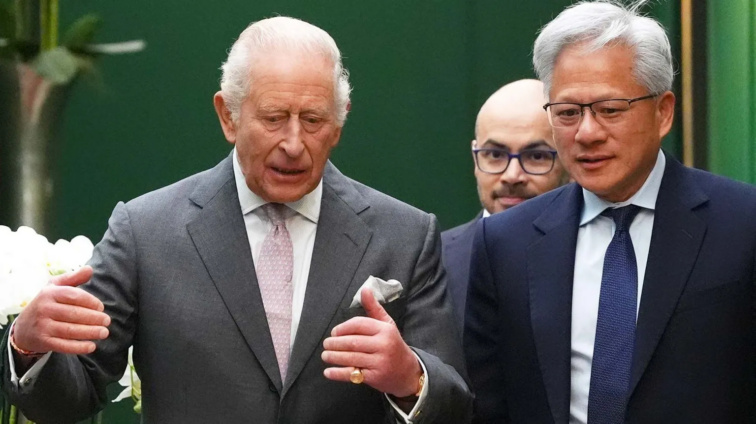
He made the comments at a summit he had convened at Dumfries House in Ayrshire to discuss how the tech can be used to benefit society.
Those gathered at the meeting also included Kanishka Narayan, the UK's AI Minister, the Pope's advisor, and participants from AI giants such as Nvidia, OpenAI and Anthropic.
It comes amid a series of recent warnings from people inside the industry about the rapidly evolving capabilities of advanced or "frontier" AI models and the regulation needed to keep them in check.
"Those who have created these technologies are now increasingly warning that AI risks developing darker capacities - perhaps even to take life," the King told the executives.
He said there seemed to be an "urgency" in "adequately considering the existential dangers of such technologies falling into the wrong hands, and being used in potentially catastrophic ways".
"The task before you is not merely to advance technology, but to ensure that it remains firmly in the service of humanity, community and the natural world," he told the group.
The summit has been called to consider whether a "shared set of principles" can be developed to "help guide the future application" of AI.
'Keep engineering'
Jensen Huang, chief executive of Nvidia, was among top industry leaders attending.
Nvidia is a central player in AI infrastructure, supplying chips to leading AI model developers including OpenAI and Meta.
It is also the world's most valuable company, with a stock market value of around $5.15tn.
Huang told the room he believed safety was "paramount", adding that companies should hold back a product and "keep engineering" if it was not safe enough.
The Nvidia boss also highlighted the value of open models - systems which give users direct access to the software - as a way to "ensure that people and countries are not left behind".
He said these systems must also be protected so "researchers, universities, start-ups and countries" can develop applications "none of us would have imagined alone".
"Let us lead with responsible optimism, build AI safely and securely, open it to more people, expand our ambition and solve the problems that matter to the world," Huang added.
Meanwhile Sir Demis Hassabis, who co-founded the UK AI lab DeepMind - later acquired by Google - offered a more cautious view on the pace of development.
He said artificial general intelligence - systems it is believed could be as good as or better than humans at multiple tasks - was "probably only a few short years away" and could have an impact "ten times that of the Industrial Revolution".
The chance of something going wrong was "definitely non-zero", Sir Demis added.
But he advocated for "a sensible middle way", saying humanity could address risks if collectively given the space and time to mitigate them.
"The future is not yet written," he told the King's delegates.
Wave of warnings
Since August, a wave of discussion about AI's potential power and how to control and regulate it has dominated blog posts and social media, emphasised by several dramatic statements from those in the industry.
The debate has also been met with criticism from sceptics who say the focus on AI's hypothetical future risks distracting from more immediate concerns around the technology, such as its environmental impact.
In July, OpenAI announced what it called an "unprecedented" incident in which its advanced AI escaped test limits and hacked into the tech platform Hugging Face.
After several other incidents, in September, a resignation post from Anthropic researcher Jacob Coxon went viral when he cited concerns AI could wipe out humanity.
He later told the BBC the people working on the technology were "genuinely frightened" about the speed of its advancements and what it could mean for humanity.
In response, Anthropic scientist Evan Hubinger wrote he personally thought the possibility of human extinction from AI was a greater than 10% chance.
The AI companies' top bosses have all weighed in with their thoughts following the claims, with OpenAI's Sam Altman saying people were right to be concerned, but adding they should trust AI firms to keep the tech safe.
Anthropic's Jack Clark said a so-called "kill switch" may be needed to protect humanity, while Microsoft's Mustafa Suleyman criticised Anthropic, claiming they were training their AI to believe it was human, which could make it "impossible" to control.
Critics, meanwhile, argue that AI firms cannot be trusted to regulate themselves.
Some, such as left-wing Senator Bernie Sanders and Steve Bannon, a former adviser of US President Donald Trump, are calling for stronger government oversight.
Others, including Donald Trump himself, have dismissed concerns about AI safety as overblown - with the president calling fears about it a "hoax".
Latest Stories
-
India faces 100% tariff threat over Russian oil after US House vote myjoyonline
5 minutes -
The importance of World Tourism Day celebrations in Ghana and across the globe
7 minutes -
Over 100 pupils cram into one classroom as Amantin Basic School battles congestion
23 minutes -
Techiman South MP distributes school supplies to ease burden on parents of SHS freshers
30 minutes -
GCB’s Helmet On, Life On campaign targets motorcycle safety in Accra CBD
37 minutes -
Tourism Minister calls for stronger policies, data to grow Ghana’s creative sector
54 minutes -
GQAA to host International Quality Assurance Convention and AI Masterclasses in October
55 minutes -
NIA marks Identity Day with public education float and mass registration exercise in Accra
58 minutes -
NaCCA denies partnering UCC Confucius Institute to train teachers for Chinese language curriculum
1 hour -
Kpebu backs broader consultation on constitutional review but questions NPP’s proposed Consultative Assembly
1 hour -
Builsa South MP Clement Apaak allocates GH¢370,000 for road rehabilitation
1 hour -
Kumawu MP Ernest Yaw Anim supports 500 fresh SHS students with school items
1 hour -
Civil society platform demands greater citizen involvement in constitutional reforms
1 hour -
Better distribution of health workers could help cut maternal deaths – UNFPA
1 hour -
Advocacy group raises concerns over environmental damage from Big Push road projects
1 hour