

Audio By Carbonatix
Ghana has built important foundations for protecting children online. The harder question is whether those foundations form a system that works at the speed, scale and sophistication of the digital world children now inhabit.
The answer is not a simple yes or no. Ghana is not idle. The Cybersecurity Act, 2020 (Act 1038) criminalizes key forms of online child sexual exploitation. The National Child Online Protection Framework provides an architecture. The Cyber Security Authority’s Safer Digital Ghana campaign, UNICEF Ghana, CHRAJ, the Data Protection Commission, the Ghana Police Service, schools, technology companies and civil-society organizations including Child Online Africa all contribute. The problem is not the absence of effort. It is whether the effort is connected, measurable and fast enough.
Childhood is now digital. The playground includes social-media platforms. Classrooms spill into WhatsApp groups and online learning tools. Entertainment happens on YouTube, TikTok, gaming sites and streaming services. A predator no longer needs to enter a neighbourhood; grooming, blackmail and sexual exploitation can begin in a chat, a game or a direct message from thousands of kilometers away. Traditional child-protection systems were designed for physical spaces: the home, the school, the community. We must now treat the digital environment as a core domain of childhood and build protection systems designed for it.
Awareness is necessary but insufficient. Telling children to “be careful” or parents to “monitor more” places the heaviest burden on those least equipped to defeat sophisticated offenders. A child can understand grooming and still be groomed. A parent can recognize cyberbullying and still not know where to turn when their child is being blackmailed. A teacher may spot abuse yet lack a clear reporting protocol. A police officer may receive a complaint without the specialized digital-forensic capacity to investigate it.
What Ghana needs is a complete protection chain: prevention → detection → reporting → response → investigation → prosecution → recovery. Every link crucial. If reporting works but investigation does not, the system fails. If investigation occurs but survivors receive no psychological or social support, the system fails. If schools educate children but platforms do not embed safety by design, the system fails. Child online protection is a whole-of-society responsibility, not the mandate of any single agency.
The real test is what happens after a child report. We need to know how many reports are received, how quickly they are assessed, how many leads to investigations, how many children receive support, how many perpetrators are identified, and how many cases reach prosecution. Without these data we measure activity, not impact. A thousand awareness sessions mean little if a child who reports abuse cannot obtain timely help.
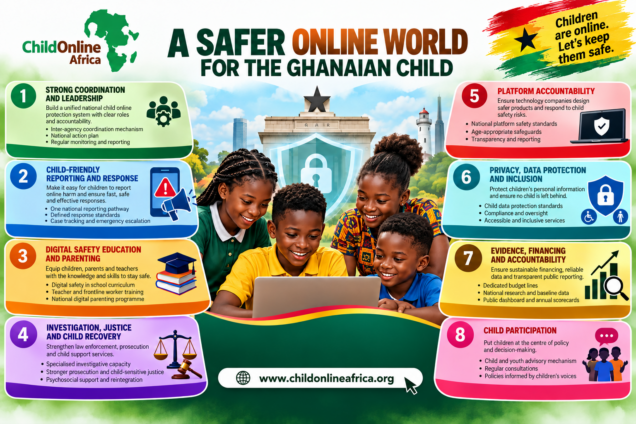
Ghana should therefore build one connected National Child Online Protection System. This does not require another institution or another glossy document. It requires linking the institutions and programmes that already exist through clear referral pathways, shared accountability and consistent response standards. The guiding principle is simple: a child should never be left alone to navigate an online protection crisis. Children, parents and teachers must know where to go; those who receive reports must know exactly what happens next. Reporting channels must be child-friendly and accessible to children with disabilities. Common expectations for response times, evidence preservation, confidentiality and follow-up must apply regardless of where a child lives or which institution first receives the complaint.
Parents need practical tools, not lectures on surveillance. Digital parenting education should cover privacy settings, gaming risks, social media, grooming, sextortion, cyberbullying, pornography exposure, artificial intelligence and online relationships and, above all, how to respond when a child says “Someone online is threatening me.” The first response must be belief and support, not confiscation of a phone or punishment. Schools must become digital safeguarding environments: every school needs a child digital safety policy; teachers need training to recognize online exploitation, preserve evidence, and refer cases; digital literacy and citizenship must be mainstreamed into the curriculum.
Technology companies that profit from children’s presence on their platforms cannot shift the entire safety burden onto parents. Child safety must be designed into products: effective reporting mechanisms, age-appropriate defaults, privacy protections, systems that detect and respond to child sexual exploitation material, and transparent handling of credible reports. Platforms should be required to demonstrate how they identify foreseeable risks to children and what safeguards they have put in place.
Online child exploitation is not a conventional crime. Investigators need specialized capacity in digital evidence, social media, online identities, cryptocurrency, digital forensics, and cross-border cooperation. Prosecutors and the judiciary need corresponding training. The goal is not simply more arrests; it is a complete justice chain that ends in protection and recovery for the child.
Children themselves must be partners, not only subjects of protection. Young people understand digital culture, platform dynamics and why peers stay silent. Meaningful mechanisms for their participation in policy and programme design are essential. At the same time, the system must reach every child, including those with disabilities and those in disadvantaged communities who face additional barriers to reporting.
A practical 12-month agenda could focus on eight priorities:
- Establish a single, clearly understood national referral pathway linking children, families, schools, platforms, police and social services.
- Create a national child online safety dashboard using anonymized data on reports, response times, investigations and outcomes.
- Integrate digital safety into mainstream education.
- Launch a nationwide digital parenting programme.
- Resource specialized law-enforcement capacity for online child exploitation, with matching capacity for prosecutors and the judiciary.
- Make reporting systems child-friendly and accessible to children with disabilities.
- Require technology companies operating in Ghana to demonstrate concrete child-safety measures.
- Commission sustained research into children’s actual online experiences and secure sustainable financing for the protection system.
These priorities need clear institutional owners, measurable outcomes and timelines. Short-term projects and occasional campaigns will not suffice.
The conceptual shift is equally important. We should stop to ask ourselves which approach will work considering the evolving nature of the needs of our children. The internet is already part of childhood, education, employment and social life; artificial intelligence will deepen that reality. The question must become: how do we make the digital environment worthwhile for children?
Ghana has foundations. What it does not yet have is a protection system operating at the required speed, scale and sophistication. That gap should be of concern to us. It should also motivate a decisive move from commitment to implementation, from awareness to protection, and from fragmented interventions to an integrated national system.
The measure of digital progress is not only how many people a country connects. It is also how well it protects the children it connects.
Director@childonlineafrica.org
+233571000001
Latest Stories
-
Education Ministry renews return-to-class appeal despite teachers’ refusal to end strike
1 minute -
Remains of dozens of suspected kidnap victims found in Nigerian forests
2 minutes -
Four bodies found after avalanche hits Himalayan climbing group
8 minutes -
Adipa residents give government seven days to halt Agbogbloshie waste transfer
17 minutes -
Desks rotting in abandoned Kintampo South E-Block: A decade of neglect and a waste of state resources
19 minutes -
West Africa cannot simply import security models without accounting for local realities – WAMS
20 minutes -
Bono East Minister directs MCE to stop hotel project near Konkrompe SHS
43 minutes -
AGN Chair urges action-driven tracking and reporting on inclusive climate adaptation in Ghana’s agriculture
46 minutes -
Man City rule breaches not my concern – Mancini
46 minutes -
NSA releases PIN Codes for 2026/2027 national service private candidates and foreign-trained graduates
49 minutes -
GMet forecasts thunderstorms, rain across parts of Ghana this evening
50 minutes -
APRA wins Africa PR Legacy Award
53 minutes -
UN Special Rapporteur on adequate housing to visit Ghana
56 minutes -
Telecel Ghana concludes SME Month 2026 with Business Runway in Takoradi
1 hour -
Ghana must embrace AI to transform tourism — GHATOF
1 hour