

Audio By Carbonatix
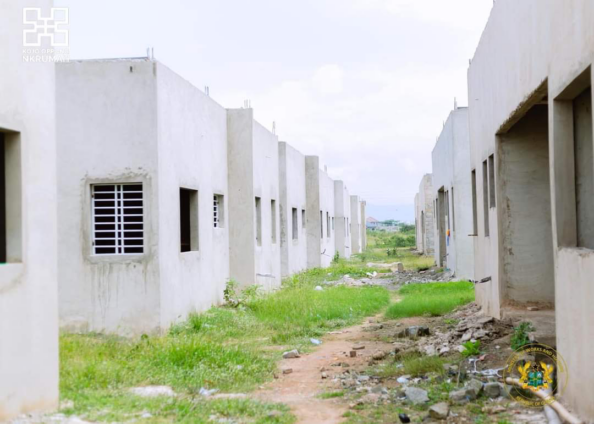
The Government has reaffirmed its commitment to making decent, safe, affordable and inclusive housing accessible to more Ghanaians, as the country joins the international community to commemorate World Habitat Day 2026 under the theme “Adequate Housing for All.”
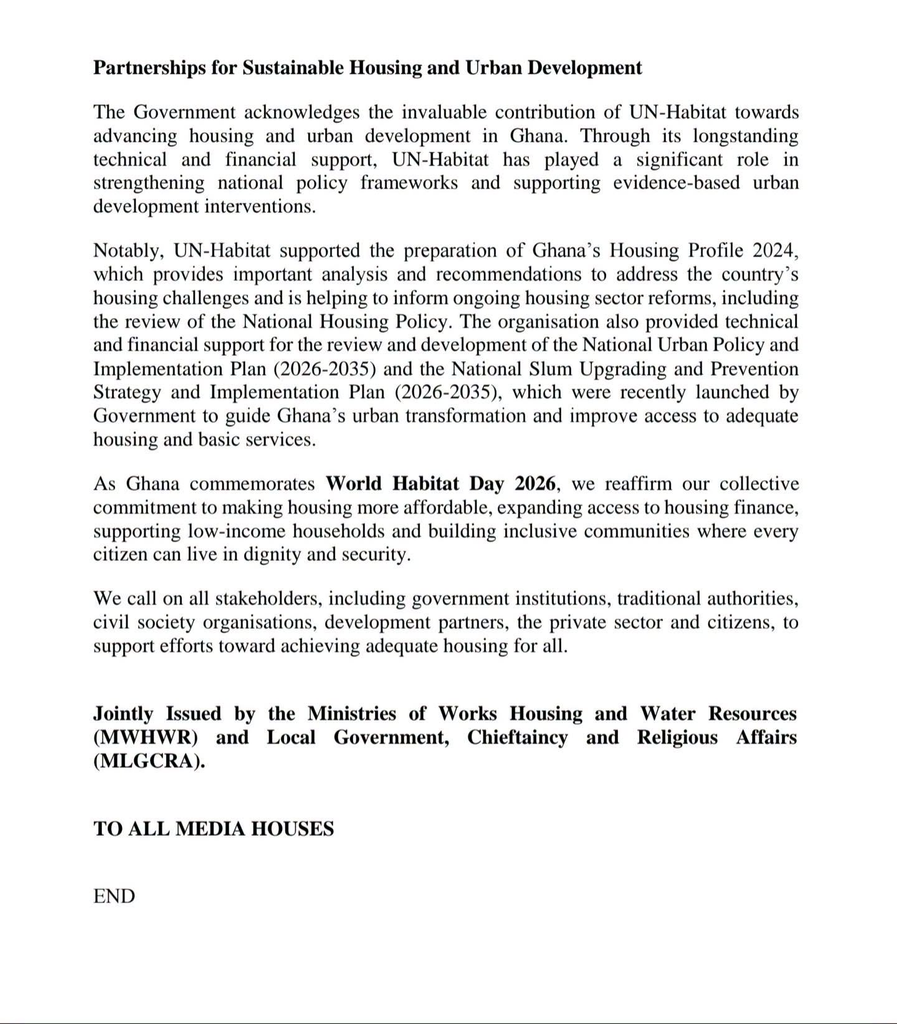
In a joint statement issued on Monday, October 5, the Ministry of Works, Housing and Water Resources (MWHWR) and the Ministry of Local Government, Chieftaincy and Religious Affairs (MLGCRA) said the theme highlights the urgent need to address the barriers preventing many citizens from accessing suitable housing.
The Government said housing should not be viewed merely as a physical structure, but as a source of security, dignity and stability for individuals, families and communities.
It acknowledged that despite ongoing efforts to address Ghana’s housing deficit, high land prices, rising construction and infrastructure costs and limited access to affordable housing finance continue to make homeownership and decent accommodation difficult for many citizens.
According to data from the Ghana Statistical Service cited by the Government, only about 5% of Ghanaians can secure housing without assistance, while approximately 60% require state-facilitated support and a further 30% remain unable to access housing even with government subsidies.
The Government said the figures underscore the need for sustained and deliberate interventions to make adequate housing more accessible and affordable.
Government expands affordable housing initiatives
As part of its response, the Government said it is pursuing policies aimed at improving housing affordability, expanding access to housing finance and decentralising housing development beyond Ghana’s major urban centres.
It is also working with private developers to facilitate access to land, basic infrastructure and credible off-takers, while leveraging private-sector expertise and investment to increase housing delivery.
A key intervention is the National Mortgage Scheme, being implemented in partnership with the National Housing Fund and Republic Bank.
The scheme is intended to provide mortgage financing at an interest rate of approximately 8.4% per annum, with repayment periods of up to 20 years.
The Government said the arrangement is designed to widen access to homeownership, particularly for people who have traditionally been excluded from the conventional mortgage market.
Other initiatives, including the Greenville District Housing Programme and the National Rental Assistance Scheme, are also being pursued to expand housing options and improve access to affordable accommodation across the country.
Focus on housing for vulnerable groups
The Government said its housing agenda also places emphasis on inclusive housing, particularly for vulnerable groups and Persons with Disabilities (PWDs).
As part of ongoing housing developments, ground-floor units are being reserved for persons with disabilities to improve accessibility and convenience.
Implementing agencies have also been directed to engage disability groups and incorporate accessibility requirements into the planning, design and implementation of housing projects.
The Government said provisions to strengthen inclusive housing delivery are also being incorporated into the ongoing review of the National Housing Policy.
It said the objective is to ensure that future housing programmes take into account the needs of different categories of citizens and contribute to more equitable communities.
Urban policy targets housing and slum challenges
The Government also pointed to recent policy reforms aimed at tackling housing challenges within the wider context of urban development.
In July 2026, the MLGCRA launched the National Urban Policy and Implementation Plan (2026–2035) alongside the National Slum Upgrading and Prevention Strategy and Implementation Plan (2026–2035).
The two frameworks are intended to guide efforts to develop inclusive, safe, resilient and sustainable human settlements while addressing housing challenges associated with rapid urbanisation.
The National Urban Policy prioritises investment in affordable and social housing, including measures to expand low-income rental housing, increase housing opportunities in slums and informal settlements and streamline housing development approval processes.
It also seeks to encourage greater participation by private-sector and other non-state actors in affordable housing delivery and strengthen collaboration among local authorities, housing institutions and investors.
The Slum Upgrading and Prevention Strategy, meanwhile, focuses on improving conditions in underserved communities while preventing the expansion of informal settlements.
Among the proposed interventions are land tenure regularisation, the provision of public land for low-cost housing, expanded rental opportunities, land pooling and land readjustment schemes, innovative housing finance mechanisms and affordable and resilient building technologies.
Government links housing to infrastructure
The Government stressed that adequate housing goes beyond putting up housing units, noting that sustainable communities also require essential infrastructure and services.
These include potable water, sanitation, roads, electricity, drainage systems and public spaces.
It said future housing delivery would therefore increasingly focus on integrated developments that combine housing with the infrastructure and services required to create healthy, productive and resilient communities.
The Government said it would continue working with Metropolitan, Municipal and District Assemblies (MMDAs), private developers, financial institutions, development partners and other stakeholders to expand access to sustainable housing.
UN-Habitat support acknowledged
The Government also recognised the contribution of UN-Habitat to Ghana’s housing and urban development agenda.
It said the organisation’s technical and financial support has contributed to the development of national policy frameworks and evidence-based interventions in the housing and urban development sectors.
Among these interventions is the Housing Profile 2024, which provides analysis and recommendations on Ghana’s housing challenges and is helping to inform housing sector reforms, including the review of the National Housing Policy.
UN-Habitat also supported the review and development of the National Urban Policy and Implementation Plan (2026–2035) and the National Slum Upgrading and Prevention Strategy and Implementation Plan (2026–2035).
As Ghana marks World Habitat Day, the Government said it remains committed to making housing more affordable, expanding access to housing finance, supporting low-income households and promoting inclusive communities where citizens can live with dignity and security.
Latest Stories
-
Black Star Experience announces national choral music contest to discover new Ghanaian talent
1 minute -
Melcom serves 1,000 meals to children in selected orphanage homes
3 minutes -
Miracles Aboagye questions Mustapha Gbande’s authority to direct EOCO arrest of Manhyia South MP
4 minutes -
My music is a true reflection of who I am – Nigerian singer Ladé
4 minutes -
Activa International Insurance Ghana reinforces culture of compliance and customer protection
10 minutes -
Mining must prove its impact, not just publicise it — Chamber of Mines
20 minutes -
NDC disqualifies Dzifa Gunu from La Dadekotopon contest
27 minutes -
Togbe Afede XIV opposes proposed 5-year presidential term
30 minutes -
World Vision targets 90 percent universal WASH access in Asunafo North, Asutifi North
48 minutes -
I told EOCO to arrest Manhyia South MP – Mustapha Gbande
1 hour -
2028 election will be a combination of strategy and ‘buga’ – Miracles Aboagye
1 hour -
Bombs preventing rescue of kidnapped youths, Nigerian police say
1 hour -
Flydubai co-pilot planned to crash plane into Tel Aviv airport or building, reports say
1 hour -
National security must be built beyond Accra – Muntaka
1 hour -
Ghana bans preaching on buses with jail terms for offenders
1 hour