

Audio By Carbonatix
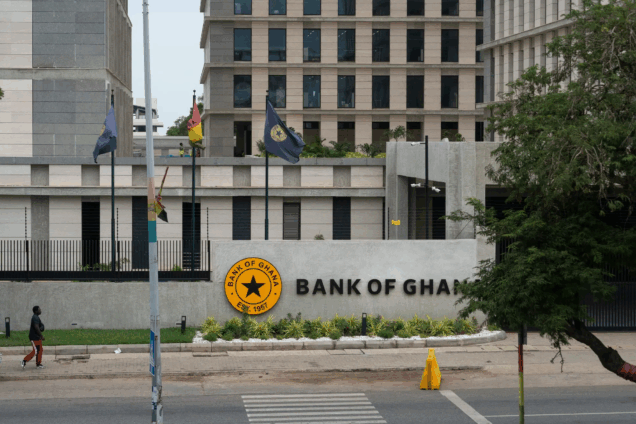
The Bank of Ghana (BoG) has cautioned users of digital financial services to remain vigilant against fraudsters and avoid sharing confidential financial information with unauthorised persons.
The central bank said the increasing use of digital platforms for banking, mobile money and other financial transactions requires consumers to adopt stronger security measures to protect their funds and personal information.
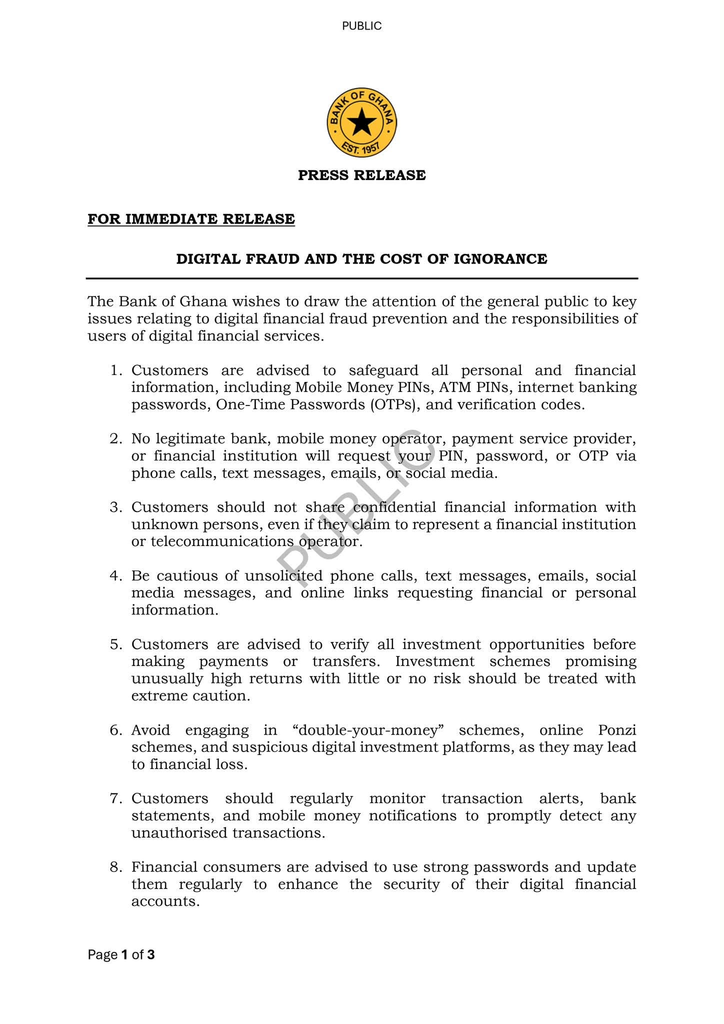
In a statement issued on Wednesday, October 7, the BoG urged customers to safeguard sensitive information, including Mobile Money and ATM PINs, internet banking passwords, One-Time Passwords (OTPs) and verification codes.
It stressed that legitimate banks, mobile money operators, payment service providers and other financial institutions would not ask customers to disclose such information through phone calls, text messages, emails or social media.
Customers have therefore been advised not to share confidential financial details with individuals who claim to represent banks, telecommunications companies or other financial institutions unless their identity has been properly verified.
Warning over suspicious links and investment schemes
The BoG also warned the public to exercise caution when responding to unsolicited phone calls, text messages, emails, social media messages and online links requesting personal or financial information.
It particularly urged consumers to thoroughly verify investment opportunities before making payments or transferring funds.
Investment schemes promising unusually high returns with little or no risk, it said, should be treated with extreme caution.
The public has also been advised to avoid “double-your-money” schemes, online Ponzi schemes and suspicious digital investment platforms, which could result in significant financial losses.
The central bank urged consumers to conduct appropriate checks before committing funds to any investment opportunity and to be wary of offers that appear too good to be true.
Consumers urged to strengthen account security
The BoG further encouraged users of digital financial services to regularly monitor transaction alerts, bank statements and mobile money notifications to identify unauthorised transactions as quickly as possible.
Consumers have also been advised to use strong passwords and change them regularly, while activating available security features such as transaction alerts, biometric verification and two-factor authentication where applicable.
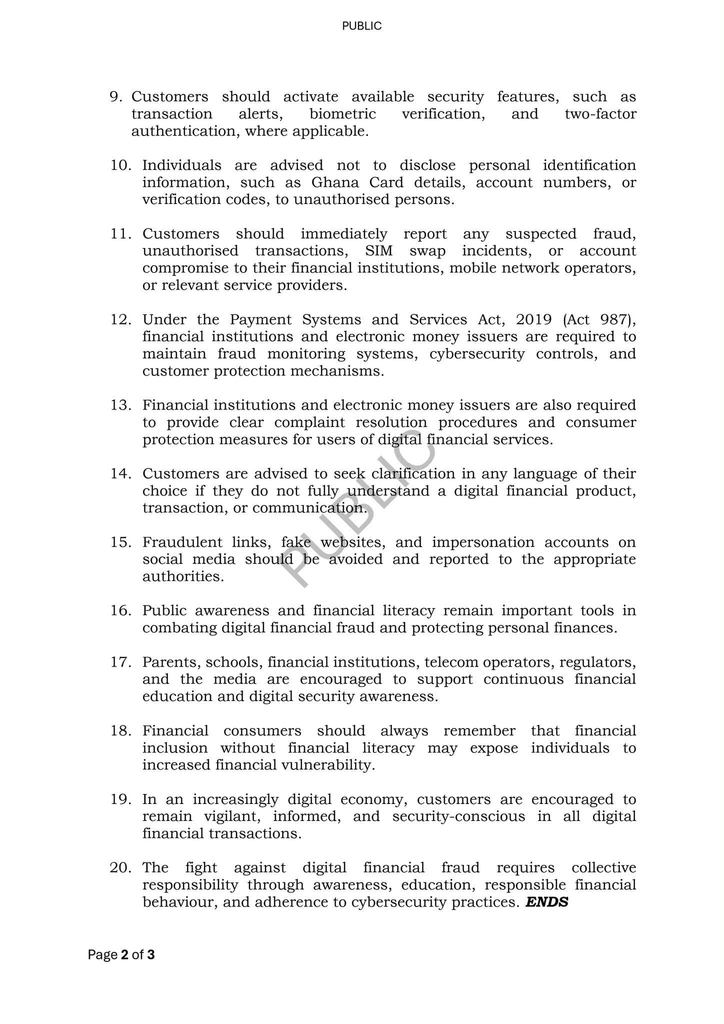
The central bank cautioned individuals against disclosing personal identification information, including Ghana Card details, account numbers and verification codes, to unauthorised persons.
It said customers who suspect that they have fallen victim to fraud, experienced an unauthorised transaction, suffered a SIM swap or had their account compromised should report the incident immediately to their financial institution, mobile network operator or relevant service provider.
Financial institutions have fraud-prevention obligations
The BoG noted that financial institutions and electronic money issuers also have responsibilities under the Payment Systems and Services Act, 2019 (Act 987).
The law requires such institutions to maintain fraud-monitoring systems, cybersecurity controls and mechanisms aimed at protecting customers who use digital financial services.
They are also required to provide clear procedures for resolving customer complaints and appropriate consumer protection measures.
The central bank urged consumers who do not fully understand a digital financial product, transaction or communication to seek clarification before proceeding.
It stressed that customers should be able to obtain explanations in a language of their choice to ensure they understand the financial service or transaction involved.
Public urged to report fake platforms
The BoG also warned consumers to avoid fraudulent links, fake websites and social media accounts impersonating legitimate financial institutions or service providers.
Such platforms, it said, should be reported to the appropriate authorities.
The central bank said public awareness and financial literacy remain important tools in the fight against digital financial fraud, particularly as more people gain access to digital financial services.
It encouraged parents, schools, financial institutions, telecommunications operators, regulators and the media to support continuous education on financial literacy and digital security.
The BoG stressed that increased access to financial services must be accompanied by the knowledge required to use those services safely.
“Financial inclusion without financial literacy may expose individuals to increased financial vulnerability,” the central bank warned.
It therefore urged financial consumers to remain vigilant, informed and security-conscious when conducting digital transactions.
The BoG said combating digital financial fraud requires a collective effort involving consumers, financial institutions, regulators, telecommunications operators and other stakeholders through sustained awareness, education, responsible financial behaviour and adherence to cybersecurity practices.
Latest Stories
-
Ten people linked to Kenya’s first-ever Ebola case quarantined as screening concerns grow
3 minutes -
Ghana warns medical travellers to South Africa to obtain visas for treatment beyond 90 days
9 minutes -
Canada suspends plans to expand assisted dying to people with mental illness
10 minutes -
Minority accuses Sports Ministry, NSA of creating fake portfolios for VISA applicants
12 minutes -
6th Inter Tourism Expo comes off in Cape Coast this October; register now
31 minutes -
Afenyo-Markin accuses government of diverting attention from cocaine seizures linked to Ghana
31 minutes -
GJA gives Armed Forces 14 days to account for alleged assaults on Sika Official, Bullet TV’s Philip Abutiate
33 minutes -
PAC gives CWSA 30 days to recover GH¢10m in unpaid water bills from police, army, hospitals, other public institutions
36 minutes -
Major Accra roads to get facelift ahead of Ghana’s 70th Independence anniversary – Agbodza
56 minutes -
Account for GH¢650bn allocated to existing programmes before new economy – Oppong Nkrumah to gov’t
1 hour -
‘You’re an action man’ – Abena Osei-Asare hails Rent Commissioner’s hostel fee crackdown
1 hour -
Mahama directs Finance Minister to allocate GH¢1bn for Housing Fund in 2027 Budget
1 hour -
NPP celebrates Bawumia on birthday, prays for 2028 election victory
1 hour -
Mahama recounts ‘exhausting and frustrating’ struggle to find a home as a young spouse
1 hour -
‘Take damaged banknotes to commercial banks for replacement’ – BoG warns against repairing cedi notes for resale
1 hour