

Audio By Carbonatix
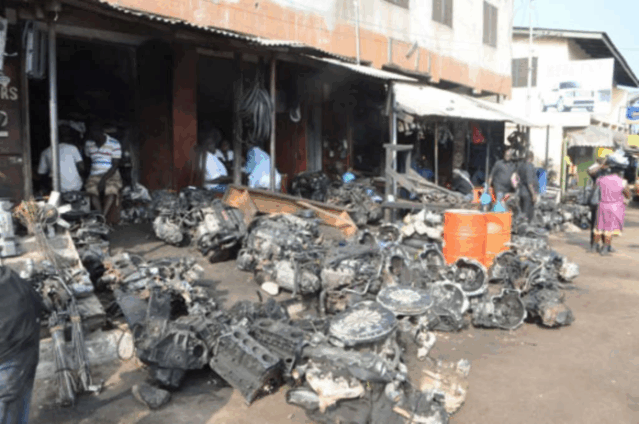
The Abossey Okai Spare Parts Dealers Association has announced plans to close down foreign-owned retail shops in the business enclave on Monday, September 8, 2025, if no intervention is made.
The Association’s Director of Communications, Takyi Addo, confirmed the planned action in an interview on Adom FM’s Dwaso Nsem on Friday.
He explained that the move is intended to enforce the Ghana Investment Promotion Act (Act 865), which restricts retail trade to Ghanaian citizens.
According to Mr. Addo, the action is not targeted at any particular group of foreign nationals but is aimed at ensuring strict adherence to the law.
“On Monday, we are closing all shops of foreigners. There are laws in this country, and we don’t know how they have managed to infiltrate the retail business. Some are driving Uber, others are in trades strictly reserved for Ghanaians. We have been patient for too long, but this time we are serious,” he declared.
He further explained that under Act 865, foreign investors are required to deposit at least $1 million to operate in the retail sector or import goods of the same value.
“Instead, many, especially the Chinese, bring in products worth over $10 million and still engage directly in retail trade, which the law forbids. They are supposed to operate as suppliers, not retailers,” he argued.
Mr. Addo stressed that such practices place Ghanaian traders at a disadvantage, as they face high rent, levies, and import duties while competing with foreign businesses that ignore regulations.
The Association maintained that the action is long overdue, noting that many local spare parts dealers have already been forced out of business at Abossey Okai due to what they describe as “unfair competition.”
This is not the first time local traders have clashed with foreign retailers in Ghana.
The enforcement of Act 865 has been a recurring source of tension, particularly between Ghanaian traders and foreign nationals, most notably Chinese and Nigerian retailers.
In 2020 and 2021, similar disputes led to widespread shop closures, protests, and calls for stricter enforcement of the law.
Successive governments have promised to address the matter, but traders argue that enforcement has been inconsistent, leaving local businesses vulnerable.
Latest Stories
-
World Cup visa scandal: People have leveraged public office to facilitate fraud – Senyo Hosi
22 seconds -
Glut! Farmers count losses as prices crash, customers happy
36 minutes -
GSA postpones auction of unserviceable vehicles
38 minutes -
Man charged with attempted murder after stabbing
41 minutes -
World Cup visa scandal: Senyo Hosi says issue goes beyond calls for Sports Minister’s resignation
43 minutes -
Yaw Ampofo Ankrah hasn’t taken or received any money to facilitate visas – Lawyer insists
1 hour -
World Cup visa scandal: Senyo Hosi urges focus on constitutional accountability
1 hour -
La Beach demolition: Senyo Hosi condemns lack of consultation
1 hour -
Russian glide bomb attack on Zaporizhzhia kills at least 15 people
1 hour -
Jinapor warns underperforming energy sector CEOs of consequences, says no protection for failure
1 hour -
Fire destroys head of tipper truck on Lower Volta Bridge
2 hours -
Palmer signs new Chelsea contract until 2034
2 hours -
World Cup visa scandal: Mahama will act on corruption allegations – Abass Nurudeen
2 hours -
Abass Nurudeen accuses Minority of ‘scandal scavenging’ over World Cup visa controversy
2 hours -
US Embassy recognised NSA, GFA and GTA as separate entities for visa applications – Sports Minister’s aide
2 hours