


Audio By Carbonatix
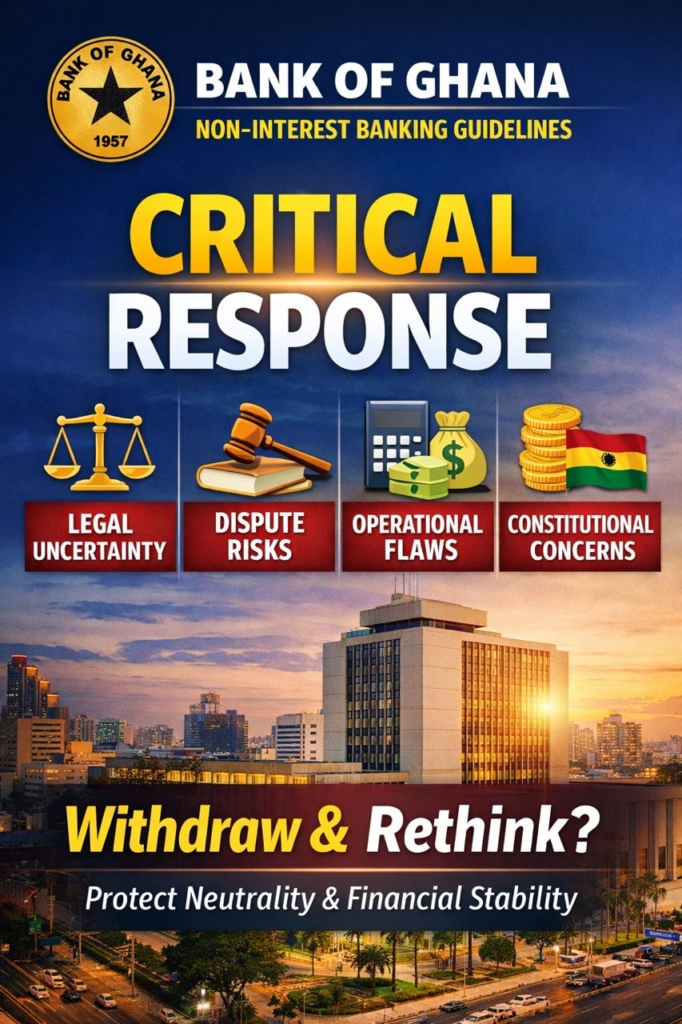
Advocates for Christ Ghana (A4CG), through its Economy, Business & Finance Gate, has formally called on the Bank of Ghana (BoG) to withdraw its Exposure Draft on the Regulation and Supervision of Non‑Interest Banking, citing what it describes as deep legal, prudential, and regulatory flaws.
In a detailed submission dated December 23, addressed to the Governor of the Bank of Ghana, A4CG, a Christian professional advocacy group, acknowledged the central bank’s objectives of promoting financial innovation and inclusion but argued that the draft guidelines, as currently framed, are “not fit for implementation.”
The group said the BoG lacks a tested non‑interest banking model tailored to Ghana’s legal and financial environment, resulting in internal contradictions and regulatory incoherence.
Among the key concerns raised are conflicting standards hierarchies, unclear supervisory authority between the BoG and internal non‑interest banking committees, and dispute‑resolution mechanisms that could weaken consumer protection.
A4CG warned that the proposed structures risk creating a parallel governance and adjudicatory system that may undermine constitutional equality before the law and dilute the central bank’s supervisory primacy.
The submission also criticised the proposed “window” model, which would allow conventional banks to operate non‑interest banking units within existing institutions. According to A4CG, this approach is operationally complex, cost‑opaque, and vulnerable to manipulation in the absence of detailed accounting, audit, and supervisory frameworks.
On prudential regulation, the group argued that applying conventional capital adequacy rules to non‑interest banks without tailored guidance is technically unsound, given the different risk profiles involved.
It further questioned whether there is sufficient market demand in Ghana to justify the costs and systemic implications of a specialised non‑interest banking regime.
A4CG emphasised that its objections are not ideological or faith‑based, but grounded in constitutional neutrality, consumer protection, and public‑interest considerations.
It recommended that any future framework be comprehensively redesigned to ensure regulatory clarity, equal treatment of consumers, and transparency, while avoiding regulatory arbitrage.
The organisation concluded by urging the Bank of Ghana to withdraw the draft, undertake a thorough technical revision, and re‑engage stakeholders to preserve institutional credibility and public confidence.
Below is the full submission:
Latest Stories
-
Early UK local election results point to big losses for Starmer’s Labour Party
22 seconds -
I authorised OSP to prosecute cases – Former AG Godfred Dame
8 minutes -
EOCO declares three women wanted over alleged financial loss to state
22 minutes -
2025 WASSCE results decline due to lack of clear education formula — Dr Osei Adutwum
24 minutes -
Ghana’s governance transition system is one of the poorest globally — Dr Osei Adutwum
28 minutes -
“Do Africans Live on Trees?” — Dr Osei Adutwum recalls facing stereotypes while teaching in America
31 minutes -
East Gonja: Tipper truck accident kills 4, one critically injured at Kinkinlin near Makango
36 minutes -
Reposition TVET to drive SME growth and youth employment — Development Expert
37 minutes -
A stranger’s kindness helped my brother reach Germany and opened my path to America — Dr Osei Adutwum
39 minutes -
Gender Ministry monitors North Legon child abuse case, says victim is responding to treatment
44 minutes -
Free SHS remains free – GES rejects claims of GH¢1,700 feeding fee
47 minutes -
Microsoft executive, Ashesi University co-founder praises Ghana for One Million Coders initiative
48 minutes -
NPP condemns attacks on Kufuor, urges NDC to rein in Kevin Taylor
53 minutes -
Volta REGSEC suspends reopening of Ho Central Mosque over security concerns
55 minutes -
Grueter shines as 120 golfers compete at 3i Africa Summit Invitational in Accra
1 hour