

Audio By Carbonatix
Air pollution is becoming one of Africa’s biggest public health threats. From vehicle exhaust fumes and dust to smoke from burning waste and cooking fuels, millions of people across the continent breathe polluted air every day.
But before countries can solve the problem, they first need to measure it properly.
That remains a major challenge in many African countries because most air quality sensors are manufactured outside the continent. Many institutions also lack enough experts who can deploy the sensors, retrieve the data and properly interpret the information collected.
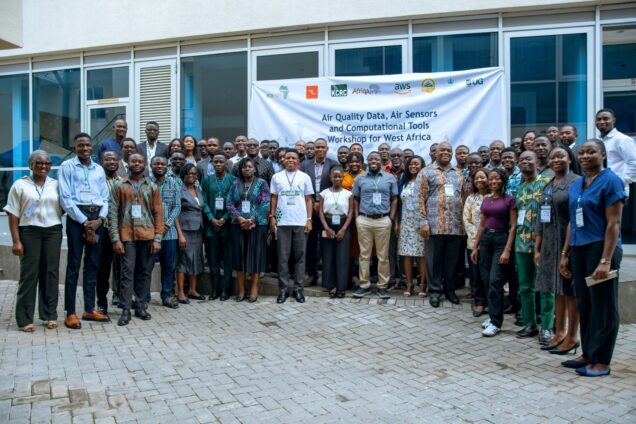
It is against this background that the Air Quality Sensor Evaluation and Training Facility for West Africa (Afri-SET) at the University of Ghana has held a four-day workshop on Air Quality Data, Air Sensors, and Computational Tools for West Africa from May 18 to May 21, 2026.
The workshop brought together researchers, students, policymakers, civil servants, NGOs and media practitioners from across West Africa, both physically in Accra and online.
Afri-SET, which is based in the Department of Physics at the university, was set up to evaluate low-cost air quality sensors and test how they perform in African weather and pollution conditions.
Speaking at the workshop, the Country Lead for the Clean Air Fund in Ghana, Desmond Appiah, said the project is important because many sensors developed abroad may not perform the same way in Africa.
“There’s been a lot of air quality sensors developed around the world, but most of them did not really have the opportunity of being evaluated in the context of, say, Ghana or West Africa, and that is where Afri-SET's work is extremely important,” he said.
He explained that weather conditions, such as heat and humidity, can affect how the sensors work in African countries.
“For instance, temperature variation. If a sensor is developed in North America, you would expect it to work much better in the North American context. But maybe when it comes to Ghana or West Africa’s context, the readings may be impacted,” he added.
Mr Appiah also warned that air pollution data collection across Africa remains very low.
“One, because the level of air quality data collection in Africa is very low. Secondly, because it’s low, we are not really putting the information in the hands of the policymakers in the states that the policymakers can understand,” he said.
The Head of the Department of Physics at the University of Ghana and Facility Manager of Afri-SET, Dr Allison Felix Hughes, said the workshop is focused on building technical capacity across the sub-region.
“Afri-SET, which is the Air Quality Sensor Evaluation and Training Facility, which is located in the Department of Physics, is a facility that has been set up to evaluate low-cost air quality sensors and see how well they perform in the realistic African environment,” he explained.
Dr Hughes said most of the sensors are tested in Europe and North America before being brought to Africa, even though pollution sources and weather conditions are different.
“Our sources of pollution tend to be a bit different from what is happening in Europe and America, and also our weather conditions are different,” he said.
He added that the training is not just about using the sensors, but also about understanding the data they produce.
“We want to get them to understand how these sensors behave, and then we also want to build a capacity. The data that comes from these sensors, how do you analyze it? How do you make sense of the data? How do you visualise it?” he said.
According to Dr Hughes, the programme is designed as a “training of trainers” model so participants can return to their countries and train others.
“So we bring people from across West Africa and Ghana, and we want them to be able to go back to the various institutions and also train others,” he added.
In a speech read on behalf of the Chief Executive Officer of the Environmental Protection Authority, Professor Nana Ama Browne Klutse described Ghana’s air pollution situation as alarming.
“The situation in Ghana is equally concerning and should not be taken for granted,” the statement said.
According to the EPA, monitoring activities show that particulate matter concentrations exceed national air quality standards in most monitoring locations, while “virtually the entire population in both urban and rural areas is exposed to particulate matter concentrations that exceed the World Health Organisation’s guidelines.”
The statement added that the World Health Organisation estimated in 2017 that air pollution contributes to approximately 28,000 preventable deaths in Ghana every year.
“In the greater Accra metropolitan area alone, about 2,800 premature deaths were attributed to air pollution in 2015, and this figure is projected to rise to 4,600 by the year 2030 if urgent interventions are not implemented,” the statement added.
“In Ghana, the economic burden associated with air pollution has been estimated as 2.5 billion U.S. dollars, representing approximately 4.5 per cent of the country’s gross domestic product,” the statement said, citing the World Bank country analysis report for 2020.
Despite the challenges, the EPA said Ghana has made progress in air quality management, including the publication of the Air Quality Management Regulations, LI2507, in 2025 and the development of the Ghana Air Quality Portal to provide real-time air quality data for researchers, students, NGOs and the public.
At the workshop, there were presentations from Dr Frank Out-Larbi on Urban Air Quality Monitoring, Dr Irene Opoku-Ntim on The Hidden Risk of Radon, and Prof. Raphael Arku on the Health Impacts of air Pollution. Prof. Dan Westervelt from Columbia University took participants through Air Quality Sampling Techniques. Mathias Borketey presented on Data Pre-processing and Visualisation using R. Dr Cosmos Wemegah of the University of Energy and Natural Resources first walked the participants through the Data Retrieval using API from OpenAQ and Purple Air, and later explained Remote Sensing of Air Pollution from Satellite. James Nimo from the University of Albany also spoke about Source Apportionment and Correction and Calibration Models using Python.
This story was a collaboration with New Narratives. Funding was provided by the Clean Air Fund, which had no say in the story’s content.
Latest Stories
-
Ghana Enterprise Brands Awards 2026: Leading brands, business trailblazers to shine on November 30
15 minutes -
T-bills auction: Demand improves as government exceeds target by about 76%; interest rates soften
21 minutes -
Ziope undertakes initiative to build a technologically inclined community, commissions self-help ICT lab
46 minutes -
ECG announces power outage in parts of Tema, Central Region due to network fault, maintenance
1 hour -
When the Gospel Becomes a Weapon: The church, blackmail and the abuse of faith
2 hours -
JoyNews’ Jacqueline Ansomah Yeboah selected for UK Media Excellence for Emerging Technology Fellowship
2 hours -
Mental Health Alliance urges government to operationalise Mental Health Fund
2 hours -
Ghana–Holy See agreement heads to Parliament after Cabinet approval
2 hours -
Luv FM Corporate Games 2026: Kumasi Central Prisons, Amanfiman Bank win big amid fun
2 hours -
WAFU B U17: Ghana top Group A after win over Togo
3 hours -
Ho Central Mosque reopens amid unresolved leadership dispute that led to closure
4 hours -
Minority caucus questions GH¢16.4m in Ablakwa’s SA evacuation spending, demands independent audit
4 hours -
Gender Ministry meets Nana Akua Addo’s husband over domestic violence after hospital discharge
5 hours -
UG Vice-Chancellor urges swift operationalisation of National Research Fund
6 hours -
Pope Leo to have surgery after lump found in lung
6 hours