

Audio By Carbonatix
Africa’s vast lithium deposits could hold the key to transforming the continent’s economic fortunes—if African countries can take control of the entire value chain and stop exporting raw minerals.
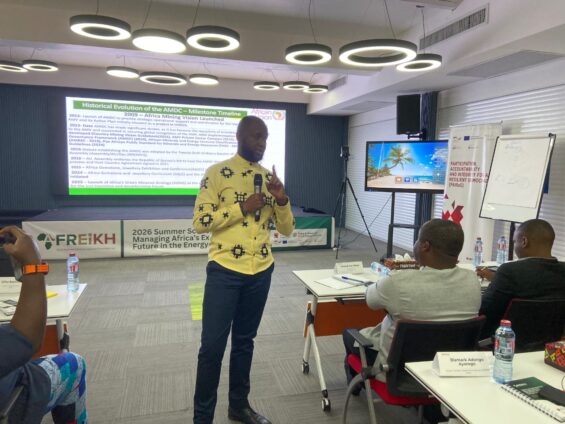
This is the emerging message from the ongoing Summer School on Managing Africa’s Extractive Future in the Energy Green Transition, organised by the Africa Centre for Energy Policy (ACEP) in Accra.
The programme has brought together civil society organisations, journalists and extractive-sector experts from 15 African countries to examine how the continent can maximise its mineral wealth amid the global transition to clean energy.
Speaking at the Summer School, Nkuli Ncobe of Zimbabwe said Africa is sitting on enormous lithium resources estimated to be worth about US$9 trillion, describing the mineral as a potential game-changer for the continent.
He argued that African countries must move beyond the traditional model of extracting minerals and exporting them in their raw state.
According to him, African countries should develop a strategic regional mineral-feedstock value chain covering the upstream, midstream and downstream stages of lithium production.
From rocks to riches
Mr Ncobe said countries could specialise in different segments of the lithium value chain, creating a continent-wide industrial ecosystem that generates jobs, investment, technology and trade.
Some countries, he explained, could focus on supplying capital goods and mining machinery, including dozers and other heavy equipment, while others could develop industries producing critical mining consumables such as explosives, drilling steel, spare parts, grinding media and chemical services.
Other countries could position themselves as hubs for financial services, analytical services, security, information and communications technology (ICT) and other support industries required by the lithium sector.
Such a coordinated approach, he argued, could create a massive internal African market around lithium while ensuring that the wealth generated from the mineral remains largely on the continent.
Africa must stop exporting its wealth
Mr Ncobe challenged African leaders to think beyond individual national interests and create a single continental market for African goods and services capable of supporting the emerging lithium economy.
He believes stronger regional integration could allow African countries to leverage their different comparative advantages and build a competitive lithium industry capable of serving both African and international markets.
He also suggested that the Nigerian and Ghanaian stock exchanges could play a major role in mobilising the huge capital required to develop Africa’s lithium resources.
The proposal comes at a time when lithium has become increasingly important to the global energy transition because of its use in batteries and energy-storage technologies.
The big question: who will control Africa’s lithium?
For Africa, the lithium boom presents both an enormous opportunity and a major warning.
The continent can either remain a supplier of raw materials to industries elsewhere, or use its mineral wealth to build factories, industries, jobs, technology and prosperity at home.
The challenge, therefore, is no longer simply how much lithium Africa has underground.
The real question is: Can African leaders turn the continent’s estimated US$9 trillion lithium wealth into African-owned industries and shared prosperity?
The ongoing ACEP Summer School is putting that question, and Africa’s broader extractive future, firmly on the table.
-
By: David Kwasi Okyere Agyeman (PhD), Participant of 2026 AFREIKH SUMMER SCHOOL
Latest Stories
-
Atta Akyea fumes as Manhyia MP is to spend another night in EOCO custody
9 minutes -
SSNIT says La Beach clearance was to protect hotel investments, beaches to remain public
1 hour -
APSU congratulates St Augustine’s College after back-to-back National Investment Quiz wins
1 hour -
Renewed flood intervention at Mallam Junction raises hopes among residents, businesses
2 hours -
St Augustine’s College retain National Investment Quiz title after nail-biting grand finale
2 hours -
Education infrastructure investment will drive Banda’s development – Ahmed Ibrahim
2 hours -
Teacher unions strike: Gov’t presents fresh proposals as talks end inconclusively
3 hours -
51,000 teachers’ promotion arrears to be validated for October payment – Education Minister
3 hours -
Kwabena Boamah appointed Board Chair for Impact Investing Ghana
3 hours -
Striking teacher unions to meet Fair Wages and Salaries Commission on October 6
4 hours -
EOCO working with AG to arraign Nana Baffour Awuah before weekend court
4 hours -
Duraplast reassures customers after fire, announces October 5 reopening
4 hours -
Call off strike, gov’t will not renege on promotion arrears pledge – Haruna Iddrisu to teacher unions
4 hours -
Committee set up to validate teachers eligible for 20% deprived-area allowance – Education Minister
4 hours -
Five-member committee to search for new Black Stars coach after Sports Ministry-GFA meeting
4 hours