

Audio By Carbonatix
Ghana’s air is slowly killing its people — and experts say we’re letting the biggest culprits roam free.
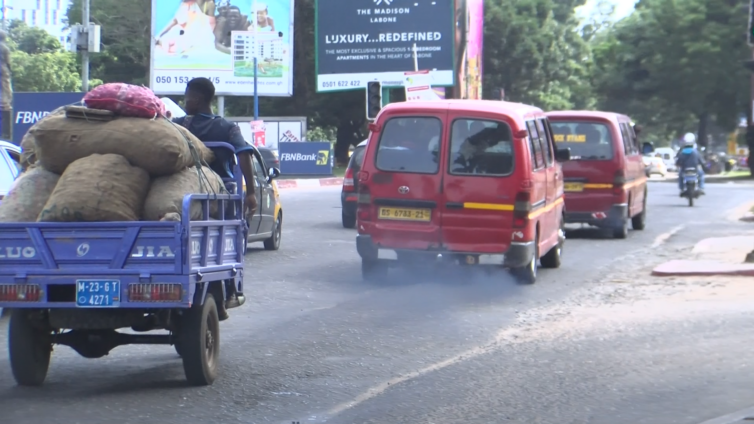
Professor Kofi Amegah, Associate Professor of Environmental and Nutritional Epidemiology at the University of Cape Coast, is calling for a ban or heavy taxation on high-emitting vehicles, warning that Ghana cannot afford to ignore their contribution to a public health crisis that is already claiming thousands of lives every year.
"The high-emitting vehicles, I think we need to find a way and either get rid of them by not giving them roadworthiness, or we need to tax them heavily," he said during the Ghana Thoracic Society’s maiden public lecture, held in Accra.
"I'm in support of taxing these vehicles heavily so that it will serve as a deterrent...we can also look at a policy whereby there could be some form of replacement for a vehicle owner so that they can pay over time."
While Professor Amegah supported the now-repealed vehicle emissions levy — widely criticized and eventually scrapped by government — he lamented that its focus was misplaced.
"The problem with the emissions tax was that it was not really about air quality. It was just another revenue-generating tool for government," he explained.

His warnings come on the back of shocking data.
According to the World Health Organisation (WHO), air pollution was responsible for more than 28,000 deaths in Ghana in 2019 alone — a figure that surpasses the combined national death toll from malaria, HIV, and tuberculosis.
That translates to one death every 19 minutes. If that trend continues unchecked, air pollution could claim over 2,300 lives every month in Ghana.
But it gets worse. The Global State of Air Report, published in 2021, revised Ghana’s death toll upward to 30,000 lives lost per year.

On a global scale, air pollution was linked to 8.1 million deaths in 2021 — that’s 22,192 people dying every single day.
Even more alarming, one child dies every minute due to air pollution, according to UNICEF-backed findings.
The 2024 Air Quality Life Index (AQLI) adds that polluted air cuts the average global life expectancy by 1.9 years, equal to a staggering 14.9 billion life-years lost.
At the public lecture, themed “A Neglected Killer: Air Pollution and the Lung,” Professor Kofi Amegah joined other medical and environmental experts in calling for urgent, targeted interventions.
He emphasised not just policies, but bold enforcement measures.
"In our homes, we need to find a way and transition to clean cooking solutions by using LPG and getting rid of the charcoal. We need to stop open burning. But the vehicles? Those are the ones doing damage every second on our roads."
To him, the solution is simple but politically inconvenient.
Professor Jane Afriyie Mensah, President of the Ghana Thoracic Society, says the group’s mission is to translate such alarming data into public action.
“We have realised that a lot needs to go into education to let people understand how they can achieve optimal lung health,” she said. “This is becoming alarming. And we need to raise our voices to address this menace.”

“We'll go sector by sector, looking at the people who are most at risk of air pollution. And then we will channel our educational activities through that.”
Desmond Appiah, Country Lead for the Clean Air Fund, was direct in his appeal.
“There is still a gap when it comes to a policy direction, a clear, clean air or air quality policy, which says this is our aspiration when it comes to air pollution. And these are the things that we think that we can work together.”

He added, “What a policy does is that it helps to guide how we do everything. So if government initiates or puts in place a national air quality policy, anybody coming to do some work in Ghana, which would have a bearing on air pollution or quality of air, would have to toe the line.”
Ghana’s toxic air is no longer an invisible threat — it’s a proven killer. And as the smoke clears on the debate, Professor Amegah's message is clear: either we clean the air now or we keep counting the dead.
Latest Stories
-
TTAG raises alarm over proposed recruitment of 7,000 teachers, demands national posting roadmap
29 minutes -
Civilians feared killed after reports of air strike on Nigerian market
39 minutes -
Bishop Simon Kofi Appiah installed as new Jasikan Diocese Bishop
40 minutes -
Trump’s Strait of Hormuz blockade threat raises risks and leaves predicaments unchanged
43 minutes -
US Court backs extradiction of former MASLOC CEO Sedina Tamakloe-Attionu’s to Ghana
1 hour -
Seven arrested as NAIMOS dismantles illegal mining camp, seizes firearms at Boin River
1 hour -
Fire erupts at Madina Ritz Junction, destroys multiple wooden structures and containers
1 hour -
Daniel-Kofi Kyereh returns from long-term injury, registers assist for Freiburg U23
1 hour -
Knifeman calling himself ‘Lucifer’ slashes three at NYC’s Grand Central
2 hours -
Brands are built from within to without
2 hours -
Matriculants urged to pursue excellence as gov’t reaffirms support for Maritime education
2 hours -
See the areas that will be affected by ECG’s planned maintenance on Monday, April 13, 2026
2 hours -
GPL 2025/26: Salim Adams double fires Medeama back to summit after Kotoko rout
2 hours -
Two robbery suspects convicted following violent gold dealer attack in Obuasi
2 hours -
Supreme Court @150: Fanfare meets reflection as nationwide activities roll out
2 hours