

Audio By Carbonatix
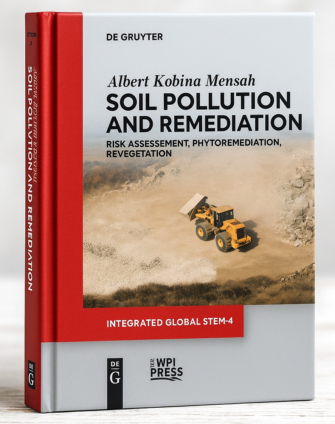
Dr Albert Kobina Mensah’s Soil Pollution and Remediation: Risk Assessment, Phytoremediation, Revegetation is a substantial scholarly contribution to the study of mining-induced environmental degradation and ecological restoration.
Published in 2025 and extending to 445 pages, the volume is organized into 23 chapters and addresses, with notable breadth and technical seriousness, the interrelated questions of soil pollution, potentially toxic elements, risk assessment, phytoremediation, revegetation, and post-mining land rehabilitation.
At its most basic level, the book belongs to the fields of soil science, environmental management, and land reclamation. Yet it also speaks, implicitly and sometimes quite powerfully, to a wider ethical concern: how damaged land may be restored to conditions of ecological functionality, human usefulness, and renewed stewardship.
The central achievement of the book lies in its integrative character. Dr Mensah gathers material that is often dispersed across technical reports, journal articles, field studies, and specialist methods papers, and he presents it in a single, coherent framework.
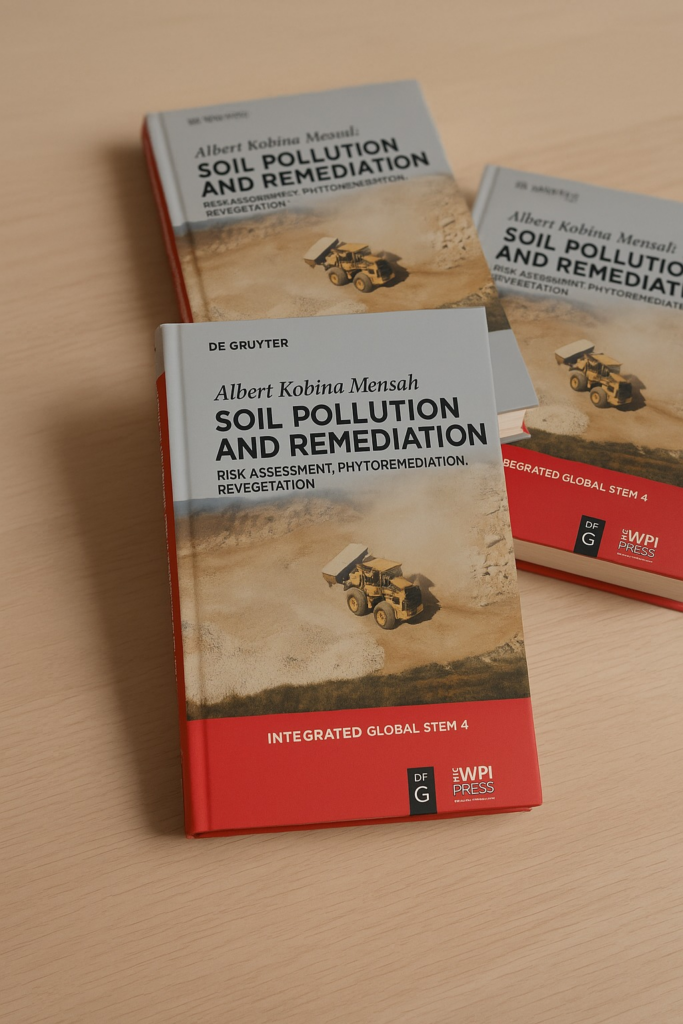
The preface makes clear that the book aims to provide an in-depth analysis of scientific methodologies used to identify environmental risks associated with potentially toxic elements in mining sites and to examine revegetation as a strategy for ameliorating degraded and contaminated lands. In this sense, the work is not simply descriptive. It is organized around a practical thesis: that mine-degraded soils can be rigorously assessed and meaningfully restored through scientifically grounded and ecologically sensitive remediation strategies.
The structure of the volume reinforces this practical orientation. The early chapters focus on the foundations of the problem: the evolution of land reclamation practices, methods used in soil and human-health risk assessment, sequential extraction analyses, size fractionation, acid neutralization, geospatial analysis, and related scientific approaches.
These are followed by chapters on the impacts of mining on soil quality, topsoil management, and the accumulation of potentially toxic elements. From there, the book moves toward solutions: the role of plants in stabilizing and cleaning contaminated soils, the pursuit of mining-sector sustainability, rehabilitation and restoration of degraded lands, case studies in revegetation, the significance of post-reclamation monitoring, critical success factors, management of restored sites, and research gaps for future inquiry.
This progression from diagnosis to response gives the volume both internal coherence and pedagogical clarity. It reads as a book designed not merely to inform, but to guide action.
One of the great strengths of the book is its rootedness in the Ghanaian mining context. Rather than offering only an abstract or universalized discussion of soil pollution, Dr Mensah situates the problem in a concrete environmental and regulatory setting shaped by mining activity, land degradation, and state oversight. Ghana here becomes more than a case study.
It becomes a site through which the broader dilemmas of extraction, contamination, restoration, and sustainability are rendered visible in a particularly vivid form. This regional grounding enhances the value of the book, especially for readers working in African contexts where mining, ecological fragility, and questions of land restoration are deeply intertwined.
The book is also highly relevant for what may be called the everyday practitioner. By this one may mean the environmental officer at a mine site, the reclamation consultant, the regulator, the agricultural or extension worker, the restoration scientist, the NGO field coordinator, or the local project officer or manager tasked with responding to degraded land in practical settings. For such readers, the value of the book lies in its usability.
It offers an architecture of practice: how to identify damage, how to assess contamination risk, how to think through remediation pathways, how to approach revegetation, and how to monitor recovery after intervention. It does not reduce restoration to a cosmetic greening of damaged land. Rather, it insists that restoration must be tied to soil quality, ecological function, and long-term management. That makes the text especially useful for practitioners who must move between scientific evidence and field-level decision-making.
It is here that a small philosophical inflection becomes appropriate. The book may be read not only as a technical account of polluted soils, but also as a meditation, whether intended or not, on the meaning of repair. Soil, in this work, is not simply inert substrate. It appears as the material condition of life, productivity, habitation, and interdependence.
When mining degrades soil, what is damaged is not only chemistry or structure, but a wider ecology of relation linking land, water, plants, animals, and human communities. Remediation therefore emerges as more than a technical procedure. It becomes an ethical act of restoration, a disciplined effort to return damaged ground to a state in which life may again take hold.
From that perspective, Mensah’s attention to revegetation is especially significant. Revegetation is treated not as surface beautification, but as a living practice of ecological recovery, one that acknowledges the temporal and relational dimensions of environmental healing.
A balanced review, however, should also note the book’s limitations. Its strengths are overwhelmingly scientific, technical, and applied. Readers seeking a deeper engagement with the politics of extraction, the social experience of mining-affected communities, environmental justice, or the moral economy of land degradation may find that these concerns remain secondary.
The book’s interpretive center of gravity is environmental remediation rather than critical political ecology. That is not a flaw so much as a boundary of scope. Still, it is worth stating, because it clarifies what kind of contribution the work makes and what kind it does not.
Overall, Soil Pollution and Remediation is an impressive and valuable reference work. Its methodological breadth, regional grounding, and practical orientation make it especially important for environmental scientists and practitioners concerned with mine-land restoration.
At the same time, its deeper significance lies in the seriousness with which it approaches damaged land: not as an afterthought of extraction, but as something demanding knowledge, patience, and responsibility. For that reason, the book deserves to be read not only as a technical resource, but as a disciplined contribution to the broader question of how human beings might repair the ecological worlds they have injured.
Brief biography of Albert Kobina Mensah (Ph.D.)
Born in a gold mining area of the Western Region of Ghana, Dr. Mensah noticed that environmental pollution continues to threaten the sustainability of the ecosystem. This problem was on his mind since Secondary School years. As young as he was in the Secondary School, his answer to a question by biology teacher on his future profession was to become an environmental scientist who would deal with problems arising from environmental degradation due to mining activities in his community. Since then, he developed growing interest in environmental issues. This was further deepened when he studied a four-year bachelor’s degree programme in General Agriculture at the University of Cape Coast, Ghana where he read soil science, Agric engineering, Agric economics, forestry, among other courses.
Dr. Albert Kobina Mensah is a research scientist at the CSIR-Soil Research Institute. He works as an adjunct lecturer at the University of Mines and Technology in Tarkwa and as a lecturer at the CSIR-College of Science and Technology. His research interests include soil science, soil contamination and pollution, soil trace elements, soil potentially toxic elements, remediation, phytoremediation, environmental risk assessment, redox chemistry of potentially toxic elements (PTEs), and artisanal and small-scale mining sustainability. He has conducted numerous laboratory investigations and field experiments to find sustainable solutions to soil contamination problems from gold mining.
Dr. Mensah's research has been funded by various sources, including the Ruhr University Bochum, Ghana, the Government of Ghana, and the German Academic Exchange Service. His four-year PhD project focused on contamination of potentially toxic elements in gold mine polluted sites and green and sustainable remediation options. The project resulted in the publication of four quality research papers, two additional ready manuscripts, five published abstracts, oral presentations at more than seven international conferences, and a 232-paged doctoral dissertation that led to the award of a Doctor of Philosophy in natural sciences. In addition to his research, Dr. Mensah is involved in mining sector sustainability, investigating artisanal and small-scale mining sustainability/use of the military and armed security men against informal miners in Ghana (2018-2021). He also conducted a project on the impacts of biochar and compost applications on soil properties, growth, and yield of maize in acidic rainforest and coastal savannah soils in Ghana (2016-2017).
Dr. Mensah holds a Doctor of Philosophy in natural sciences from the Ruhr-Universität Bochum in Germany, a Master of Science in water resources/watershed management from the Kenyatta University in Nairobi-Kenya, and a Bachelor of Science in general agriculture from the University of Cape Coast in Ghana. Dr. Mensah's research has been published in peer-reviewed publications, focusing on the performance of the mining sector in Ghana, factors affecting adoption of mulching in Kibaale sub-catchment, South Central Uganda, and the role of revegetation in restoring fertility of degraded mined soils in Ghana. He also discussed the institutionalizing community participation in watershed management and policy interventions in watershed management. Dr. Mensah's doctoral dissertation focused on arsenic contamination from gold mining and remediation of active and abandoned mining spoils in Ghana. His master's thesis focused on the effects of Eucalyptus sp. plantation on soil physico-chemical properties in Thiririka Sub-catchment, Kiambu County, Kenya, and his bachelor's thesis on the restoration of fertility of degraded mined soils through revegetation.
Dr. Mensah's research has contributed significantly to understanding the impact of mining on watershed management and the potential for revegetation to restore fertility in degraded mined soils. He discusses the sustainability of the Ghanaian mining sector, focusing on topics such as military intervention in addressing illegal mining (galamsey), the role of artisanal mining in regulating mining activities, and the need for paradigm shifts in the mining sector. He has participated in various talks and interviews, including GBC Radio Behind the News program in ACCRA, Star Radio UK Faith Talk, CITITV/FM The Big Issue, SPICE 91.9 FM morning show in Takoradi, and the fight against galamsey.
Dr. Mensah provides a comprehensive analysis of the mining sector sustainability in Ghana, emphasizing the need for a more sustainable approach to combating illegal mining. He has received numerous awards and scholarships for his contributions to the environmental and science research. These awards include Leadership Award from the African Plant Nutrition Institute at the University of Cape Coast in Ghana, a German Academic Exchange Service (DAAD) research scholarship grant for PhD training at Ruhr University, and a six-month graduate internship grant from the Association of African Universities (AAU). He also received an In-Region Scholarship for Master of Science (IWM) Studies from Kenyatta University in Nairobi, Kenya.
Dr. Mensah has presented at various international conferences and meetings, discussing the role of tree crops in harnessing Ghana's economic potential and discussing sustainable reforms to stop informal miners from returning to mining sites in Ghana. Further, he has made oral presentation and appeared in some leading international soil science conferences such as the British Soil Science Society Annual Meeting conference in Sheffield, United Kingdom, in 2019; Soil Science Society of America International Annual Meeting conference in Salt Lake City, Utah, USA in 2021; First Joint Meeting on Soil and Plant System Sciences in Bari, Italy, in 2019; and was selected as a Right Livelihood Junior Scientist in Bonn, Germany, in September 2017.
Additionally, he got a diverse background in research and training, including participation in various workshops, seminars, and training programs. He has also received various capacity building and participated in workshop and conferences such as the 1st Phy2SUDOE Workshop, the West African Forum on Precision Agriculture, and the Science College organized by Research School in Ruhr University Bochum in Germany. He has also received certificates in statistics, experimental designs, and R for Soil Scientists, and completed certificates in Participatory GIS and E-Learning, developing Lively E-Learning Materials for Integrated Watershed Management, and Certificate in E-Library Resources.
Dr. Mensah has conducted several research projects, including a study on the potential human health risks of eating geophagic clays among pregnant women in Ghana, developed a concept note on mercury toxicity, and a proposal on phytoremediation potential of plant functional groups on contaminated mined soils. He was also part of the POLY4 product trials and experiments at the Soil Research Institute which evaluating polyhalite products as a base dressing and top-dress vs the local practice of 150 kg/ha 23-10-5 basal plus 100 kg/ha urea top-dress. In conclusion, Dr. Mensah’s expertise and commitment to research and education have significantly contributed to his career development and trained other young/up and coming scientists.
Latest Stories
-
SSNIT intensifies informal sector enrolment drive with Techiman float
31 minutes -
Ghana seeks long-term mining investments that benefit local communities – Armah-Kofi Buah
37 minutes -
GHATOF demands compensation for 85 businesses affected by La Pleasure Beach demolition
43 minutes -
Bono Regional Minister calls for investor education to drive economic growth
47 minutes -
Ghana’s Ambassador to China, Kojo Bonsu, presents credentials to Nepalese President
50 minutes -
Fairtrade Africa’s Cocoa Hubs Project strengthens rural service centres in cocoa-growing communities
55 minutes -
MPs are not development officers – Edem Kpotosu
56 minutes -
SEC cautions investors against fraudulent investment schemes
57 minutes -
Land Ministry urges rCOMSDEP operators to reserve earnings for land reclamation
1 hour -
Commercial drivers give authorities one week to clear traders from lorry terminals, bus stops
1 hour -
Trump calls off livestream of Fort Hood attacker’s execution by firing squad
1 hour -
Nana B denies claims that Kojo Bamba was his driver and bodyguard
2 hours -
Engage Now Africa to construct a 10-unit classroom block for struggling Navrongo Vocational Training Centre
2 hours -
One digital financial breach could expose linked accounts to fraud – Financial Crimes Manager
2 hours -
Ghana Russia Centre signs ICT cooperation agreement with Moscow University
2 hours