

Audio By Carbonatix
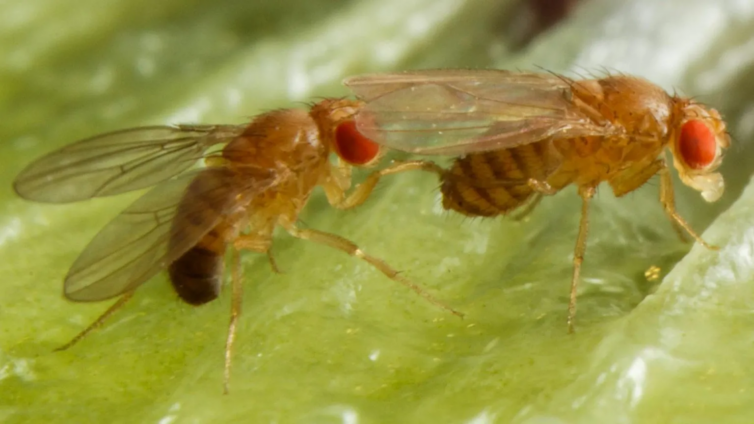
Male fruit flies that drink alcohol become more attractive to females, according to a new study.
Adding alcohol to males' food increases their release of chemicals that attract females and leads to higher mating success.
Fruit flies, or Drosophila melanogaster, are often found around our food waste bins as they feed on rotting fruit which gradually produces alcohol.
Scientists have been trying to study why they are attracted to alcohol and how it affects them.
Previous research has studied different theories about this attraction, such as the flies were seeking a euphoric state or a substitute for the high of mating among males rejected by females.
Study author Bill Hansson, head of the Department of Evolutionary Neuroethology at the Max Planck Institute, said such research has taken an anthropomorphic view of fly behaviour, whereas this latest study suggests drinking alcohol gives the flies a reproductive advantage.
"We don't think flies drink alcohol because they are depressed," he said.
The fly's attraction both to the carbohydrates and yeast in rotting fruit, as well as to the alcohol, cannot be separated, he added.
In the study, alcohol, and particularly methanol, increased the males' production and release of chemical sex signals, called pheromones, which made them more attractive to females.
Pheromones are released into the air from one individual to influence the behaviour of another animal of the same species.
Males were therefore strongly attracted to alcohol, especially those males which had never mated.
The new study also showed that the fly's response to smelling alcohol is controlled by three different neural circuits in its brain.
While two are responsible for attracting male flies to small amounts of alcohol, a third ensures that excessive amounts have a deterrent effect.
Because alcohol is toxic, the fly's brain must carefully weigh the risks and benefits of drinking it, and it does this by balancing signals of attraction with aversion.
"This means that the flies have a control mechanism that allows them to get all the benefits of alcohol consumption without risking alcohol intoxication," lead author Ian Keesey, of the University of Nebraska, said.
For their investigations, the researchers combined physiological studies - such as imaging techniques to visualise processes in the fly brain, chemical analyses of environmental odours, and behavioural studies.
The paper is published in the journal Science Advances.
Latest Stories
-
Ofori-Sarpong named Alumni President of the Year, honoured for PRESEC dormitory project
31 minutes -
Germany commits $132m to Ghana for skills development and training university – Pelpuo
32 minutes -
‘Influence should go beyond visibility’ – Taadi Banyinba GH launches The TB Impact
37 minutes -
Videos: Government announces emergency LEAP package for Hohoe flood victims
41 minutes -
Salomey Baffoe’s children are crying for their mother – Family appeals for her release
43 minutes -
Shortage of trained investigators and prosecutors hampers Ghana’s fight against money laundering – Report
43 minutes -
GoldBod generates US$1.87bn in September FX operations, exceeding monthly target
44 minutes -
Roads Minister says it is time to change one-year defect liability period for contractors, consultants
44 minutes -
Nana Asamoah takes Highlife across five West African languages
51 minutes -
UNICEF Ghana launches first Children’s Film Festival to amplify children’s voices
56 minutes -
Ghana must close gaps that allow drug trafficking – Dr Pelpuo
1 hour -
Emmanuel Osei: President Mahama, dissolve GFA and save our soul
1 hour -
Uganda Airlines to launch direct Accra-Entebbe flights from October 27
1 hour -
Ghana records surge in 2025 tourism receipts as Ahafo Region honors top industry players
1 hour -
I don’t have an official car, I use my own – Pelpuo
2 hours