


Audio By Carbonatix
Joao Lourenço was supposed to be a relatively safe pair of hands.
A liberation party stalwart, a veteran of Angola's long wars, an ambitious but unremarkable Soviet-trained artillery general hand-picked by other generals, a man who would, surely, do nothing to rock the boat.
That, at least, appeared to be the plan.
When he took over as president of the oil-rich country in 2017 - and soon after as leader of the governing MPLA - the expectation was that he would shake things up a little, introduce cautious economic reforms, root out some corruption in a way that would not scare too many wealthy generals, seek to revive the reputation of his ageing party, and leave his predecessor, Jose Eduardo dos Santos and his family, to enjoy their various business empires in peace.
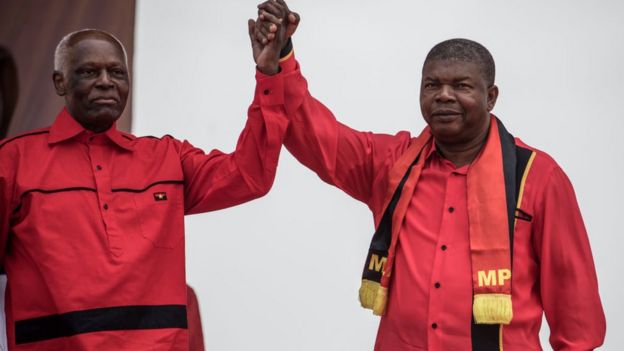 Ex-President Jose Eduardo dos Santos (l) assumed Joao Lourenço (r) would not rock the boat.
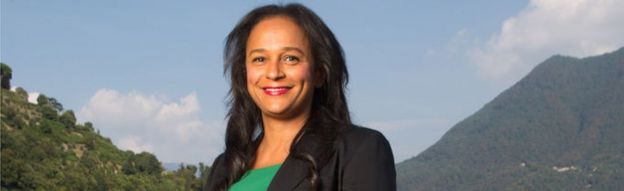
That was followed, this week, by an announcement that an international arrest warrant would be issued if she did not return home to answer formal accusations of embezzlement.
Ms Dos Santos has called allegations revealed by leaked documents entirely false and said that the Angolan government was engaged in a politically motivated witch-hunt.
In a statement she said that they showed they were part of a "very concentrated, orchestrated and well-co-ordinated political attack, ahead of elections in Angola next year".
Ex-President Jose Eduardo dos Santos (l) assumed Joao Lourenço (r) would not rock the boat.
That was followed, this week, by an announcement that an international arrest warrant would be issued if she did not return home to answer formal accusations of embezzlement.
Ms Dos Santos has called allegations revealed by leaked documents entirely false and said that the Angolan government was engaged in a politically motivated witch-hunt.
In a statement she said that they showed they were part of a "very concentrated, orchestrated and well-co-ordinated political attack, ahead of elections in Angola next year".

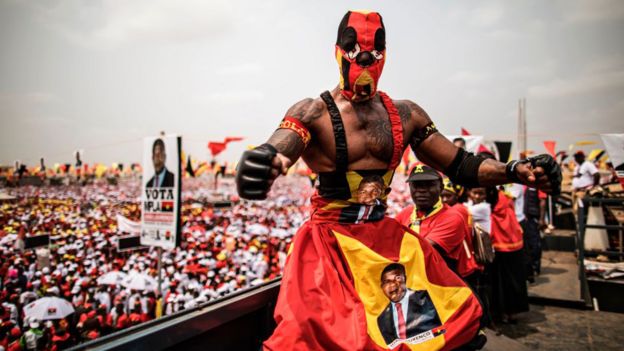 President Lourenço got more than 60% of the vote in 2017.
The general assumption is that the MPLA - worn-out but still dominant, much like the ANC in South Africa - will retain control of Angola for some years to come by fair means or foul.
But JLo, like South Africa's new President Cyril Ramaphosa, is quickly learning how hard it is to rebuild a brittle, fragmented party from within, and to make any serious headway against corruption when so many key state institutions are rotten to the core.
President Lourenço got more than 60% of the vote in 2017.
The general assumption is that the MPLA - worn-out but still dominant, much like the ANC in South Africa - will retain control of Angola for some years to come by fair means or foul.
But JLo, like South Africa's new President Cyril Ramaphosa, is quickly learning how hard it is to rebuild a brittle, fragmented party from within, and to make any serious headway against corruption when so many key state institutions are rotten to the core.
First families fall out
Instead, in office, President Lourenço, 65, has turned out to be - or at least aspires to be - more of a "Gorbachev" figure, throwing caution and precedent to the wind, dragging Angola out of its sluggish, authoritarian past and leading it towards a future that suddenly looks both exciting and precarious. "He's a bulldozer. Nothing he does is discreet. He goes for the jugular," political analyst and Angola expert Paula Roque told the BBC. The first, and most prominent, target of that bulldozing instinct has been the Dos Santos family. Much to the surprise and delight of many Angolans, who had grown tired of watching the former president's family grow staggeringly wealthy, at least in part from government contracts, and who had long feared the prospect of a Dos Santos political dynasty, President Lourenço - or JLo, as he's known to all Angolans - moved fast and aggressively against the former "first family". Isabel dos Santos was brusquely removed from her job running the giant state oil company, Sonangol. Her half-brother received similar treatment at the state's sovereign wealth fund, and soon afterwards found himself in custody and is now on trial for allegedly trying to smuggle some $500m (£380m) out of the country. Jose Filomeno dos Santos has denied wrongdoing. "It feels personal. There is a genuine animus between the two families," said Ms Roque, of JLo's actions. Then came a series of even more dramatic steps, as Ms Dos Santos' business assets in Angola were frozen by a local court, financial documents from within her empire were leaked to investigative journalists, leading to fresh allegations of corruption and damning global headlines.
Ex-President Jose Eduardo dos Santos (l) assumed Joao Lourenço (r) would not rock the boat.
That was followed, this week, by an announcement that an international arrest warrant would be issued if she did not return home to answer formal accusations of embezzlement.
Ms Dos Santos has called allegations revealed by leaked documents entirely false and said that the Angolan government was engaged in a politically motivated witch-hunt.
In a statement she said that they showed they were part of a "very concentrated, orchestrated and well-co-ordinated political attack, ahead of elections in Angola next year".
Who is Isabel dos Santos?
- Eldest daughter of ex-President Jose Eduardo dos Santos
- Married to Congolese art collector and businessman Sindika Dokolo
- Educated in the UK, where she currently lives
- Reported to be Africa's richest woman, with a fortune of some $2bn
- Has stakes in oil and mobile phone companies and banks, mostly in Angola and Portugal
Who is Joao Lourenço?
- Active in MPLA struggle against Portuguese colonial rule as a teenager
- Part of first group of guerrillas to enter Angolan territory from Congo-Brazzaville
- Received military training and studied history from 1978 to 1982 in the former Soviet Union
- General in the Angolan Armed Forces in post-independence civil war
- Said to be one of the few Angolan generals and politicians free of allegations of involvement in major corruption scandals
President Lourenço got more than 60% of the vote in 2017.
The general assumption is that the MPLA - worn-out but still dominant, much like the ANC in South Africa - will retain control of Angola for some years to come by fair means or foul.
But JLo, like South Africa's new President Cyril Ramaphosa, is quickly learning how hard it is to rebuild a brittle, fragmented party from within, and to make any serious headway against corruption when so many key state institutions are rotten to the core.
'Like a tango in the dark'
In this context, the fate of Ms dos Santos and her business empire (so important to the Angolan economy) could still be settled by negotiations, behind the scenes. "It's hard to say if this is the endgame. The relationship between the Dos Santos family and JLo is very complicated. It's like a tango in the dark," said Darias Jonker, from the Eurasia Group. "They do need each other to varying degrees and ways, but they're also in competition. They're frenemies - so to speak." There's no doubt that JLo - who once compared himself to China's reformist leader Deng Xiaoping - has allowed the winds of change to sweep through Angola. People are seizing the opportunity to speak out, without repercussion, and to challenge decades of repressive, inefficient rule and staggering inequality. But, as the Soviet leader Mikhail Gorbachev discovered to his own cost, truly radical reforms, like revolutions, tend to devour their own.DISCLAIMER: The Views, Comments, Opinions, Contributions and Statements made by Readers and Contributors on this platform do not necessarily represent the views or policy of Multimedia Group Limited.
DISCLAIMER: The Views, Comments, Opinions, Contributions and Statements made by Readers and Contributors on this platform do not necessarily represent the views or policy of Multimedia Group Limited.
Latest Stories
-
The Paradox of Plenty — When every smartphone becomes a newsroom
26 minutes -
GTA sensitises taxi drivers in ‘Know Ghana’ tourism campaign
2 hours -
Archbishop Agyinasare calls for responsible speech amid growing social media abuse
2 hours -
‘It will be inexcusable for gov’t not to honour payment of teachers’ arrears by 30th October’ – Haruna Iddrisu
2 hours -
Forbes’ World’s Best Employers 2026: No Ghanaian firm ranked among 900 companies
2 hours -
Electronic processing of teachers’ data: ‘The decision is the Controller’s’ – GES boss
2 hours -
Teachers’ Strike: Haruna Iddrisu questions paper-based processing of promoted teachers’ data
2 hours -
Savannah Region: Kunfusi bridge collapses again, leaving nearly 4,000 residents cut off
2 hours -
Teachers’ strike: GES targets Monday deadline to submit promotion data to Controller
2 hours -
Inflation to average 11.3% in 2027 – Fitch Solutions
3 hours -
‘I didn’t campaign for NDC to come and do this nonsense’ – Kpebu on EOCO’s conduct
3 hours -
Fitch Solutions maintains policy rate forecast of 14% by December 2026
3 hours -
Diaspora Nasara Caucus congratulates Mohammed Ali Suraj, new NPP executives
5 hours -
Dr Antwi-Boasiako’s cybersecurity book showcased at UN crime prevention congress
5 hours -
We will empower the grassroots and protect every vote – NPP’s 1st Vice Chair Kojo Bamba
5 hours