

Audio By Carbonatix
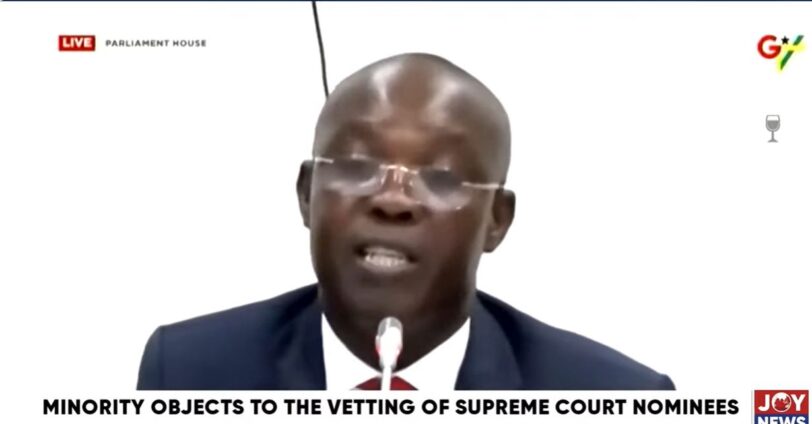
Chairman of Parliament’s Appointments Committee, Bernard Ahiafor, has dismissed the Minority’s objection to the vetting of three Supreme Court nominees, insisting that the process is firmly grounded in Parliament’s decision to recall the House.
His comments come after Minority Leader Alexander Afenyo-Markin formally objected to the three-day timetable for vetting the nominees, arguing that the process had been rushed and did not allow adequate time for scrutiny.
Mr Ahiafor said the President’s request for Parliament to be recalled specifically included the three nominations for appointment to the Supreme Court, alongside two ministerial nominations and the Banks and Special Deposits Institution Act Amendment Bill, 2026.
He said the House was therefore mandated to deal with all the matters contained in the President’s request.
“Clearly, the request was not only limited to the referral of the nomination of two ministerial nominees, vetting and consideration by Parliament. It includes the referral of the three judges’ nominees, referral and vetting by the committee,” he said.
According to him, the committee had already considered the Minority’s concern during a preliminary meeting held on Wednesday.
He said one of the issues raised was that the Supreme Court nominees had not been published, unlike the usual process that allows members of the public to submit memoranda on nominees.
However, the committee concluded that the referral from Parliament covered all three Supreme Court nominees and that it could not selectively vet the ministerial nominees while excluding the judicial nominees.
“The committee resolved that the referral includes the three judges’ nominees. We cannot therefore discriminate in favour of our colleague nominees and against the three judges’ nominees. Therefore, we must take the decision to vet all of them together,” Mr Ahiafor stated.
He further pointed to the decision of the House to suspend aspects of its Standing Orders to facilitate the urgent consideration of the matters for which Parliament was recalled.
Mr Ahiafor cited the Business Statement presented to Parliament on Monday, which included a request for the House to invoke Standing Order 3 to suspend Standing Order 217 and pave the way for the urgent consideration of the President’s request.
He argued that once Parliament adopted the Business Committee’s report containing the request for the waiver, there was no need for a separate motion to suspend the relevant Standing Order.
The Chairman’s defence follows the Minority’s insistence that the absence of a vacancy on the Supreme Court removes any urgency that could justify compressing the vetting process.
The Minority has also argued that Supreme Court nominees have traditionally been given adequate notice and that the committee requires sufficient time to examine their records, judgments and other relevant documents before making a recommendation.
The dispute has consequently set the Majority and Minority against each other over whether the circumstances surrounding Parliament’s current recall justify an accelerated vetting process.
Latest Stories
-
Eurobond repayment: Ghana faces US$6.4bn repayment burden between 2027 and 2030 – World Bank
13 minutes -
Government to add 100 new ambulances to national fleet in 2027
27 minutes -
Ex-Spurs player Vega set to run for FIFA president
48 minutes -
Arteta signs new contract with champions Arsenal
58 minutes -
Former Man City player Silva comes out of retirement
1 hour -
‘I have a screen in my office’ – Akandoh on real-time emergency bed tracking
1 hour -
Government begins pilot of national emergency bed management system
2 hours -
GRA forms 9-member committee to probe alleged missing containers at Tema Port
2 hours -
Foreign Minister inspects VFS Global Visa Centre, highlights commitment to service quality standards
2 hours -
Declan Rice close to agreeing new Arsenal deal
2 hours -
‘Draining’ few days for Gauff after online racist abuse
3 hours -
Media worker, journalist remanded over alleged GH¢800,000 fraud
3 hours -
PAC sends Ghana Water hearing back, demands Minister and MD appear over financial status
3 hours -
Foreign Affairs Minister inspects 20+ visa centres, demands better conditions for Ghanaian applicants
3 hours -
Guardiola set to attend Man City v PSG next week
3 hours