

Audio By Carbonatix
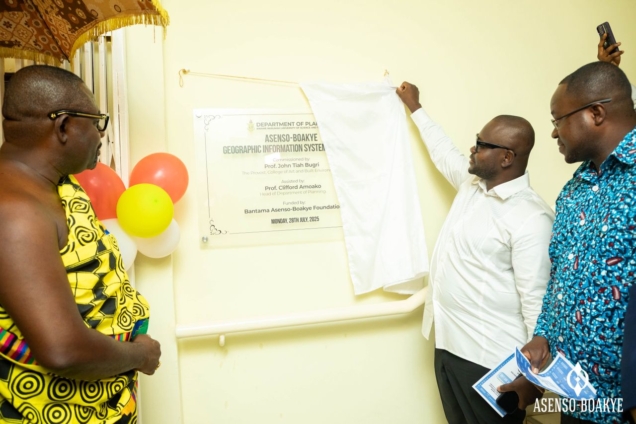
Bantama MP Francis Asenso-Boakye has commissioned a fully equipped Geographic Information Systems (GIS) Laboratory at the Department of Planning, Kwame Nkrumah University of Science and Technology (KNUST).
The facility, funded by the Bantama Asenso-Boakye Foundation, is expected to significantly enhance the practical training of planning students and support data-driven urban development across Ghana.
Speaking at the commissioning ceremony held at the forecourt of the Department of Planning, the former Deputy Roads and Highways Minister, an alumnus of the Department, described the occasion as a “deeply special homecoming.”
“It is with great joy and deep humility that I return once again to my academic roots, and more specifically to the Department of Planning, where my professional training began nearly three decades ago,” he stated.
Reflecting on his student years, during which he served as Financial Secretary of the Association of Student Planners and later as President of the Student Society of the then Faculty of Environmental and Development Studies, he added:
“Those experiences gave me a firm foundation in service, teamwork, and leadership — values that have shaped my path in public life to this day.”
He went on to acknowledge the invaluable mentorship he received from Professor Emeritus Kwasi Kwafo Adarkwa, former Vice Chancellor of the university, noting the privilege of having served as his research assistant — a role that quietly shaped the course of his professional journey
Mr. Asenso-Boakye emphasised the transformative role of Geographic Information Systems (GIS) in modern planning and explained the motivation behind his Foundation’s support for the initiative.
“In today’s world, planners must be equipped not just with theoretical knowledge, but with tools to collect, analyse, and visualise spatial data to inform better decision-making.
"GIS empowers planners to see beyond the map, think spatially, act strategically, and plan sustainably,” he said.
He also announced plans to establish a Research Hub for Planning, Housing, and Infrastructure Development in collaboration with the Department.
The proposed hub, he explained, would serve as a multidisciplinary platform to promote policy-relevant research, data analysis, and hands-on training, bridging the gap between academic study and real-world planning challenges.
“Once launched, this hub will provide a space for deep inquiry, experimentation, and applied learning that connects academia with the practical needs of society.
"It will also foster partnerships with government institutions, private sector actors, and international development agencies,” he noted.
Professor Christian Koranteng, Dean of the Faculty of Built Environment, who represented the Provost of the College of Art and Built Environment, commended Mr. Asenso-Boakye for his exceptional vision and commitment to higher education and national development.
In his remarks, he emphasised that academic theory alone is not sufficient in today’s planning environment:
“Theoretical knowledge alone is not enough to be a master of any field. This lab provides the missing link — the opportunity for our students to apply what they learn in real, practical contexts.”
Prof. Koranteng also expressed heartfelt appreciation to the Member of Parliament, describing him as a product of the university who continues to pour back into its growth:
“You are the seed that fell on good soil. We are deeply grateful for this kind gesture.”
Professor Clifford Amoako, Head of the Department of Planning, also expressed appreciation to his longtime friend from the same department:
“This is a powerful reminder that when alumni remain connected and committed, the impact extends far beyond classrooms. We are deeply grateful to Mr. Asenso-Boakye for his unwavering commitment and dedication to the school.
The Dean went further to make a passionate appeal to other alumni:
“We urge all past students of this great Department to follow this example — to come back to their roots and support the next generation. The challenges in planning and development today demand not just institutional commitment, but collective alumni responsibility.
In his concluding remarks, Mr. Asenso-Boakye called for collective support and action.
“The challenges facing our nation from housing deficits and unplanned urbanisation to climate change and youth unemployment — require knowledge, innovation, and collaboration,” he said.
“I urge alumni, institutions, citizens, and development partners to support KNUST as it continues to fulfil its mandate of advancing knowledge, shaping future leaders, and contributing to Ghana’s transformation.”
The ceremony was attended by distinguished faculty, alumni, the Kumasi Major, Members of Parliament from the Kumasi bloc, students, and guests.
It concluded with a tour of the laboratory, which was widely praised as a significant step towards advancing planning education and capacity in Ghana.
Latest Stories
-
At least 30 feared dead in crush at Haitian tourist site
1 hour -
Four arrested over murder of Scottish businessman in Kenya
1 hour -
New Mainoo deal closer, says Man Utd boss Carrick
1 hour -
Sinner beats Alcaraz to return to world top spot
2 hours -
An inappropriate joke nearly ended his career. Now he’s back with more humour
2 hours -
GPL 2025/26: Dreams FC stage stunning comeback to hammer Eleven Wonders
3 hours -
Livestream: The Probe examines Kumasi’s looming water crisis
3 hours -
MTN Ghana gears up to lead Africa’s AI revolution
3 hours -
Philanthropist Alhaji FuZak donates Da’wah bus to Ambariya Sunni community
3 hours -
GUTA calls for suspension of Publican AI system over trade disruptions
3 hours -
TTAG raises alarm over proposed recruitment of 7,000 teachers, demands national posting roadmap
4 hours -
Civilians feared killed after reports of air strike on Nigerian market
4 hours -
Bishop Simon Kofi Appiah installed as new Jasikan Diocese Bishop
4 hours -
Trump’s Strait of Hormuz blockade threat raises risks and leaves predicaments unchanged
4 hours -
US Court backs extradition of former MASLOC CEO Sedina Tamakloe-Attionu to Ghana
4 hours