

Audio By Carbonatix
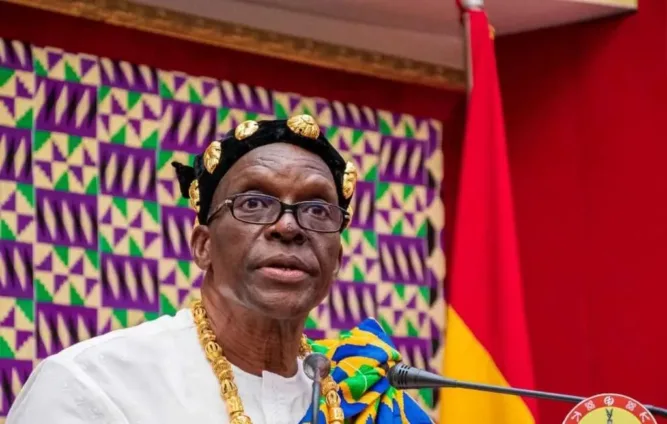
The Speaker of Parliament, Alban Sumana Kingsford Bagbin, has emphasised the need for significant constitutional amendments to integrate traditional and religious leaders into the framework of Parliament.
He believes such measures would not only foster a more unified national identity but also curtail the increasing partisanship that has characterised the legislative body.
Mr. Bagbin made this compelling case during the National Development Conference hosted by the Church of Pentecost, where he delivered the keynote address to a broad audience comprising government officials, religious leaders, traditional authorities, and other notable participants in national development.
"This reform would make Parliament a more nationalistic institution and help reduce the growing partisan nature of the House by promoting broader national representation," he asserted.
In his address, the Speaker also called on traditional and religious leaders to take up the mantle of nurturing and sponsoring individuals of high integrity. He underscored the critical role these leaders play in fortifying ethical leadership and furthering national progress.
The National Development Conference, an annual event, serves as a platform for deliberating crucial issues related to governance and development efforts in the country. It attracts a diverse audience committed to the advancement of Ghana's socio-economic landscape.
Adding to the call for reform, Odeefuo Amoakwa Buadu VIII, the President of the National House of Chiefs and the Paramount Chief of Breman Asikuma, stressed the importance of better recognising and empowering the Chieftaincy Ministry. He advocated for its strengthening in accordance with constitutional provisions.
“Our traditional systems must be upheld and enhanced, as they are crucial for the harmonious governance of our people,” he remarked, echoing the sentiments of Mr. Bagbin for a collaborative effort in addressing governance challenges.
With voices from both political and traditional landscapes calling for inclusive reforms, the discourse surrounding the role of traditional and religious leaders in governance is gaining momentum, marking an urgent step towards a more representative parliamentary system.
Latest Stories
-
Nigeria’s Ben Dancer completes 168-hour dance marathon, awaits Guinness verdict
26 minutes -
I’m now a minister of God – Actress Jumoke Odetola announces
35 minutes -
Banks accounted for 86% total enquiries for credit in 2025
37 minutes -
‘I paused for my mom’ – Kizz Daniel opens up on music break
40 minutes -
Habib Iddrisu rejects argument that court cases bar Parliament from investigating drug scandal
48 minutes -
Over 25m enquiries conducted by financial institutions for credit appraisals, others in 2025
53 minutes -
Venezuelan man shot by ICE in Texas is charged with assault
1 hour -
Eiffel Tower chief to quit after female staff replaced by men during religious visit
1 hour -
South Africa to clean up high-risk areas after 12 women killed
1 hour -
Kpandai case sets the precedent – Habib Iddrisu challenges Speaker’s rejection of drug probe
2 hours -
Habib Iddrisu questions Speaker Bagbin’s rejection of motion after Parliament recall
2 hours -
More than 400 detained as France student protests escalate
2 hours -
China adds 55% tariff to Brazil beef imports
3 hours -
Ballon d’Or Power Rankings: Lamine Yamal leads race for Golden Ball ahead of Rodri and Kane
3 hours -
‘Nothing worked for us’ – Gideon Mensah takes responsibility for Gambia defeat
4 hours