

Audio By Carbonatix
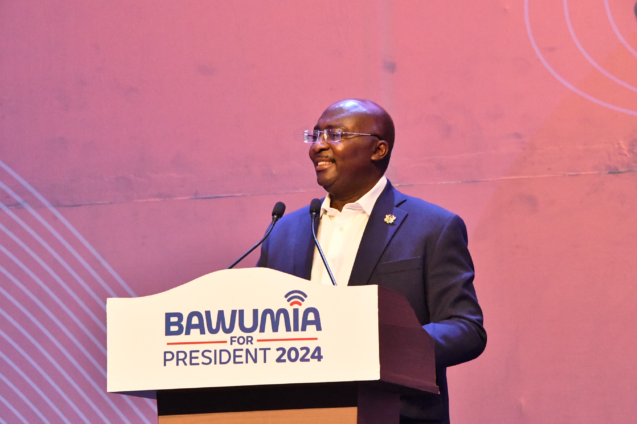
Flagbearer of the governing New Patriotic Party (NPP), Dr. Mahamudu Bawumia has described the Pwalugu Multi-purpose Dam in the Upper East Region as a priority project and must be constructed.
He admits the government’s inability to construct the project despite the cutting of sod in 2019 with close to one billion cedis funding and expected to be executed by China Power, operators of Sinohydro.
Although the necessary processes have been advanced for the project's construction, the actual construction is yet to begin.
Addressing the clergy in his ongoing campaign tour of the Upper East Region, Dr. Mahamudu Bawumia assured that his government will complete the project to assuage the perennial flooding from the spillage of the Bagre Dam in Burkina Faso.
“My priority is going to be agriculture, agriculture in large scale commercial agriculture, mechanised agriculture with the application of technology. This is what has been lacking.
“We have the land, we have the water and so we need to move into large scale commercial production, mechanised, with technology that we are going to use to help our farmers access credit and with irrigation.
“I do not doubt in my mind that I was championing the Pwalugu dam. We have not yet been able to do it. But by the grace of God, I believe we are going to do the Pwalugu dam.
“It has to be done. It'is a major priority because that can bring 28,000 hectares into cultivation and I want to see, and of course, it's also going to generate electricity and stop the flooding that we are seeing usually when the Bagre dam is opened across our country. So I want to really focus on agriculture to reduce food prices along the White Volta, we can do a lot and the North, in particular, has vast amounts of land.”
Dr. Bawumia also addressed the power situation in the country and outlined his plans to solve it.
“The next major objective for me is to bring down the cost of power, electricity and how am I going to do it? I want to do it by shifting Ghana away from fuel-generated power to solar-generated power.
“I want us to move away from fuel to solar. Solar is given to us by God for free, for free. If we have to buy fuel we need foreign exchange, and then we have to import it, but solar we can harness it and generate power.
“So I want us to bring in 2,000 megawatts in the first four years which is about half our consumption, 2,000 megawatts in the first four years and we can reduce the cost of power by at least 50%, if we move in this direction, and that is where I want us to focus on.
“I want us, when we move into solar, not just to be doing solar and be satisfied with it, I want Ghana to start manufacturing solar panels as well...” he added.
Latest Stories
-
SSNIT intensifies informal sector enrolment drive with Techiman float
30 minutes -
Ghana seeks long-term mining investments that benefit local communities – Armah-Kofi Buah
37 minutes -
GHATOF demands compensation for 85 businesses affected by La Pleasure Beach demolition
42 minutes -
Bono Regional Minister calls for investor education to drive economic growth
46 minutes -
Ghana’s Ambassador to China, Kojo Bonsu, presents credentials to Nepalese President
49 minutes -
Fairtrade Africa’s Cocoa Hubs Project strengthens rural service centres in cocoa-growing communities
55 minutes -
MPs are not development officers – Edem Kpotosu
55 minutes -
SEC cautions investors against fraudulent investment schemes
56 minutes -
Land Ministry urges rCOMSDEP operators to reserve earnings for land reclamation
59 minutes -
Commercial drivers give authorities one week to clear traders from lorry terminals, bus stops
1 hour -
Trump calls off livestream of Fort Hood attacker’s execution by firing squad
1 hour -
Nana B denies claims that Kojo Bamba was his driver and bodyguard
2 hours -
Engage Now Africa to construct a 10-unit classroom block for struggling Navrongo Vocational Training Centre
2 hours -
One digital financial breach could expose linked accounts to fraud – Financial Crimes Manager
2 hours -
Ghana Russia Centre signs ICT cooperation agreement with Moscow University
2 hours