

Audio By Carbonatix
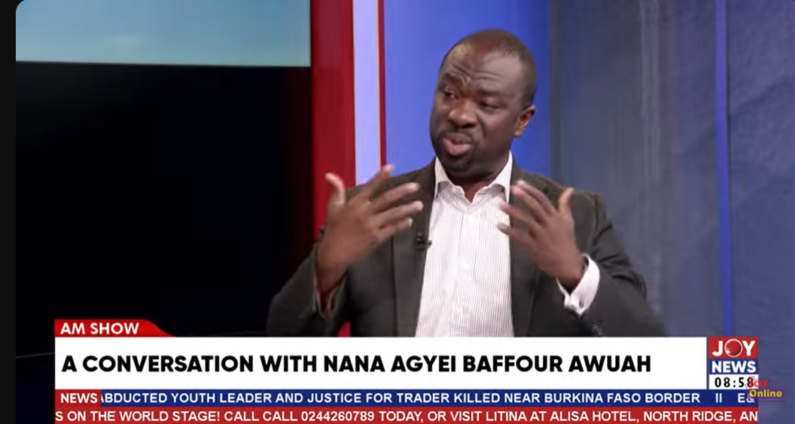
The Member of Parliament for Manhyia South, Nana Agyei Baffour Awuah, has cautioned that the government’s flagship infrastructure programme, the “Big Push," will not be enough to solve Ghana’s growing unemployment problem, particularly among university graduates.
Speaking on JoyNews AM on Monday, 16 March, the legislator, who also serves as vice chairman of the Subsidiary Legislative Committee of Parliament, said while the initiative may create some employment, it is unlikely to provide the scale or type of jobs needed to address the country’s rising youth unemployment.
“I understand and appreciate the President’s efforts, for instance, in the construction industry, what he calls the Big Push,” he said. “But the Big Push will not be sufficient to guarantee Ghanaian youth, particularly our university graduates, jobs.”
According to him, the programme is more likely to generate labour-intensive roles rather than long-term professional opportunities for the thousands of graduates entering the labour market each year.
Rising unemployment challenge
Mr Baffour Awuah noted that Ghana’s unemployment challenge continues to deepen as more young people graduate from universities annually without corresponding growth in job opportunities.
“I’ll be happy to have a more transparent procedure where every Ghanaian youth who applies is recruited on a merit-based system,” he said.
However, he stressed that such measures alone would not solve the broader structural challenge facing the economy.
“If you don’t solve the bigger problem, we have 500,000 Ghanaian youth today. Let’s say you have one million Ghanaian youth looking for work. Subtract 5,500 from 500,000, and you realise we are not solving our basic unemployment issues,” he explained.
He said the real sectors of the economy are currently unable to absorb the growing number of job seekers.
Decline of job-absorbing sectors
The Manhyia South MP pointed out that in previous years, sectors such as finance and telecommunications played a key role in absorbing graduates and reducing unemployment.
“Previously, we had a very vibrant financial sector, which was absorbing some of them. We also had a vibrant telecommunications sector which was employing many of these young people,” he said.
However, he argued that those sectors have slowed in their ability to create new jobs, making it necessary for the government to identify and develop new engines of growth.
“We need to find ways to grow the economy of this country such that it will create real jobs, sustainable jobs, and more secure jobs for the Ghanaian youth. Otherwise, we are going to be in crisis,” he warned.
Need for new economic cycle
Mr Baffour Awuah also explained that economies naturally move through cycles, and Ghana must adopt deliberate policies to revitalise sectors once their growth momentum declines.
“Every country has an economic cycle,” he said. “After a while, about 10 or 20 years maximum, there is likely to be a burst, and governments need to think about how to activate the economy again, and that is what we have failed as a country.”
He recalled that during the administration of former President John Agyekum Kufuor, Ghana experienced rapid expansion in the financial sector.
“At the time, we did not have as many banks as we later came to have. We did not have as many savings and loans companies or microfinance institutions as we later saw,” he said.
According to him, that growth phase eventually came to an end, highlighting the need for the country to identify new sectors capable of driving employment.
“That cycle has ended. We need to do something new,” he added.
Government must create opportunities
While acknowledging ongoing government efforts, Mr Baffour Awuah said authorities must think more creatively about job creation.
“We need to think outside the box. Government must, as a matter of necessity, use its budget to create opportunities for the Ghanaian youth,” he said.
He emphasised that the state’s role should largely be to create the right economic environment for private sector growth.
“I envisage government creating the necessary atmosphere and environment for the private sector to create the jobs,” he stated.
Political and economic implications
Mr Baffour Awuah also warned that failure to deliver jobs could have political consequences, pointing to growing frustration among some supporters of the opposition National Democratic Congress (NDC), who he said feel disappointed about employment opportunities.
“Today, some NDC supporters are complaining because they are not getting the jobs that they were promised,” he said.
He added that such frustrations could eventually translate into political apathy if expectations continue to go unmet.
Economic management under pressure
Despite acknowledging signs of improvement in Ghana’s economic management, the MP cautioned that the country remains vulnerable to global developments.
“In terms of the management of the economy, on paper it is beginning to look good,” he said.
“But when you are a government in the Republic of Ghana, it is not a job that should be attended to with fanfare. You need to get down and work because there are a lot of crises.”
He stressed that the real test of economic policy lies not in macroeconomic indicators alone, but in whether ordinary citizens are able to find work.
“It’s not just the books looking good,” he said. “It’s the Ghanaian youth looking for a job.”
Latest Stories
-
A source of excellence across generations – Vice President Opoku-Agyemang lauds Mfantsipim
35 minutes -
(Photos) Mfantsipim School launches historic 150th anniversary
58 minutes -
Knights and Ladies of Marshall group backs Catholic Bishops’ stance on anti-LGBTQ+
2 hours -
Bright Simons writes: All the Filla in the Ibrahim Mahama/E&P – Gold Fields Saga
2 hours -
Monetise Idiocy In Ghana
2 hours -
The Ghanaian prophet and the mysterious death of his scottish wife Charmain Speirs
3 hours -
Nearly 400 sentenced in Nigeria for links to militant Islamists
4 hours -
Ghana’s recovery supported by gold strength despite global oil price pressures – Standard Bank Research
4 hours -
Methodist Church hails Mfantsipim@150; calls for “fresh consecration” to excellence
4 hours -
‘Excellence is our inheritance’ – Nana Sam Brew-Butler hails Mfantsipim’s 150-year reign in leadership
4 hours -
Kwaku Azar writes: A-G vs OSP
4 hours -
Mfantsipim–Adisadel rivalry built excellence, not division – Sam Jonah
5 hours -
Vice President launches Mfantsipim’s 150 years of shaping Ghana’s greatest mind
5 hours -
I assure Otumfuo, Mahama will join him to commission KNUST Teaching Hospital by end of this year – Haruna Iddrisu
6 hours -
Barcelona dominate derby to extend La Liga lead
6 hours