

Audio By Carbonatix
A blind man has had his vision partially restored using optogenetic therapy and engineered goggles -- the first successful case of such therapy in humans.
Researchers treated a 58-year-old man who for 40 years had been suffering from retinitis pigmentosa -- a neurodegenerative eye disease where loss of photoreceptors can lead to complete blindness.
Retinitis pigmentosa changes how the retina responds to light, making it hard to see, and people with the condition lose their vision slowly over time, according to the American Academy of Ophthalmology.
Scientists used a form of gene therapy to reprogram cells in the eye's retina, injecting it with a viral vector and making it light sensitive. "In optogenetic therapy... we create an artificial photosensitive layer in this blind retina," researcher Botond Roska, professor in the faculty of science at the University of Basel, explained at a press briefing.
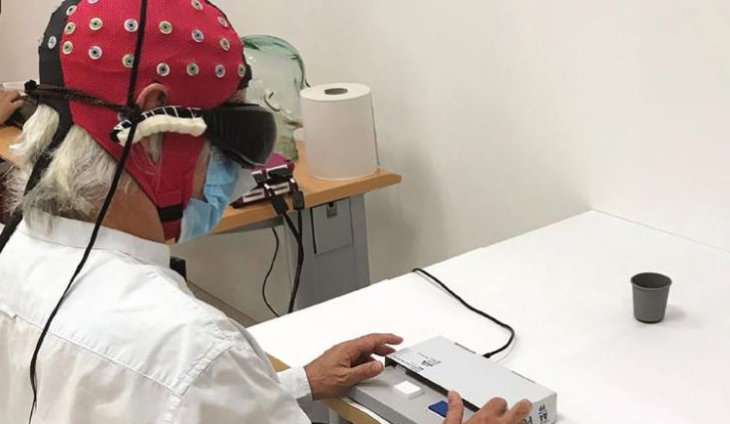
Months after the injection, researchers equipped the patient with engineered goggles which detected changes in light intensity, and would project corresponding light pulses onto the eye's retina to activate the treated cells.
Although the patient couldn't recognize faces or read following the treatment, he was able to perceive, locate, count and touch objects using his treated eye alone while wearing the goggles, researchers said in a study published Monday in the journal Nature Medicine.
Before the treatment, the patient couldn't see anything using the goggles. But months after the injection, the man could see the white stripes on a pedestrian crossing, detect objects including a plate, mug or phone and identify furniture in a room or a door in a corridor when using the goggles.
"Initially the patient couldn't see anything with the system, obviously this must have been quite frustrating. And then spontaneously he started to be very excited, reporting that he could see the white stripes across the street," José-Alain Sahel, professor of ophthalmology at the University of Pittsburgh School of Medicine and the Vision Institute in Paris, said at the press briefing.
Scientists also checked that the visual behavior was corresponding with the man's brain activity. The man was the first patient in the first cohort of the study who managed to be properly trained before the coronavirus pandemic disrupted the research.
' A significant milestone'
"Retinitis pigmentosa is one of the most common causes of blindness in young people and results from the loss of the light-sensing photoreceptor cells in the retina at the back of the eye," Robert MacLaren, a professor of ophthalmology at the University of Oxford, told the Science Media Centre in London.
"In this trial the researchers used gene therapy to reprogram other cells in the retina to make them light sensitive and thereby restore some degree of vision. This is a significant milestone and undoubtedly further refinements will make optogenetic therapy a viable option for many patients in future," MacLaren, who was not associated with the study, added.
James Bainbridge, professor of retinal studies at University College London, said that the technology "might help people whose eyesight is very severely impaired."
"It is a high quality study. It is carefully conducted and controlled. The findings are based on laboratory tests in just one individual. Further work will be needed to find out if the technology can be expected to provide useful vision," Bainbridge, who was not involved in the research, told the Science Media Centre.
Latest Stories
-
Photos: Housing solutions take centre stage at Day 2 of the 3rd Republic Bank-JoyNews Habitat Fair
17 minutes -
Video: Immunity should be exercised without creating classism – Inusah Fuseini on cocaine bust
50 minutes -
Ghana Air Force passes out 293 recruits after six months of intensive training
58 minutes -
EOCO vrs Baffour Awuah: EOCO should have secured warrant before arrest attempt at court – Inusah Fuseini
1 hour -
Triple fibre cuts disrupt telecom services across Northern, Oti regions – Sam George
1 hour -
Politicisation could undermine parliamentary probe into cocaine seizures – Dr Osae-Kwapong
1 hour -
EOCO chases MP: Can Section 41 cure lacuna in EOCO Act? – Inusah Fuseini asks
1 hour -
GNFS, GWL inspect fire hydrants in Ministries enclave; 23 found faulty
1 hour -
Gov’t directs release of 50,000 bags of grain to ECOWAS
1 hour -
Ghana, Germany deepen cooperation on railways, labour mobility
1 hour -
Huge crowds greet Pope in Paris for open-air Mass
2 hours -
‘I never said I’ll declare a state of emergency’ – President Mahama on galamsey
2 hours -
Bobby Banson condemns EOCO’s attempted arrest of Nana Agyei Baffour Awuah
3 hours -
When Kumasi begins to look like somebody is in charge
3 hours -
Parliamentary probe into cocaine seizure would be a waste of time – Inusah Fuseini
3 hours