

Audio By Carbonatix
Ghana’s Constitution Review Committee (CRC) has proposed far-reaching amendments to the 1992 Constitution, recommending a fundamental shift from what it describes as “electoral democracy” to a more development-driven, accountable and people-centred system of governance.
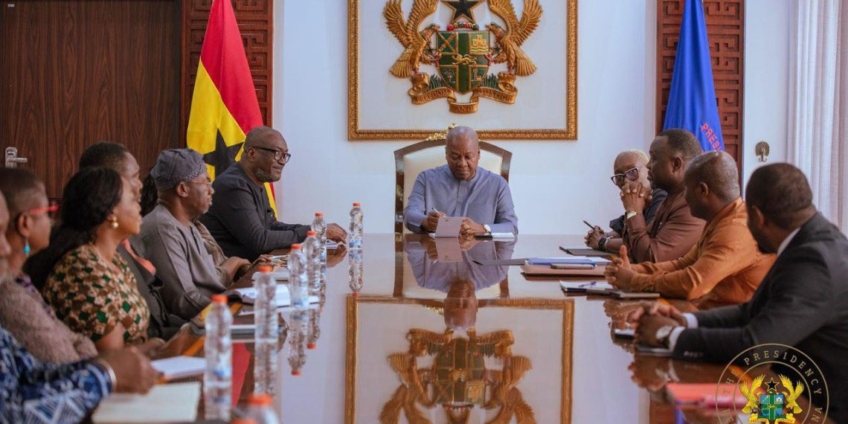
Presenting its final report, “Transforming Ghana: From Electoral Democracy to Developmental Democracy,” to President John Dramani Mahama, the eight-member committee, chaired by Professor H. Kwasi Prempeh, outlined reforms cutting across the Executive, Legislature, Judiciary, public service, decentralisation, human rights, public finance and national security
A refocused Presidency
On the Executive, the committee recommends retaining the two-term limit for presidents but extending each term from four to five years, lowering the minimum presidential age from 40 to 30, and subjecting presidential salaries and benefits to taxation. It proposes stripping Members of Parliament of eligibility for ministerial appointments, capping the total number of ministers at 57, and tightening rules on appointments, censure, succession and the exercise of power during post-election transition periods.
Stronger Parliament, cleaner politics
To deepen representative democracy, the CRC proposes capping Parliament at 276 members, strengthening constituency engagement, tightening conflict-of-interest rules and expanding space for private members’ bills. It calls for reforms in political party financing, internal party democracy, and the establishment of an independent regulator for political parties. The committee also urges a serious national study into adopting proportional representation to improve inclusion of women, youth and marginalised groups.
Independent electoral and governance bodies
The report recommends restructuring the Electoral Commission, National Commission for Civic Education and National Media Commission, with clearer appointment processes, security of tenure, improved funding and stronger regulatory mandates, while safeguarding media freedom.
Development planning and resource governance
At the heart of the report is a proposal to constitutionally anchor a long-term National Development Plan, aligned with annual budgets and overseen by a strengthened National Development Planning Commission. It recommends reforms to land administration, natural resource governance, mining revenue allocation to host communities, environmental protection — including recognition of ecocide — and the creation of new oversight bodies such as an Independent Fiscal Council and a Natural Resources Commission.
Public finance and state enterprises
The CRC proposes stricter controls on tax exemptions, public borrowing and debt, enhanced independence for the Central Bank and Government Statistician, and constitutional recognition of the State Interests and Governance Authority (SIGA) to improve corporate governance of state-owned enterprises, including merit-based appointments and fixed tenures for CEOs.
Rebuilding trust in accountability institutions
To restore public confidence, the committee recommends reform — not abolition — of the Council of State, sweeping judicial reforms covering appointments, tenure, removal and financial independence, and the creation of a new constitutional Anti-Corruption and Ethics Commission.
Professionalising the public service
The report calls for depoliticising the public service, strengthening the Public Services Commission, protecting public officers from political interference, enforcing asset declaration, addressing unexplained wealth and introducing clearer sanctions for misconduct.
Rights, inclusion and social justice
On human rights, the CRC proposes reforms on multiple citizenship, gender equality, disability rights, digital privacy, access to health, housing, food and education, legal aid, fair trial guarantees and the abolition of the death penalty. It also seeks to close discrimination gaps affecting women, Zongo communities and historically mobile groups.
Decentralisation and local development
Declaring that “all development is local,” the committee recommends the election of Metropolitan, Municipal and District Chief Executives, creation of an Independent Devolution Commission, fiscal decentralisation reforms, and clearer roles for traditional authorities while keeping chiefs out of active party politics.
Security sector reforms
The report proposes consolidating security services into a single constitutional framework, strengthening civilian oversight, clarifying the deployment of the armed forces for internal security, and reforming police and prisons governance structures.
A living constitution
Finally, the CRC urges reforms to make constitutional amendment more flexible, including provisions for popular initiative, to prevent constitutional obsolescence and keep the supreme law responsive to Ghana’s evolving needs.
Taken together, the recommendations amount to the most comprehensive blueprint for constitutional reform since 1992 — one that seeks to stabilise Ghana’s democracy, cut the cost of politics, strengthen accountability and re-engineer the state for long-term national development.
Latest Stories
-
Walter Mosley visits W.E.B. Du Bois Centre in Accra: A New York Secretary’s homecoming story on where Du Bois spent his final years.
1 hour -
MTN set to deploy 5G services after winning spectrum licenses worth US$202m
4 hours -
NPP national elections: 3,000–4,000 police to handle security, traffic in Kumasi – Karbo
6 hours -
Atta Akyea fumes as Manhyia MP is to spend another night in EOCO custody
6 hours -
SSNIT says La Beach clearance was to protect hotel investments, beaches to remain public
7 hours -
APSU congratulates St Augustine’s College after back-to-back National Investment Quiz wins
7 hours -
Renewed flood intervention at Mallam Junction raises hopes among residents, businesses
8 hours -
St Augustine’s College retain National Investment Quiz title after nail-biting grand finale
8 hours -
Education infrastructure investment will drive Banda’s development – Ahmed Ibrahim
8 hours -
Teacher unions strike: Gov’t presents fresh proposals as talks end inconclusively
9 hours -
51,000 teachers’ promotion arrears to be validated for October payment – Education Minister
9 hours -
Kwabena Boamah appointed Board Chair for Impact Investing Ghana
9 hours -
Striking teacher unions to meet Fair Wages and Salaries Commission on October 6
9 hours -
EOCO working with AG to arraign Nana Baffour Awuah before weekend court
10 hours -
Duraplast reassures customers after fire, announces October 5 reopening
10 hours