

Audio By Carbonatix
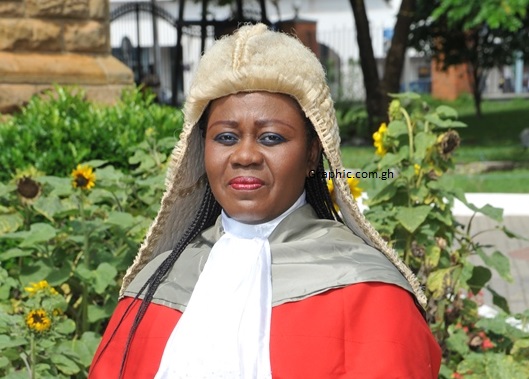
The unprecedented legal challenge launched by suspended Chief Justice Gertrude Torkornoo at the ECOWAS Court of Justice has ignited a debate about judicial accountability and the independence of the judiciary.
Her decision to seek redress at the regional court in Abuja, Nigeria, over her suspension and ongoing removal proceedings has drawn sharp criticism from legal experts and former public officials, who warn of potential implications for Ghana's constitutional order.
The development, confirmed by Deputy Attorney General Justice Srem-Sai, reveals that Chief Justice Torkornoo's filing at the ECOWAS Court alleges that her suspension and the efforts to remove her from office violate her fundamental human rights, specifically asserting that she was "removed from her official capacity without a final determination, impairing her right to function and serve in a position she was constitutionally [appointed to]."
Among the prominent critics is Inusah Fuseini, a former Member of Parliament for Tamale Central and a seasoned legal practitioner.
Speaking on "The Big Issue" on Channel One TV on Saturday, July 12, 2025, Mr. Fuseini minced no words, stating that the Chief Justice's actions raise profound concerns about judicial accountability.
"The Chief Justice has created the impression that she has the right not to be removed from office. She has created the impression that she has the right not to be held judicially accountable for her stewardship in the judicial service," Mr. Fuseini asserted, implying that such a move could set a dangerous precedent for judicial oversight.
Chief Justice Torkornoo's suspension by President John Dramani Mahama in April 2025 came under Article 146 of the 1992 Constitution, which outlines the procedure for the removal of Justices of the Superior Courts.
This action by the President followed the submission of three separate petitions seeking her removal, which were then referred to the Council of State.
The Council, after deliberation, determined a prima facie case, leading to the President's warrant of suspension and the establishment of a Committee of Inquiry to investigate the merits of the petitions.
This marks the first time in Ghana's 68-year history that a Chief Justice has faced removal proceedings, making the process highly scrutinized.
The Chief Justice has, however, challenged the legitimacy of her suspension and the constitutionality of the proceedings against her at various levels within Ghana's legal system, including cases before the Supreme Court and the High Court. On May 21, she filed an injunction application with the Accra Supreme Court against Justice Pwamang and the Committee of Inquiry, arguing her suspension was unconstitutional due to a lack of a valid prima facie determination.
While the Supreme Court dismissed her injunction application, it did so on grounds of admissibility, meaning the substantive case regarding the constitutionality of the process remains to be heard within Ghana's domestic courts.
Mr. Fuseini expressed significant concern about the implications of these multiple legal challenges, particularly now that they extend beyond Ghana’s jurisdiction to a regional court.
"She is telling the entire country — and even we lawyers are becoming more confused because of her actions,” he noted, highlighting the potential for jurisprudential chaos and public uncertainty regarding the judicial process.
Indeed, the ECOWAS Court of Justice, while having jurisdiction over human rights violations in member states, typically encourages the exhaustion of domestic remedies before its intervention.
Legal analysts widely suggest that the Chief Justice's substantive case still pending before Ghana's Supreme Court could lead to the ECOWAS Court dismissing her application on admissibility grounds, as she has not yet exhausted all avenues within the Ghanaian legal system.
Mr. Fuseini further warned that Chief Justice Torkornoo's continued resistance could politicise the judiciary, an institution meant to be above partisan fray, and erode public trust in the legal system.
Public confidence in Ghana's judiciary has been a recurring concern, with a 2021/23 Afrobarometer survey indicating that 62% of Ghanaians have little or no trust in the courts, a significant increase from 30% in 2005/6. Allegations of corruption and political influence, particularly in high-profile cases, have contributed to this decline.
"She has staged her actions in politics, which is clouding the law. So, I will advise that we stay the matter and wait for the ECOWAS court. It is an advisory court,” Mr. Fuseini concluded, suggesting a pause in the domestic proceedings while awaiting the ECOWAS Court's stance, though stressing the ECOWAS Court's advisory rather than definitive role in such internal constitutional matters. The unfolding saga is set to be a defining moment for judicial independence and accountability in Ghana.
Latest Stories
-
New health training facility at Ampoma-Jema to address admission shortfalls, but Minister flags missing amenities
6 minutes -
Black Challenge unveiled with sights set on Amputee World Cup glory
26 minutes -
Pay striking teachers before expressway spending, Dr Kingsley Agyemang tells government
1 hour -
Customs intercepts assault rifle, two pistols and 610 rounds of ammunition at Tema Port
1 hour -
PKO boxers secure wins at Odwira Festival
2 hours -
South Tongu Records Rise in Teenage Pregnancy
2 hours -
Cabinet threw out US health compact faster than anything I’ve seen – Mahama
2 hours -
MoFA urges Finance Ministry to reverse World Bank food programme withdrawal over GH¢643m commitments
2 hours -
NAGRAT demands signed timelines before calling off strike
2 hours -
National Investment Quiz: West Africa SHS, St. Louis SHS advance to semi-finals
3 hours -
Shatta Wale appeals to Mahama for balanced framework to tackle social media abuse without stifling free speech
3 hours -
Education Ministry urges data-driven talks to resolve teacher impasse
3 hours -
‘What we wanted was money to buy medications’ – Dr Nawaane on US health support
3 hours -
Osman Ayariga leads NDC team to vet constituency aspirants in Central Region
3 hours -
‘We shouldn’t allow their drugs in just because they’re giving us $100m’ – Dr Nawaane
3 hours