

Audio By Carbonatix
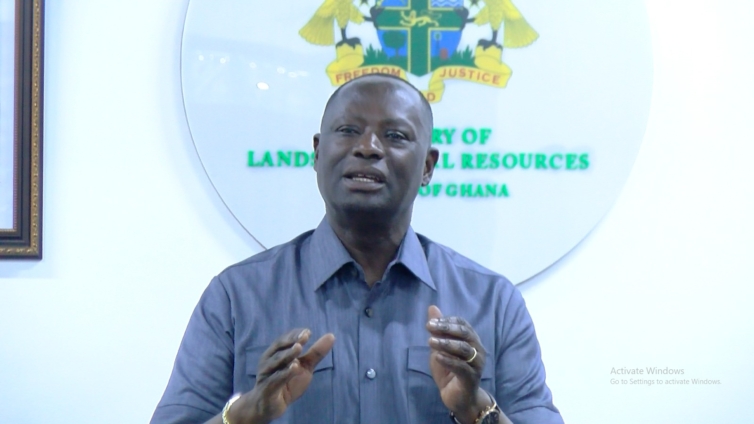
The Minister of Lands and Natural Resources, Hon. Emmanuel Armah Kofi Buah (MP), has announced a bold strategy to decentralise Ghana’s anti galamsey efforts by actively involving local chiefs and Municipal, Metropolitan and District Chief Executives (MMDCEs).
This initiative comes amid alarming reports that approximately 16% of Ghana’s forest reserves have been lost to illegal mining.
Addressing a workshop for newly appointed MMDCEs on Wednesday, 18 June 2025, Minister Buah stressed the need for a “bottom up” approach, with traditional leaders and district officials playing a direct role in issuing mining licences and enforcing local oversight.
“Chiefs and MMDCEs will play a crucial role in fighting galamsey,” the Minister declared. “The decentralised system will drive a bottom up approach to allow your involvement in the issuance of mining licences.”
This shift aligns with government priorities following President John Dramani Mahama’s January 2025 inauguration under the NDC, and complements wider measures such as the Blue Water and Blue River Guards, launched in March 2025 to protect rivers and water bodies.
According to the Minister, the government’s anti galamsey strategy includes five pillars:
- Reclaiming degraded mining areas
- Providing alternative livelihoods
- Strengthening law enforcement
- Reforming licensing regimes
- Enhancing stakeholder education and engagement
He urged the MMDCEs to “fully commit to the cause to halt the devastation of Ghana’s lands,” warning that “defaulters and connivers of illicit activities will face the full force of the law.”
However, civil society remains cautious. The Ghana Academic Professional Forum has labelled the current anti galamsey effort a "mirage" and merely cosmetic, urging a declaration of emergency in illegal mining zones.
While acknowledging Minister Buah’s initiatives, they argue that without genuine empowerment of traditional authorities and robust enforcement, progress may be superficial.
Academic critics, citing government statistics, note that 44% of forest reserves have been degraded and water turbidity levels are still dangerously high. They warn that unless deeper structural reforms are implemented rapidly, legal frameworks like L.I. 2462, which currently permit mining in forest reserves, could prolong environmental damage.
By embedding anti galamsey efforts into local structures and championing community custodianship, the government aims to preserve Ghana’s forests and rivers. But only time and sustained action, will reveal whether this is more than rhetoric, and whether chiefs and local authorities can effectively shield Ghana’s natural heritage.
Latest Stories
-
Drug fight will yield results as Mahama steps up action – Dzimega
7 minutes -
‘It’s bizarre’ – Freddie Blay questions EOCO’s handling of Baffour Awuah case
9 minutes -
NPP conference to reinforce support for Bawumia ahead of 2028 – Evans Nimako
18 minutes -
France and Ghana’s Gender Ministry explore cooperation on women’s economic empowerment
26 minutes -
Ghana’s growing drug trafficking links are deeply troubling – Victoria Bright
29 minutes -
‘The MP’s tears are crocodile tears’ – Kofi Bentil on La Pleasure Beach demolition
31 minutes -
Freddie Blay alleges Mahama ordered demolition of son’s Polo Beach Club at La Beach
42 minutes -
‘We’ve complied with all the rules’ – NPP assures transparency in national elections
53 minutes -
‘Who is financing all this?’ – Victoria Bright questions networks behind Ghana-linked drug trade
59 minutes -
If we don’t know Baffour Awuah’s charge, there’s a fishing expedition going on – Kofi Bentil
1 hour -
Parliament questions continued detention of Baffour Awuah by EOCO, demands due process
2 hours -
Baffour Awuah did not report to EOCO voluntarily; an arrest warrant forced him – Theophilius Dzimega
2 hours -
Baffour Awuah case risks looking like a display of state power – Sulemana Braimah
2 hours -
Campaign posters, billboards take over Kumasi as NPP goes to polls
2 hours -
‘I’ve been told I’m also involved’ – John Darko says he’ll cooperate with EOCO if invited over Baffour Awuah case
2 hours