

Audio By Carbonatix
Police in the Democratic Republic of Congo have clashed with opposition supporters demanding that last week's presidential poll be annulled.
Leading opposition candidates have denounced the election as a sham and have demanded a rerun.
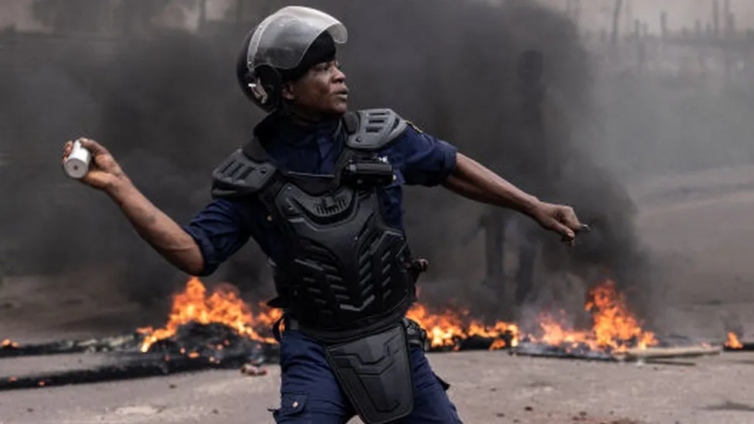
Several people were wounded as police fired tear gas and threw stones back at protesters in the capital, Kinshasa.
The government banned the protest, saying it would not tolerate attempts to undermine the electoral process.
Election officials have so far not said exactly how many polling stations opened or how many people voted in the 20 December election.
About 44 million people were registered to vote at about 75,000 polling stations.
With just over nine million ballots counted so far, President Felix Tshisekedi is in the lead with almost 80% of the vote as he seeks a second term.
Football tycoon and mining magnate Moïse Katumbi is trailing him with about 16%.
Former oil executive Martin Fayulu, who claims he was robbed of victory in the 2018 election, is in third place with about 4%.
Mr Fayulu's supporters burnt tyres and clashed with police outside his campaign headquarters in Kinshasa.
Police took up positions on key roads in the city and thwarted an attempted march to the headquarters of the electoral commission.
Mr Fayulu said that 11 of his supporters were injured, while police reported two injuries on their side.
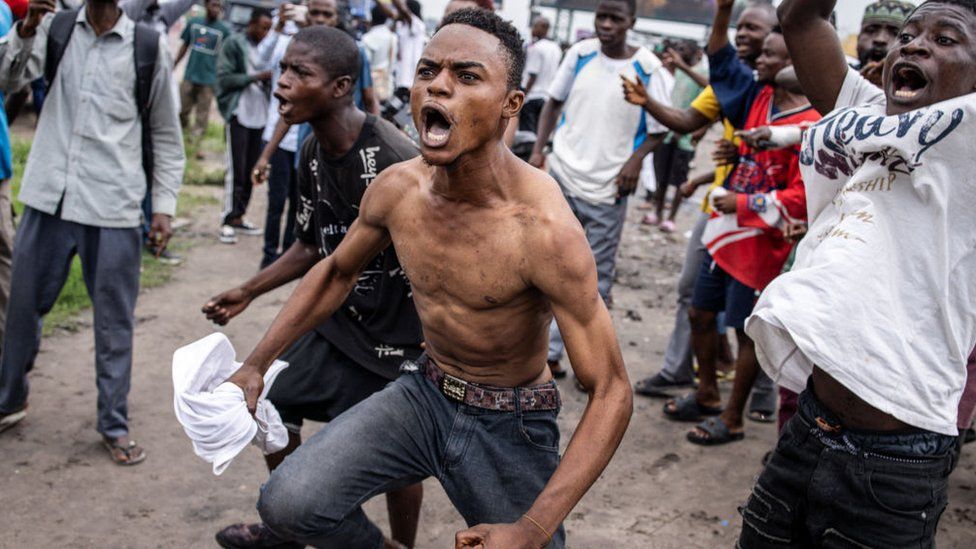
GETTY IMAGES
The election was marred by logistical delays and administrative chaos, forcing voting to be extended to a second day in some parts of the country.
The opposition has also accused the electoral commission of orchestrating fraud and ballot stuffing in order to pave the way for Mr Tshisekedi to be declared the winner.
The commission has denied the allegations.
DR Congo is roughly four times the size of France but lacks basic infrastructure. Even some of its main cities are not linked by road.
About two-thirds of the country's 100 million population live below the poverty line, earning $2.15 (£1.70) a day or less.
Voters also chose parliamentary, provincial and municipal representatives, with about 100,000 candidates in total.
The elections were not held in parts of the East because of insecurity.
Dozens of armed groups have been competing to control parts of the region, home to much of the country's vast mineral wealth.
This includes vast reserves of cobalt, a vital part of many lithium batteries, seen as essential to a future free of fossil fuels.
Latest Stories
-
Real-Time VAT on cross-border digital services – not a new tax and does not violate double taxation principle
45 minutes -
Digitalisation, AI key to Ghana’s tourism transformation – GHATOF
57 minutes -
Stronger GTA-private sector partnership needed to grow tourism – GHATOF
1 hour -
Amazon eyes Ghana for broadband expansion after talks with Mahama
2 hours -
National Investment Quiz 2026: Six schools qualify for quarter-finals
2 hours -
‘Do not let Russia pay for its madness with lives of your people’ – Zelensky to Ghana, 46 other countries
2 hours -
6,079 promotion cases fully processed and paid – CAGD says amid nationwide teachers’ strike
3 hours -
Teacher unions to meet government Monday over nationwide strike
3 hours -
Photo story: Republic Bank-JoyNews Habitat Fair clinic wraps up after three days of housing solutions, expert engagement
3 hours -
National Peace Council urges investment in youth to sustain Ghana’s peace
3 hours -
Afenyo-Markin urges youth to speak up against injustice
4 hours -
CAF annuls Edo Queens victory, orders WAFU B final to resume from extra time
4 hours -
Interior Minister urges traditional authorities to enforce anti-bushfire bye-laws
4 hours -
3rd Republic Bank-JoyNews Habitat Fair Clinic ends on a high note after three days of strong patronage
4 hours -
Ten climbers missing after avalanche hits Himalayan base camp
5 hours