

Audio By Carbonatix
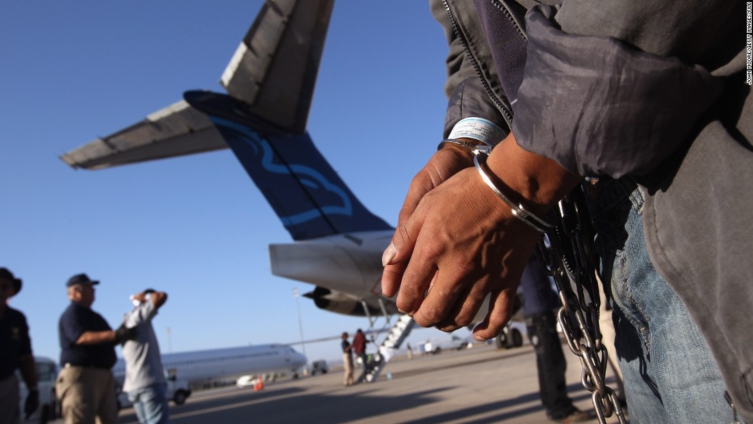
Democratic Republic of Congo is set to receive more than 30 deportees from the United States this week, four sources told Reuters, the latest example of Washington using agreements with African governments to accelerate migrant removals.
The deportees are all from countries other than Congo, and at least some are from Central and South America, according to one source and U.S. court documents. One source familiar with the matter said they would total 37, while another put the figure at 45.
They will be the first to land in the Central African country as part of an agreement with the Trump administration announced on April 5, two days after Reuters reported the two countries were negotiating a deal for Congo to receive third-country deportees.
The move coincides with the Trump administration's efforts to implement a U.S.-brokered peace deal between Congo and Rwanda aimed at ending fighting with Rwanda-backed M23 rebels in eastern Congo that has killed thousands and displaced hundreds of thousands more.
It also follows the signing of a strategic partnership granting the United States preferential access to Congo's critical minerals.
The timing of the deportees' arrival and details of how they will be accommodated in Congo have not been previously reported.
The deportees are expected to reach Congo by Friday and be housed in a hotel near Kinshasa's main airport, three of the sources said, speaking on condition of anonymity because of the sensitive nature of the move, which has attracted criticism from human rights groups and opposition politicians in Congo.
The U.S. has previously sent third-country deportees to African states, including Ghana, Cameroon, Equatorial Guinea and, drawing criticism from legal experts and rights groups over the legal basis for the transfers and the treatment of deportees sent to countries where they are not nationals.
Some of the deportees were later returned to their home countries despite receiving court-ordered protection in the U.S. meant to prevent that from happening.
A Congolese government spokesperson did not immediately respond to requests for comment on Tuesday. Kinshasa has previously stressed that it will not spend any money as part of its third-country deportees deal with the United States.
A State Department spokesperson said Washington had "no comment on the details of our diplomatic communications with other governments."
LONG-TERM PLAN UNCLEAR
The hotel near the airport in Kinshasa is due to house the deportees for only 10 to 15 days, one of the sources told Reuters. The source was unable to say what will happen to the deportees after that period.
The hotel will remain open to other guests, and the deportees will be free to move around, a diplomat and a senior humanitarian source said.
The deportees will be accommodated in single rooms, with two meals provided daily. The site is being secured by Congo's national police and a private security firm.
Neither Washington nor Kinshasa has said how many deportees would ultimately be sent to Congo.
U.N. AGENCY TO AID DEPORTEES
The deportees arriving this week will receive assistance from the U.N.-related International Organisation for Migration (IOM), two sources said.
IOM has also provided assistance to third-country deportees sent from the U.S. to Eswatini and Cameroon.
IOM said in a statement that it had no role in the deportations themselves, which it said were handled by the two governments. It said it could, at the request of Congolese authorities, provide "post-arrival humanitarian assistance".
An IOM source told Reuters earlier this month that the U.S.-Congo deportation deal could involve migrants from South America, including Venezuelans.
Reuters identified at least four migrants whose lawyers were told by U.S. Immigration and Customs Enforcement that they would be deported to Congo this week. They are from Colombia, Peru, Chile and Guatemala.
An April 8 court order from a federal judge in California, reviewed by Reuters, said the U.S. government planned to remove a Peruvian migrant to Congo.
The migrant had his request for asylum rejected, but had been granted protection against deportation to Peru because he feared persecution.
Latest Stories
-
Digitalisation, AI key to Ghana’s tourism transformation – GHATOF
8 minutes -
Stronger GTA-private sector partnership needed to grow tourism – GHATOF
18 minutes -
Amazon eyes Ghana for broadband expansion after talks with Mahama
1 hour -
National Investment Quiz 2026: Six schools qualify for quarter-finals
2 hours -
‘Do not let Russia pay for its madness with lives of your people’ – Zelensky to Ghana, 46 other countries
2 hours -
6,079 promotion cases fully processed and paid – CAGD says amid nationwide teachers’ strike
2 hours -
Teacher unions to meet government Monday over nationwide strike
2 hours -
Photo story: Republic Bank-JoyNews Habitat Fair clinic wraps up after three days of housing solutions, expert engagement
2 hours -
National Peace Council urges investment in youth to sustain Ghana’s peace
3 hours -
Afenyo-Markin urges youth to speak up against injustice
3 hours -
CAF annuls Edo Queens victory, orders WAFU B final to resume from extra time
3 hours -
Interior Minister urges traditional authorities to enforce anti-bushfire bye-laws
3 hours -
3rd Republic Bank-JoyNews Habitat Fair Clinic ends on a high note after three days of strong patronage
3 hours -
Ten climbers missing after avalanche hits Himalayan base camp
4 hours -
NPP had more permanent fuel relief measures than current GH¢2 diesel cut – Amin Adam
4 hours