

Audio By Carbonatix
Eighty people have died in a new Ebola outbreak in the Democratic Republic of Congo's eastern Ituri province, the country's health ministry said late on Friday.
Health Minister Samuel Roger Kamba Mulamba said in a statement that samples tested on Thursday had confirmed eight cases of the Bundibugyo strain of the Ebola virus in the health zones of Rwampara, Mongwalu and Bunia.
So far there have been 246 suspected cases of the virus, the ministry said. The suspected index case was a nurse who died at the Evangelical Medical Centre in Bunia after showing symptoms that included fever, bleeding, vomiting and severe weakness.
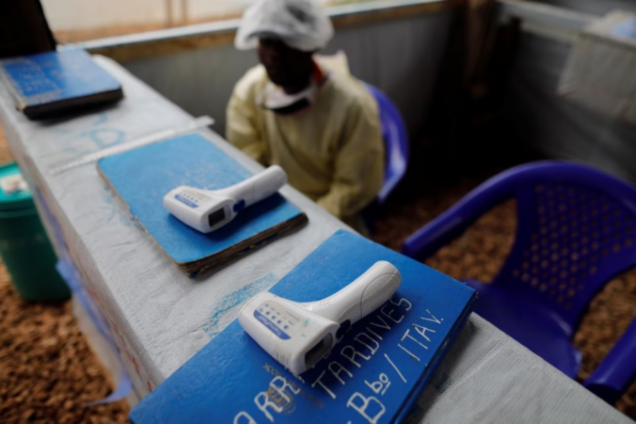
The DRC government said it has activated its public health emergency operations centre, strengthened epidemiological and laboratory surveillance, and ordered the rapid deployment of response teams.
Africa's top public health agency said earlier on Friday there was a confirmed Ebola outbreak in DRC's Ituri province, giving the death toll as 65 so far.
The Africa Centres for Disease Control and Prevention said in a statement it was convening an urgent meeting with Congo, Uganda, South Sudan and global partners to reinforce cross-border surveillance, preparedness and response efforts.
It said the deaths and suspected cases had been reported mainly in the Mongwalu and Rwampara health zones, while four deaths were reported among laboratory-confirmed cases. Suspected cases have also been reported in Bunia, the provincial capital.
The agency said initial findings suggested the presence of a non-Zaire strain of the virus, with sequencing ongoing to further characterise it.
Jean-Jacques Muyembe, the Congolese virologist who co-discovered Ebola and heads the National Institute for Biomedical Research in Kinshasa, told Reuters that all but one of Congo's 16 previous outbreaks had been caused by the Zaire strain.
The identification of a different variant will complicate the response, he said, as existing treatments and vaccines were developed against the Zaire strain.
"Africa CDC is concerned about the risk of further spread due to the urban context of Bunia and Rwampara" as well as "intense population movement" and mobility related to mining in the affected areas, which are close to Uganda and South Sudan, the agency added.

"Given the high population movement between affected areas and neighbouring countries, rapid regional coordination is essential," Africa CDC Director General Jean Kaseya said in the statement.
Uganda's health ministry said a Congolese man had died in Kampala of the Bundibugyo virus strain. Uganda said the case was imported from Congo and that no local case had been confirmed.
FIRST SAMPLES CONFIRMED POSITIVE ON THURSDAY, WHO SAYS
The World Health Organisation learned of suspected cases on May 5 and dispatched a team to Ituri to help investigate, but samples collected in the field initially tested negative, WHO Director-General Tedros Adhanom Ghebreyesus told a press briefing on Friday.
A laboratory in Kinshasa confirmed positive cases on Thursday, and the total number of confirmed cases is now 13, Tedros said.
The WHO has released $500,000 from its contingency fund for emergencies to support the response, including surveillance, contact tracing, laboratory testing and clinical care, he said.
ITURI HIT BY MILITIA CLASHES
The new outbreak is unfolding against the backdrop of a deepening security crisis in Ituri, where clashes between rival militia groups have killed scores of civilians in recent weeks.
The violence has worsened an already dire humanitarian situation, leaving health facilities overwhelmed or non-functional in parts of the province, Medecins Sans Frontieres said earlier this month. The medical charity warned of catastrophic hygiene conditions in displacement sites, raising the risk of disease outbreaks.
The outbreak is the 17th in Congo since Ebola was first identified there in 1976. The country's most recent outbreak, in Kasai province, was declared over on December 1 after three months. Out of a total of 64 cases, 45 died and 19 others recovered.
Ebola virus disease is a severe and often fatal illness that is endemic to Congo's vast tropical forests. It spreads through direct contact with the bodily fluids of infected persons, contaminated materials or persons who have died from the disease, the Africa CDC said.
Reporting by Erikas Mwisi, Nilutpal Timsina, Clement Bonnerot, Ayen Deng Bior; Elias Biryabaremam and George Obulutsa; Editing by Alexander Winning, Robbie Corey-Boulet, Alex Richardson and Tom Hogue
Latest Stories
-
Legal Aid Commission takes free legal services to Techiman main lorry terminal
3 minutes -
Nana B denies seeking passport favour, accuses Ablakwa of failing to account for GH¢16.4m
8 minutes -
Young girls demand climate action, stronger protection against child marriage
20 minutes -
Ex-gang boss sentenced to 40 years for orchestrating Tupac Shakur’s murder
20 minutes -
From near-deferral to three awards: UMaT graduate’s academic journey
22 minutes -
Atta Akyea denies seeking presidential pardon for Wontumi in galamsey case
1 hour -
Photos: Mahama commissions 85-bed Police Hospital ward, donates two ambulances
1 hour -
GTEC directs Ghana’s public universities to reopen by October 16 and begin lectures on October 19
1 hour -
Star Oil donates GH¢1million towards construction of new CID facility
1 hour -
Court hands Adjetey Sowah, two others lifetime bans after Amputee Football legal dispute
1 hour -
NDC appoints Julius Kwame Anthony as a Deputy Communications Director
1 hour -
Ghana repatriates 120 Nigerians rescued from suspected cybercrime centres
1 hour -
NPP rejects Emelia Agbenyo’s appointment as Deputy EC Chair, demands withdrawal
2 hours -
EOCO grants Suame MP John Darko enquiry bail in GH¢27m SIC investigation
2 hours -
NPP cannot question EC appointment after appointing own people to Commission – Kwakye Ofosu
2 hours