

Audio By Carbonatix
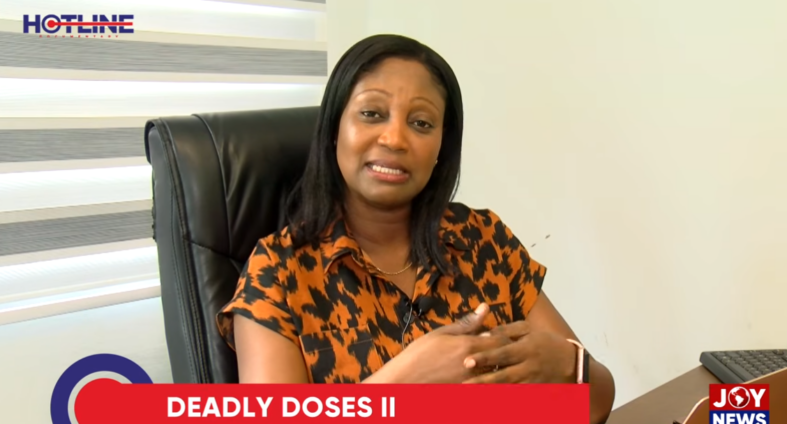
A psychiatrist, Dr Ruth Owusu Antwi, has revealed that her youngest patient treated for substance abuse at her facility began using drugs while in Primary Three, highlighting the growing threat of drug addiction among children in Ghana.
Speaking to JoyNews on the Hotline documentary, Deadly Doses II: Ghana's Growing Drug Crisis, Dr Owusu Antwi said the case demonstrates how early exposure to drugs can quickly develop into addiction.
According to her, the young boy became addicted after repeatedly watching older people smoke near his school.
"The youngest patient started using drugs. In fact, he was recently on the ward," she said.
"He started using drugs at Class Three. That's Primary Three."
Dr Owusu Antwi explained that the child would often see older people hiding behind his classroom to smoke. After they left, he would collect what remained and use it himself out of curiosity.
"He would look at older people come and hide behind his classroom and smoke. And out of curiosity, when they had left, he'd go and pick the pieces," she recounted.
According to the psychiatrist, what began as curiosity soon turned into addiction because of the effect the drugs had on the child.
"He became hooked to it. He became happy with the effect it gave him."
She said the child continued using the drug "one piece at a time" until he eventually required psychiatric treatment.
"We saw him on the ward when he was around 13 years old. We discharged him, I think, a week ago. But he started at Primary Three," she said.
Dr Owusu Antwi said the case reflects a worrying trend in Ghana's growing substance abuse crisis, where children and young people are becoming exposed to drugs at increasingly younger ages.
She also cited findings from her facility's 2025 Annual Performance Review, which showed that the majority of patients treated for mental health conditions, including substance use disorders, were young adults.
"Looking at our 2025 annual performance review, we are realising that for all disorders, including addictions, the age category that topped was from 20 to about 49. Which is largely the schooling-to-working age group," she said.
Illicit substances are increasingly reaching schools, university campuses and popular food and drinks consumed by young people.
Part Two of Deadly Doses: Ghana’s Growing Drug Crisis reveals how traffickers are moving beyond the open sale of narcotics in drug ghettos. Marijuana, opioids and other substances are now being concealed in products such as sobolo, brownies and gummies, making them more difficult to detect.
Latest Stories
-
GPL 2026/27: Medeama ease past Basake Holy Stars
32 minutes -
Appiah Adomako writes: Why DVLA must stop treating every expired licence holder as delinquent
35 minutes -
Localization must transfer decision-making power, not just project responsibilities
44 minutes -
Modernising Ghana’s traditional markets through the 24-Hour Economy markets initiative
47 minutes -
New economy will boost local production and create jobs – Finance Minister
53 minutes -
Real-Time VAT on cross-border digital services – not a new tax and does not violate double taxation principle
2 hours -
Digitalisation, AI key to Ghana’s tourism transformation – GHATOF
2 hours -
Stronger GTA-private sector partnership needed to grow tourism – GHATOF
2 hours -
Amazon eyes Ghana for broadband expansion after talks with Mahama
3 hours -
National Investment Quiz 2026: Six schools qualify for quarter-finals
3 hours -
‘Do not let Russia pay for its madness with lives of your people’ – Zelensky to Ghana, 46 other countries
3 hours -
6,079 promotion cases fully processed and paid – CAGD says amid nationwide teachers’ strike
4 hours -
Teacher unions to meet government Monday over nationwide strike
4 hours -
Photo story: Republic Bank-JoyNews Habitat Fair clinic wraps up after three days of housing solutions, expert engagement
4 hours -
National Peace Council urges investment in youth to sustain Ghana’s peace
4 hours