

Audio By Carbonatix
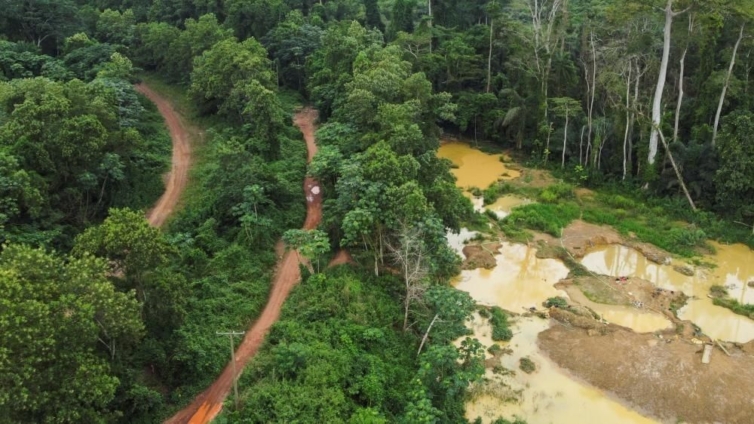
The Ghana Catholic Bishops’ Conference (GCBC) is calling on the government to declare a state of emergency in areas heavily affected by illegal mining, warning that galamsey has become “a profound moral crisis and a spiritual challenge” for the nation. The appeal was contained in a communiqué issued at the end of the Conference’s Annual Plenary Assembly held in Damongo in the Savannah Region.
According to the Bishops, the scale of environmental destruction caused by illegal mining requires bold and urgent action from President John Dramani Mahama and state authorities. “Creation is not a resource to be exploited,” the communiqué stressed, describing the environment as “a covenantal partner deserving of respect and care.”
The Conference cited alarming statistics to highlight the crisis. More than 5,252 hectares of forest reserves have been destroyed by illegal mining in 2025 alone, while 44 out of 288 forest reserves are now classified as degraded. An estimated 75% of Ghana’s rivers are polluted, largely due to mercury and cyanide from unregulated mining activities.
While acknowledging government efforts such as the creation of the National Anti-Illegal Mining Operations Secretariat (NAIMOS), the Bishops insisted that the current response is nowhere near sufficient. They urged the President to introduce stronger measures, including the swift and impartial prosecution of offenders, regardless of their political affiliation, and the full reclamation of degraded lands.
They also requested transparent national reporting on water quality, forest cover, and food safety to restore public trust and ensure accountability.
The GCBC commended chiefs and queen mothers who have taken firm positions against galamsey in their communities and encouraged other traditional leaders to do the same. They appealed to citizens to support efforts to “sanitise and heal” Ghana’s land and rivers for both present and future generations.
The communiqué adds to growing pressure on the government to adopt a more aggressive and coordinated approach to a menace that continues to threaten livelihoods, public health, and national security.
Latest Stories
-
Today’s Front pages: Friday, June 19, 2026
48 minutes -
NPP should be careful with me; I’ll spill the beans if they provoke me – Kennedy Agyapong warns
1 hour -
KAIPTC Deputy Commandant urges stronger evidence-based security response
1 hour -
KAIPTC restructures research and academic units to strengthen response to West Africa’s evolving security challenges
2 hours -
KAIPTC Research Director defends structural split as response to fast-moving West Africa security threats
2 hours -
Ghana committed to renewable energy expansion – Energy Minister
2 hours -
Valedictorian urges graduates to embrace character and purpose at St. Bernadette Soubirous School ceremony
2 hours -
Africa must define its own energy transition path – Jinapor
2 hours -
Giddens: Ghanaian-German afropop and afrofusion artiste on rise
2 hours -
Jinapor highlights energy access, industrialisation and sustainability as pillars for Africa’s just energy transition
3 hours -
Green Project Preparation Facility launched to unlock climate infrastructure investment in Ghana
3 hours -
Gender Ministry congratulates Sylvia Ama Adusu on historic ITLOS election
3 hours -
Ghana Feel It All as Coca-Cola kicks off FIFA World Cup 26 campaign
3 hours -
Reparations for slavery must go beyond financial compensation – Macron
4 hours -
Redirect 24-Hour Market funds to complete Agenda 111 hospitals – Asenso-Boakye to gov’t
4 hours