

Audio By Carbonatix
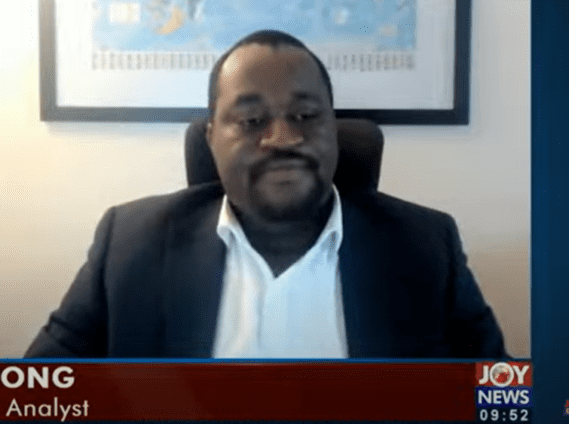
An Economist, Theo Acheampong, has decried the introduction of the electronic transaction levy presented in the 2022 budget.
According to the Political Risk Analyst, the electronic transaction levy, also known as the E-levy, is not the best tax decision by government.
He said this was because of the current state of Ghana’s economy, “especially given the time that we are talking about financial inclusion.”
“The evidence base shows even when we implement these taxes, the so-called informal sector in the country are paying a lot in terms of other indirect prices, talk of petrol, talk of fuel prices, talk of general good and services, VAT, National Health Insurance, Tourism levy.
“If you go and eat right now, let’s say you spent about ¢200 to buy a plate of food on that 200, you would have paid VAT, NHIS, Tourism levy you name it cumulatively you are talking between 17 and 20 % and then on top of that you are saying that if I make a transfer, now to pay for that service that I have procured then you are going to take an extra 1.75 % on top of that is where I challenge the bit of the premise,” he stressed.
His assertion comes after the Finance Minister on Wednesday announced the introduction of the levy in the 2022 budget statement to increase tax revenue for the country.
“The government will charge an applicable rate of 1.75% on all electronic transactions covering mobile money payments, bank transfers, merchant payments, and inward remittances, which shall be borne by the sender except inward remittances, which will be borne by the recipient,” Ken Ofori-Atta announced.
Speaking on Joy News’ Newsfile on Saturday, Mr Acheampong called for an exemption in some service of the E-levy tax.
One of the areas he called for the exemption is transfers from bank services to mobile services and vice versa.
He also listed the payment of essential services like water, electricity, medicines, etc. According to him, means should be devised to cover up E-levy charges.
He again called for the reduction of the applicable rate of the E-levy since the 1.75% is too high.
“We should reduce the rate down. I think 1.75% is too high…the rate, in my view, has to come down, possibly 0.5%. Left for me alone, I wouldn’t implement it, but if government wants to go ahead with it, then perhaps we need to look at which services you exclude, the rate and then the trigger point," he said.
Latest Stories
-
La Beach demolition: Senyo Hosi condemns lack of consultation
8 minutes -
Russian glide bomb attack on Zaporizhzhia kills at least 15 people
23 minutes -
Jinapor warns underperforming energy sector CEOs of consequences, says no protection for failure
24 minutes -
Fire destroys head of tipper truck on Lower Volta Bridge
29 minutes -
Palmer signs new Chelsea contract until 2034
30 minutes -
World Cup visa scandal: Mahama will act on corruption allegations – Abass Nurudeen
32 minutes -
Abass Nurudeen accuses Minority of ‘scandal scavenging’ over World Cup visa controversy
33 minutes -
US Embassy recognised NSA, GFA and GTA as separate entities for visa applications – Sports Minister’s aide
40 minutes -
Only 30% of Ghanaian teachers satisfied with their jobs – CAPCOE data reveals
51 minutes -
Communities affected by construction of Akosombo Dam urge government to speed up compensation process
1 hour -
World Cup visa scandal: Sports Ministry not shielding anyone – Sports Minister’s special aide
2 hours -
World Cup visa scandal: Over 30 people misrepresented as GTA board members to US Embassy – Vincent Assafuah alleges
2 hours -
Fire destroys wooden structure near Yesu Mo Villa at Bush Road
2 hours -
NDC threatens sanctions over oversized campaign posters, gives aspirants 5 days to comply
2 hours -
Star Oil paid GH¢2.7bn in taxes, levies in nine months of 2026
3 hours