

Audio By Carbonatix
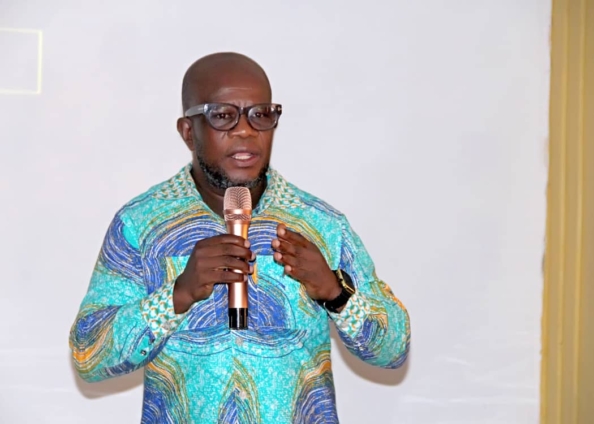
The Director-General of the State Interests and Governance Authority (SIGA), Prof Michael Kpessa-Whyte, says the Electricity Company of Ghana (ECG) could move from making losses to becoming profitable if the stability of Ghana’s economy is sustained and the company maintains prudent management.
Speaking on Joy FM’s Super Morning Show on Monday, August 31, while discussing SIGA’s State Ownership Report, he said the significant reduction in ECG’s liabilities and debts is a positive indication that the state-owned power distributor can improve its financial position if it is given a similar economic environment in which to operate.
“My observation is that if the stability of the economy is sustained and the prudent management by the board and CEO and the team at ECG continues, we will see them move from the negative to the positive,” he said.
“And that, for me, is a goal that we intend to work with ECG to achieve,” he added.
Prof Kpessa-Whyte said the reduction in ECG’s financial obligations was one of the main factors behind his optimism about the company’s prospects.
When asked what specific changes at ECG had convinced him that the company could turn its finances around, he pointed to the reduction in its liabilities and debts.
“What they have done that convinced me is that we have seen a significant reduction. We have seen a significant reduction in their liabilities and in their debts,” he said.
He said the scale of the reduction suggested that the company could make further progress if the broader economic conditions remained favourable.
“And the quantum reduction suggests that given another opportunity with similar macroeconomic environments, we will be able to see changes,” he said.
However, Prof Kpessa-Whyte said ECG’s management would be better placed to explain the precise measures that had contributed to the improvement.
He said these could include efforts to increase revenue, tighter control of expenditure and other measures aimed at improving the company’s finances.
“Now, it is for the management of the ECG to actually speak to the specific nitty-gritty of actions that they may have taken, whether they have broadened their revenue base, whether they have been more prudent with their spending,” he said.
He also identified foreign exchange movements as another factor that had played a role in ECG’s improved performance.
“Of course, we know that Forex also was quite instrumental in the changes we have seen in their performance,” he said.
Prof Kpessa-Whyte was also asked to respond to concerns that ECG’s financial challenges could not be blamed mainly on macroeconomic conditions, particularly because of the cost of excess capacity contracts.
In response, Prof Kpessa-Whyte said the view should be considered as part of the broader discussion about ECG’s operations.
“Well, I mean, I think that's an opinion from somebody else,” he said.
He said that improved revenue collection and efficient management could still make a significant difference to the company’s financial position.
“I believe that if ECG manages, collect all their debts and they operate optimally, we should be able to see them making significant progress,” he said.
Prof Kpessa-Whyte, however, acknowledged that the listener’s argument could point to other issues that needed closer examination.
“That doesn't mean that the premises of the question is wrong, but it only directs us to aspects or dimensions of ECG's overall operation that should also be critically explored and examined,” he said.
This comes after the Electricity Company of Ghana (ECG) accounted for GH¢82.31 billion of the total liabilities held by Ghana’s state-owned enterprises (SOEs) in the 2025 financial year, according to the State Interests and Governance Authority (SIGA).
According to the report, the combined liabilities of SOEs declined by 4.31 per cent to GH¢281.99 billion in 2025, with ECG alone accounting for GH¢82.31 billion.
Latest Stories
-
Benedict Okyere Yeboah: Ghana’s football problem goes beyond sacking a coach
5 minutes -
GPL 2026/27: Darkwah Wiafe’s winner sees All Blacks beat Kotoko
10 minutes -
ITF World Tour : Patel Wins Boys’ Singles Final at J100 Accra
23 minutes -
Ghana must pursue BRICS partnership if it brings economic benefits – Kpebu
26 minutes -
Success and Wright Claims J100 Accra Girls’ Doubles Championship
27 minutes -
ITF J100: America’s Wright wins J100 Accra Girls’ Singles Title
33 minutes -
Expedition hopes to find aviator Amelia Earhart’s plane on remote island
34 minutes -
US seeks changes to rejected $109m health compact with Ghana – Mahama
1 hour -
Nine dead in mass shooting at Pennsylvania home
1 hour -
‘Time for Ukraine to get new president,’ says Trump after Zelensky condemns diesel deal
1 hour -
Hincapie injury adds to Arsenal issues after Guimaraes rescue act
2 hours -
Henderson scores twice as Chelsea thumb Bournemouth
2 hours -
Photos: Mentapulse Africa convenes health and labour summit to address talent retention
2 hours -
Mahama inspects Nkokɔ Nketenkete plant, eyes Bechem as chicken capital
2 hours -
Ghana not seeking full BRICS membership, applying as Partner Country – Ablakwa
2 hours