

Audio By Carbonatix
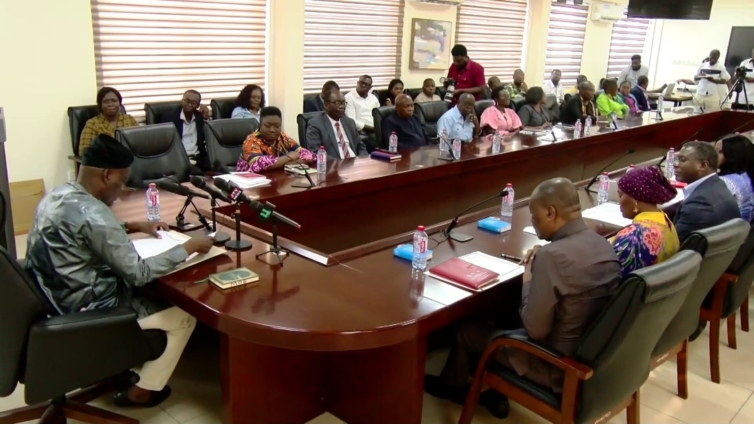
The National Education Forum Committee has assured the public of practical and implementable solutions to bridge existing gaps in Ghana’s education system.
After being duly inaugurated by the Education Minister, Haruna Iddrisu, last Tuesday, the committee was tasked with conducting a comprehensive review of the education sector and proposing steps to roll out an equitable, sustainable, and high-quality education system relevant to national development planning needs.
The Education Minister emphasised the urgency of reforming the current education system to ensure that Ghanaian children remain the ultimate beneficiaries.
“The country almost a decade ago was busy implementing a free senior high school. The country, in my view, did not adequately prepare for the absorption of the exponential increase in the numbers of persons assessing free senior high school, and how well we absorb them into our tertiary institutions.
"So there's a challenge. Residential academic infrastructure is not adequate in any of our public universities. You have 150,000 to 300,000 Ghanaian students who naturally will have aspirations to test higher education and tertiary education. How prepared are we to provide them an opportunity in the institutions of higher learning to be able to assess that public good? The ball now is in your court, chair.
"As I inaugurated, the only assurance I told my chief director I was generously going to do that, to answer the question for them, that at least the ministry is ready with budgetary support for this present initiative, which constitutes one of his major pledges to the Ghanaian electorate. He promised that within 120 days, this forum would take place.
"What the president wants is to benefit from the knack of open, relevant, transparent discussion about how we all can contribute to making education accessible, equitable, with quality, and relevant to our national development planning needs.”
The Chairman of the Committee, Prof. George K.T. Oduro, pledged to develop a competitive policy framework to shape the nation’s curriculum.
In an exclusive interview with JoyNews, Prof. Oduro indicated that, in the interim, the committee would address issues related to the ongoing Free SHS policy and propose practical solutions to make education more accessible, equitable, and sustainable. Key issues such as feeding and program beneficiaries will be prioritised.
“One thing that this committee is going to do in the interim is to work out a framework to guide the National Stakeholder Forum that we consider very important because the forum allows the nation, every individual, politicians irrespective of their orientation, religious bodies, parents, students and other groups of people to contribute to a debate and a discourse that's very, very important in resetting our educational system, particularly to the benefit of the needy in our society.
"We know there are issues relating to free SHS as to whether it should be implemented as we inherit it or whether the target should go to those who really need it, whether the focus should be on disadvantaged groups in the country or whether we should just give it to everybody. As to whether our emphasis should be on access or we should emphasize quality and equity-indexed access.
"We know feeding is also a challenge as to whether feeding should be continued on the model that we have now or whether there should be a change in its operation. When we come to a teacher training college for instance we’re talking about teacher allowances as to whether when the colleges of education move up to tertiary level with some of them getting chartering for their operations as autonomous colleges of education we should continue paying allowances as we have now compared to what traditional university tertiary.”
The former Pro Vice-Chancellor of the University of Cape Coast further emphasised that international experts would be engaged to build consensus on reshaping Ghana’s educational curriculum.
“I think this one of the things that the forum will be addressing and so we are bringing experts. We are bringing experts not only from Ghana but from the diaspora to come and then collectively we work out plans as to how best education can be financed in this country, particularly for the benefit of the needy in the society," he said.
With a two-week deadline, the committee is expected to submit a comprehensive action plan for the forum.
Additionally, within three weeks post-forum, the team will draft a national education policy framework and provide a detailed roadmap for implementation.
Latest Stories
-
Amin Adam proposes 13 measures to strengthen Ghana’s debt transparency and market confidence
9 minutes -
Mahama announces $2bn annual investment to accelerate industrialisation
14 minutes -
Amin Adam urges monthly disclosure of Sinking Fund as Ghana prepares for DDEP repayments
24 minutes -
Stronger banks will fuel business growth and jobs – ADB MD
25 minutes -
Galamsey: ‘Rivers that fed our grandparents now run the colour of chocolate milk’ – Sam Jonah
27 minutes -
We have been scammed by NDC, government is only doing PR – Abanga Fuseini
28 minutes -
Republic Bank–JoyNews Habitat Fair opens in Ho today
29 minutes -
BoG pledges stability to attract investment, urges stronger Africa–Asia partnerships
32 minutes -
Amin Adam warns treasury bill dependence could expose Ghana to refinancing risks
33 minutes -
Ghana better placed to withstand commodity price shocks – IMF
36 minutes -
GAPTE intensifies efforts to increase bus availability for Aayalolo contra-flow
38 minutes -
Amin Adam warns cedi depreciation could reverse Ghana’s debt relief gains
41 minutes -
Fiscal discipline crucial for pension fund investments – Finance Minister
42 minutes -
BoG Governor rallies IMF to back Africa’s digital sovereignty
47 minutes -
Amin Adam questions government bond pricing as short-term yields fall below inflation
53 minutes