

Audio By Carbonatix
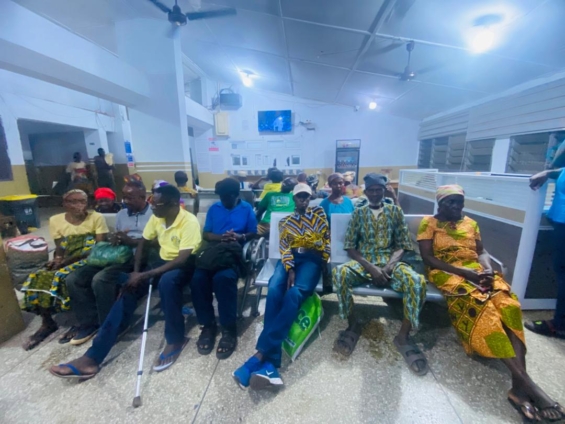
Hospital visits are not meant to test one’s patience, yet for many Ghanaians, that is exactly what they have become.
Waiting has always been part of the process when you know very well you are not the only patient to be attended to. However, when the wait becomes unbearable, it becomes frustrating.
What should be a straightforward process of seeking care often turns into hours of waiting, confusion, and unnecessary movement between departments.
My experiences may be personal, but they reflect a much larger, deeply-rooted problem within Ghana’s healthcare system, particularly government facilities.
Over the years, I have visited a few facilities, including Manna Mission Hospital and Lekma Hospital both in Teshie, and more recently, the Shai Osudoku District Hospital in Dodowa, all in Accra.
To be fair, not all experiences have been negative. All the visits have its downsides but my breaking point was the most recent experience at the Shai Osudoku District Hospital.
In fact, my antenatal and postnatal care at Shai Osudoku was excellent. The professionalism and attention given to maternal health services deserve commendation. It is proof that quality healthcare is possible within our system.
However, beyond maternal care, a different reality emerges—one that many patients know all too well.
Routine hospital visits, especially those involving laboratory tests, often become frustrating ordeals.
Today, it is nearly impossible to visit a hospital without being asked to run a lab test, even for minor complaints. Yet, the process itself is riddled with inefficiencies.
Why should a patient wait for hours just to have a sample taken? Why must one wait again—sometimes endlessly—for results? And perhaps most troubling, why are patients told their results are ready when they are not?
On one occasion, I spent over two hours waiting for my sample to be taken, told later that my results were ready. I walked to the doctor’s office, hopeful to complete the process, only to be told there was nothing in the system.
This meant going all the way back to the lab, waiting yet again, and being told—after another delay—that the results were finally ready.
This is not just about inconvenience; it is about a breakdown in coordination. It is about systems that do not communicate with each other. It is about patients being left to navigate confusion that should not exist in the first place.
Admittedly, staffing challenges—especially on weekends—may contribute to these delays. But should that excuse misinformation? Should patients bear the burden of systemic inefficiencies? The answer is NO!
What makes this even more concerning is that these experiences are not unique.
Many Ghanaians share similar frustrations: long waiting times, unclear processes, and poor communication between departments. It raises an uncomfortable but necessary question—has waiting simply become an accepted part of treatment in our hospitals?
Healthcare is not only about diagnosis and medication. It is also about dignity, efficiency, and trust. When patients spend entire days at hospitals for processes that should take a fraction of the time, that trust is gradually eroded.
Hospital management must urgently confront these inefficiencies. Laboratories, in particular, require better organisation, improved staffing where possible, and, most importantly, proper coordination with consulting units.
Patients should not have to move back and forth simply because systems are not aligned.
The solution is not beyond reach. Streamlined processes, clear communication, and accountability can significantly improve patient experience. If maternal care services can function effectively, then the same standard should be applied across all departments.
Ghanaians deserve a healthcare system that works—not one that exhausts them before they even receive treatment.
Until these issues are addressed, the unfortunate reality remains: in many of our hospitals, patients are treated—but only after they have endured the treatment of waiting.
Latest Stories
-
President Mahama ends Resetting Ghana tour of Ahafo Region
1 hour -
African negotiators seek delivery of climate commitments at COP31
1 hour -
BoG develops AI rules for financial sector
1 hour -
‘Big Push’: Government assures contractors of prompt payments
1 hour -
Court fines miner for breaking into gold buying shop
2 hours -
Tarkwa court jails labourer for three years over GH¢123,000 theft
3 hours -
GAEC must retain nuclear scientists for Ghana’s nuclear ambitions – Minister
3 hours -
Man reportedly mistaken for game and shot by hunter dead in forest
3 hours -
19-year-old mason jailed 15 years for defiling seven-year-old pupil
3 hours -
Ghana’s banking sector assets rise 20.47% to GH¢500.2bn – BoG Governor
3 hours -
22 injured as Sprinter bus overturns at Sege after tyre burst
3 hours -
UN housing expert urges Ghana to strengthen Rent Control Department amid housing affordability concerns
3 hours -
Delta-BCI partnership reaches 166,000 people with breast cancer education
4 hours -
Power restoration fault suspected in Kumasi Central Market fire
9 hours -
The 7-foot giant of Ngleshie Amanfro: Seven-foot Ghanaian Ephraim Saawa dreams of joining the national basketball team
9 hours