

Audio By Carbonatix
The Public Utilities Regulatory Commission (PURC) has increased electricity tariffs for the third quarter of 2025 by 2.45%. This move comes as a surprise to many, including PURC itself, since all traditional indicators pointed to a reduction.
In April 2025, the Commission had already implemented a 14.75% increase for the first and second quarters. Given recent economic gains, a reduction seemed more likely.
Electricity tariffs in Ghana are reviewed quarterly, using four primary indicators: the Cedi–US Dollar exchange rate, the inflation rate, natural gas prices, and the country’s electricity generation mix.
These parameters form the basis of Ghana’s Energy Sector Recovery Programme and are part of conditionalities agreed with the IMF.
By these standards, tariffs should have declined. The cedi has appreciated sharply from ₵15.5 to the dollar earlier this year to around ₵10.3 today, and continues to show signs of stability.
Inflation has fallen from 23.5% in January to 18.4% in May, with expectations of further easing as traders adjust prices in response to currency gains. The price of natural gas has remained relatively stable. Although Middle East tensions pose a risk, they have not yet disrupted gas markets.
Even PURC admits the numbers favored a cut. Its Director of Research, Dr. Eric Obutey, told JoyNews Research that based on the traditional methodology, electricity tariffs should have gone down.
So why the increase?
PURC has introduced new factors into its tariff computation. These include outstanding debts within the energy sector, reserve capacity requirements, and the cost of liquid fuels.
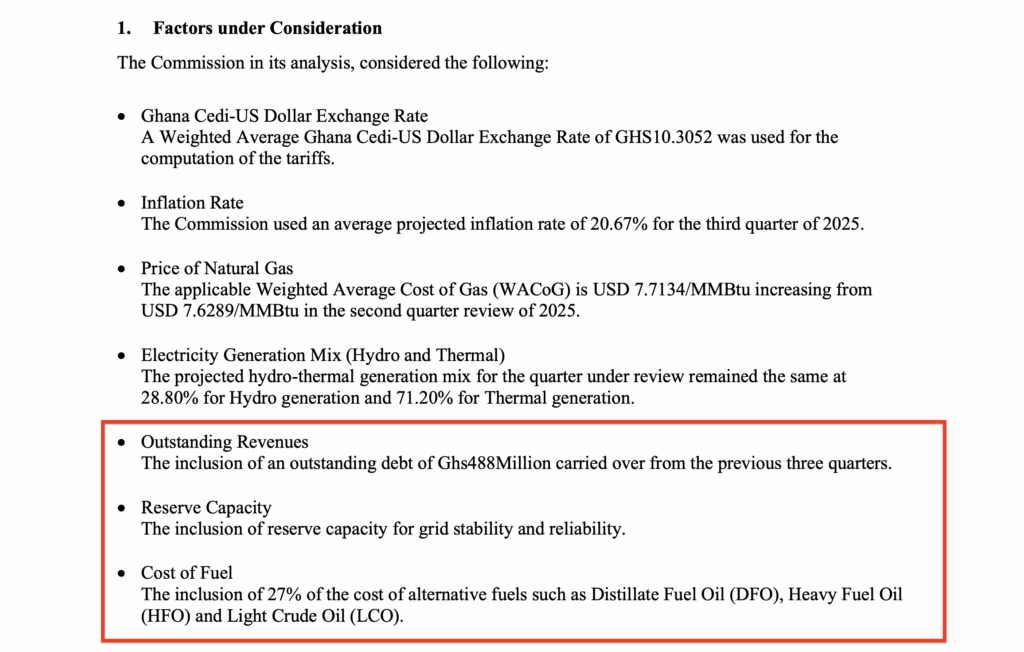
According to PURC, there is an outstanding debt of ₵488 million that this adjustment aims to begin clearing. The debt alone accounts for the bulk of the 2.45% hike.
Then there is reserve capacity. Ghana currently consumes nearly all the power it generates, leaving little margin for emergencies. PURC says including a buffer in the tariff structure to create excess capacity is necessary to prevent blackouts and reduce the risk of future instability.
The most controversial addition, however, is the partial inclusion of liquid fuel costs.
On June 3, 2025, the government, through the Finance and Energy Ministries, passed an additional ₵1 levy on petrol and diesel under the Energy Sector Levy (ESLA). The rationale was to raise funds to buy liquid fuels for thermal plants amid gas shortfalls. At the time, Finance Minister Ato Forson warned that without the levy, electricity tariffs would have to rise by as much as 50%.
Now PURC has moved to include 27% of liquid fuel costs directly in the electricity tariff build-up. The Commission argues that with the cedi strong and inflation easing, a modest increase is justified.
But this decision contradicts a key promise in the 2025 budget. The government had pledged not to factor liquid fuel costs into tariffs until the fourth quarter of 2025, when a major tariff adjustment is due. The budget clearly stated:
“PURC will continue with quarterly tariff reviews based on inflation, exchange rate, and generation mix. A major adjustment in the fourth quarter will reflect capacity charges, liquid fuel costs, and additional capital expenditure.”
What has changed is the government’s calculations. With economic indicators improving faster than anticipated, the administration has chosen to act earlier than promised.
This mirrors its decision to introduce the additional ₵1 ESLA levy as global oil prices were falling and the cedi was gaining strength, despite promising not to increase ESLA in the 2025 budget.
Whether this proves wise depends on the cedi holding firm. A renewed depreciation or new external shocks could blow apart the assumptions underpinning the 2.45% tariff increase and force steeper hikes. PURC says that if that happens, government grants may be used to cushion consumers from sudden price jumps.
The math explains the thinking from the energy and finance ministries. Energy Minister John Jinapor estimates that Ghana needs $1.2 billion, or around ₵12.3 billion, to purchase liquid fuels for thermal plants this year.
PURC’s 27% inclusion means ₵3.3 billion will be raised annually from electricity tariffs. The government also plans to generate ₵5.7 billion from the increased ESLA levy on fuel.
That adds up to about ₵9 billion, or 73% of the total requirement, leaving a ₵3 billion shortfall.
It is a gap the government can manage if the cedi stays firm and oil prices remain stable. Still, the deeper issue is one of credibility.
The government has broken yet another promise. First, it raised the ESLA levy despite assurances that it would not be increased. Now, it has adjusted the electricity tariff mechanism months earlier than pledged in the 2025 budget, which clearly stated that costs related to liquid fuel would not be included until the fourth quarter.
But the stronger-than-expected performance of the cedi, combined with falling inflation and lower fuel costs, has given the government room to act without triggering immediate public backlash.
That is good news for energy sector financing in the short term. But unless the structural problems are addressed, the cost will eventually be felt by consumers.
Latest Stories
-
NAPG Summit equips Administrative Professionals for strategic impact and the AI-driven workplace
8 minutes -
NHIA urges amendment of Health Insurance Act to accommodate free primary healthcare
11 minutes -
Ghana is tackling cybercrime head-on, not becoming a hub for it – CSA
13 minutes -
We’ll deliver without fear or favour – New EC Deputy Chairpersons assure Mahama
14 minutes -
Six Ukrainian energy sites hit by Russia since Trump announced ceasefire, Zelensky says
33 minutes -
Government directs GTEC to prepare public universities for weekend reopening as it intensifies efforts to end GAUA strike
33 minutes -
Multimedia Group’s Raymond Nii Doodo Larbie called to the Ghana Bar, seeks to combine HR practice with law
36 minutes -
Credible elections are the cornerstone of democracy – New Deputy EC Chairperson
39 minutes -
Mahama charges new EC deputies to put national interest above political loyalties
44 minutes -
Mahama urges EC to strengthen electoral technology, inclusion and professionalism
44 minutes -
Fridges in French supermarkets hit by cyber attack
45 minutes -
Evangelism or collection in God’s name? The plight of Ghana’s captive passengers
49 minutes -
‘I don’t expect preferential treatment for me, my party or gov’t’ – Mahama to new EC deputies
1 hour -
Mahama tasks new EC Deputy Chairpersons to protect electoral integrity
1 hour -
Police arrest officer after shooting injures 2 at Ritz Junction
1 hour