

Audio By Carbonatix
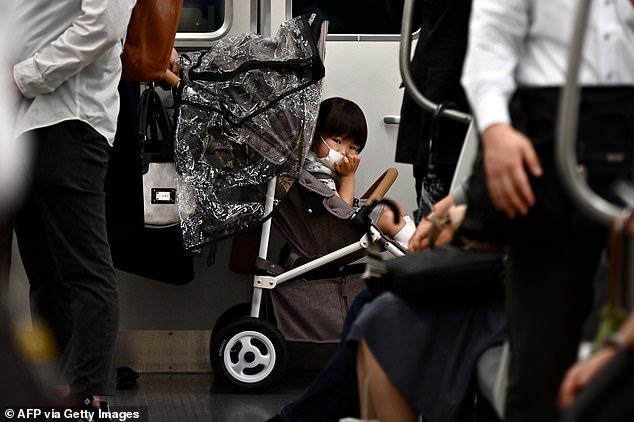
Children under the age of two should not wear face masks as they make it difficult for them to breathe and increase their risk of heat stroke, Japanese experts warn.
The Japan Paediatric Association has advised parents not to place masks on infants under two - despite Japan's coronavirus guidelines urging every individual to wear a mask.
In a leaflet issued to the Japanese public the medical body warned that infants could experience an increased burden on their lungs due to the covering of their mouths, reports CNN.
They added that the masks also obstruct the child's face, making it more difficult for parents to notice changes in expression or the colour to the face which could indicate breathing issues.
The leaflet reads: 'It is possible that masks make it difficult for infants to breathe and increase the risks of heat stroke'.
Due to their narrower air passages the mask poses a risk of suffocation, especially if a young child vomits behind a mask, states the advice.
As children have a relatively low risk of contracting coronavirus the Japanese board found that they had no logical reason to face the risks posed by wearing the mask itself.
On Monday Japan's Prime Minister Shinzo Abe lifted the coronavirus state of emergency in Tokyo and four other remaining areas, ending the restrictions nationwide.
Experts on a government-commissioned panel approved the lifting of the emergency in the capital, neighbouring Kanagawa, Chiba and Saitama prefectures, and in Hokkaido to the north, which had remained under the emergency declaration after it was removed in most of Japan earlier this month.
Japan, with about 16,600 confirmed cases and 850 deaths, has so far avoided the large outbreaks experienced in the US and Europe despite softer restrictions.
Mr Abe said the lifting of the emergency does not mean the end of the outbreak. He said the goal is to balance preventive measures and the economy until vaccines and effective drugs become available.
But the world's third largest economy has fallen into a recession, and public discontent over his handling of coronavirus has sent his support ratings tumbling.
Recent media surveys show public support for his cabinet has plunged below 30 per cent, the lowest since he returned to office in December 2012.
Mr Abe declared the state of emergency on April 7 in several parts of Japan including Tokyo, expanded it to the entire nation later in the month, and then extended it until the end of May.
Under the emergency, people were asked to stay at home and non-essential businesses were requested to close or reduce operations, but there was no enforcement.
Since May 14, when the measures were lifted in most of Japan, more people have left their homes and stores have begun reopening.
Economy minister Yasutoshi Nishimura said recent data suggests infections have slowed enough and pressure on the medical system has fallen enough to allow a gradual resumption of social and economic activity.
He said Tokyo, Kanagawa and Hokkaido, where the number of infections is still fluctuating, need to be watched closely.
Individual prefectures are allowed to impose their own measures.
Tokyo governor Yuriko Koike said last week that the capital will reopen in three phases starting with schools, libraries, museums, and longer service hours for restaurants.
She said theatres, sports facilities and other commercial establishments will be next, with nightclubs, karaoke and live music houses in the final phase.
Mr Abe said the swift development of vaccines and effective treatments for Covid-19 are priorities towards achieving the Tokyo Olympics next year.
Experts say developing an effective and safe vaccine by the Games next year would be difficult. Mr Abe acknowledged that the fight against the virus 'would be an endurance battle'.
Latest Stories
-
IMMILAC president recounts personal losses as security women lead breast cancer awareness campaign in Wa
2 minutes -
University of Ghana postpones October 12 reopening as GAUA strike persists
16 minutes -
Bahass Foundation launches vocational skills training to support mental health recovery in Wa
48 minutes -
NPP orders parliamentary aspirants and their supporters to suspend campaign activities
1 hour -
Techiman unites against child marriage: Joy Impact Makers Awardee leads charge on International Day of the Girl Child
2 hours -
Ghana Psychological Association calls for greater involvement of people with lived experience in mental health care
3 hours -
Ablakwa says Ghana could evacuate more citizens from South Africa if the situation worsens
3 hours -
Violence against girls must be tackled through individual responsibility – Gender advocate
3 hours -
Ghana’s BRICS bid must be guided by national interest – International Affairs Analyst
3 hours -
Journalists look back on a decade of breast cancer reporting in Ghana
4 hours -
President Mahama ends Resetting Ghana tour of Ahafo Region
6 hours -
African negotiators seek delivery of climate commitments at COP31
6 hours -
BoG develops AI rules for financial sector
6 hours -
‘Big Push’: Government assures contractors of prompt payments
6 hours -
Court fines miner for breaking into gold buying shop
6 hours