


Audio By Carbonatix
A fake advert purporting to have been paid for by scandal-hit Cambridge Analytica has been posted to Facebook.
The ad, now removed but still visible in Facebook's new ad transparency portal, uses the logo of EU referendum campaign group BeLeave, which, in July, was found to have broken electoral law.
It calls for a new immigration policy, saying: "Our current system is broken."
News site Business Insider confirmed to the BBC that it made the ad for a story on Facebook's advertising tools.
Cambridge Analytica closed down operations in May.
"This ad was not created by Cambridge Analytica," a Facebook spokesman said.
"It is fake, violates our policies and has been taken down.
"We believe people on Facebook should know who is behind the political ads they're seeing, which is why we are creating the Ads Library so that you can see who is accountable for any political ad.
"We have tools for anyone to report suspicious activity such as this."
Jim Edwards, editor-in-chief of Business Insider UK said, "We hope our story will push Facebook into making its advertising system more secure and less open to abuse."
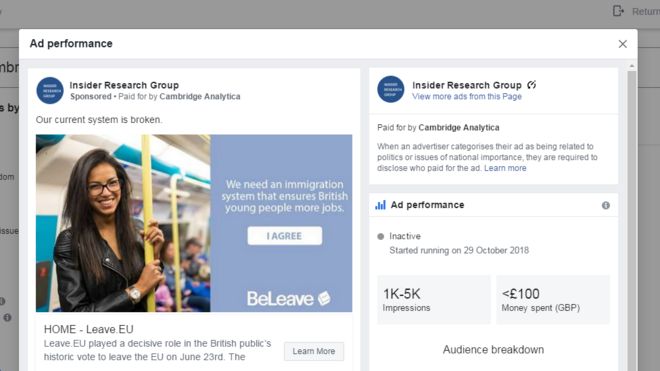
The ad cost less than £100 to promote on Facebook and has been viewed by more than 1,000 people
The ad was spotted by Guardian and Observer journalist Carole Cadwalladr.
"It just highlights how completely useless Facebook's new transparency rules are," she told the BBC.
"I can't think how they ever thought they were going to work - anybody can write anything in that box."
Tougher rules?
From 16 October, Facebook's new rules for political ads in the UK came into effect.
The social network had claimed that creators of such ads would have to prove their identity and location.
However, the resilience of Facebook's system has been called into question.
News site Vice was able to post ads purporting to be paid for by every sitting US senator, a total of 100 individuals.
"Receiving approval to run an ad 'paid for' by a senator typically just took a few minutes," said Vice journalist William Turton.
The fake ad comes as the UK and Canadian parliaments join forces to demand that Facebook chief executive Mark Zuckerberg respond to MP's questions over the Cambridge Analytica scandal.
A hearing will be held by the UK House of Commons digital, culture, media and sport committee on 27 November.
In a joint letter, the organisers appealed to Mr Zuckerberg to make an appearance.
"We would have thought that this responsibility is something that you would want to take up," wrote chair of the House of Commons committee Damian Collins and Bob Zimmer, chair of the Canadian standing committee on access to information, privacy and ethics.
Latest Stories
-
Mr President, Ghana was mentioned at the UN; why aren’t we talking about it?
3 hours -
Accra to convene Africa’s regulators and markets on tokenisation at AVAS 2026
3 hours -
The Paradox of Plenty — When every smartphone becomes a newsroom
4 hours -
GTA sensitises taxi drivers in ‘Know Ghana’ tourism campaign
5 hours -
Archbishop Agyinasare calls for responsible speech amid growing social media abuse
5 hours -
‘It will be inexcusable for gov’t not to honour payment of teachers’ arrears by 30th October’ – Haruna Iddrisu
5 hours -
Forbes’ World’s Best Employers 2026: No Ghanaian firm ranked among 900 companies
5 hours -
Electronic processing of teachers’ data: ‘The decision is the Controller’s’ – GES boss
6 hours -
Teachers’ Strike: Haruna Iddrisu questions paper-based processing of promoted teachers’ data
6 hours -
Savannah Region: Kunfusi bridge collapses again, leaving nearly 4,000 residents cut off
6 hours -
Teachers’ strike: GES targets Monday deadline to submit promotion data to Controller
6 hours -
Inflation to average 11.3% in 2027 – Fitch Solutions
6 hours -
‘I didn’t campaign for NDC to come and do this nonsense’ – Kpebu on EOCO’s conduct
6 hours -
Fitch Solutions maintains policy rate forecast of 14% by December 2026
7 hours -
Diaspora Nasara Caucus congratulates Mohammed Ali Suraj, new NPP executives
8 hours