

Audio By Carbonatix
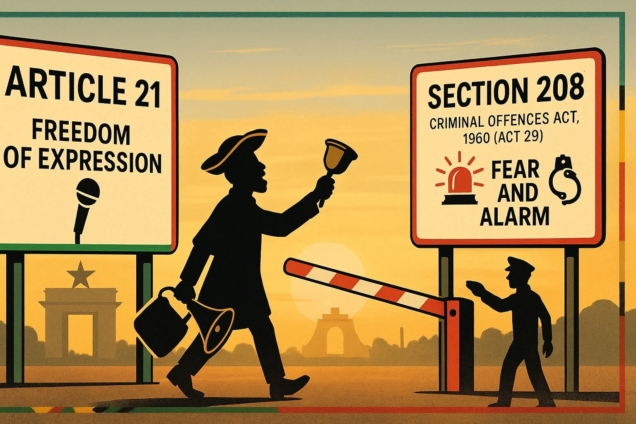
At the entrance to our Republic hang two signboards. The first, Article 21 of the 1992 Constitution, says: “Feel free to speak.” The second, Section 208 of the Criminal Offences Act, 1960 (Act 29), adds: “But do not cause fear and alarm.” That balance is fine—until we start punishing the town crier for ringing the bell. When danger looms, silencing the alarm doesn’t make us safer; it only ensures we are surprised.
Dawn is for Roosters, Not Raids
Somehow, “assisting investigations” has become Ghanaian for bring your toothbrush. We knock at dawn, when dreams are deepest and pyjamas most incriminating. Helpful at 5:10 a.m., suspect by sunrise. If a video shows people posing with hardware fit for a small coup, why is our first instinct to arrest the forward button? When a house is on fire, we don’t handcuff the smoke; we fetch water—and that fire extinguisher we promised to buy last year.
Recent Casualties of the Siren
Our soundtrack has familiar verses. In recent years, several public figures have learned how quickly a microphone can become a mugshot. Among them:
* Kwabena Bobie Ansah — learned how outspoken radio can come with handcuffs.
* Captain Smart — sharp talk branded “unsavoury” and met with arrest.
* David Tamakloe — the journalist who took the scenic route to detention for doing journalism.
* Oliver Barker-Vormawor — seasons spent in treason-limbo before the credits rolled.
* Oheneba Nana Asiedu — tasted the “false news” special under Section 208.
* Sir-Obama Pokuase — the latest, graduating from “assisting” to “accused” as if the interview room had a trapdoor.
Different names, same chorus: the law reaches for a megaphone to hush a microphone.
The Elastic-Trousers Clause
Section 208 was crafted to catch deliberate hoaxes that can stampede the public—think “there’s a bomb at the mall at 3 p.m.”—not to muzzle uncomfortable truths, clumsy forwards, or opinions that bruise official egos. Yet the law stretches like trotro upholstery: critic? it fits. Comedian? it fits. Columnist? tailored fit. We buried criminal libel but kept its favourite cousin on speed dial. Family, after all, is family.
The Bail Remix
The judge grants bail—case closed, right? Not quite. At the station, the track changes: “we’re verifying your sureties,” “OC isn’t in,” “printer has no ink,” “system is down.” Hours later, the remix ends with an overnight stay. In Ghanaian plain speak, court says go, paperwork says park and wait.
A Word on the Mind
Some public outbursts are not political; they are clinical. Handcuffs are not antidepressants, and a cell is not a clinic. When speech looks like distress, the first responder should be a clinician, not a charge sheet. That’s what a decent society does: it treats illness, it doesn’t parade it.
A Small Roadmap (served with pepper)
* Aim at the gun, not the retweet. When evidence suggests illegal arms, find the arms and the arms-bearers. Arresting the messenger is how real danger gets a head start.
* Put Section 208 on a strict diet—or retire it. Reserve it for intentional panic-hoaxes; carve out truthful reporting and matters of public interest so Article 21 can breathe like a free citizen.
* Sunlight, not spin. If we begin a case with “he’s assisting,” we should explain—publicly and promptly—when “helper” became “suspect,” whether counsel was present, and why a dawn raid was needed to collect a WhatsApp forward.
* End the bail theatre. Bail granted + terms met = home. Anything else is a throwback we can live without.
* Democracy with a strong stomach. If critique pricks, write a rebuttal. If it defames, sue—civilly. If it threatens violence, act surgically and swiftly. But abandon siren karaoke as a substitute for argument.
Final Word (and First Principle)
Ghana’s greatness is measured not by how quickly we silence discomfort, but by how calmly we answer it. Article 21 was written so that power would sweat under the lights; Section 208 was drafted to restrain panic-hoaxes, not town criers.
If we criminalise the alarm, who will warn us when the flood is coming? Reporting danger is a good deed. Correcting falsehoods is a good deed. Even satire, with its mischievous grin, is a small ladder leaning on that tree.
Let’s stop sawing the branch we all stand on. And if the road to justice feels longer than the Nsawam-Pokuase traffic at 5 p.m., we’ll still get there—provided we don’t keep stopping to arrest the traffic report.
—
The writer, Jimmy Aglah, is a media executive, author, and sharp-eyed social commentator. His latest book, Once Upon a Time in Ghana: Satirical Chronicles from the Republic of Uncommon Sense, now available on Amazon Kindle, delivers a witty, piercing take on Ghanaian society and governance. When he’s not steering broadcast operations, he’s busy challenging conventions—often with satire, always with purpose.

Latest Stories
-
Government to prioritise creation of decent jobs – Finance Minister
4 minutes -
Ghana’s ocean is not land under water: Why the Fisheries Commission is right to demand a proper assessment of offshore gold exploration
10 minutes -
Teacher unions maintain strike as FWSC, GES negotiations yield no deal
12 minutes -
Photos: Mahama Ayariga engages World Bank on sustainable cities development
17 minutes -
Foreign Affairs Minister warns embassies over long queues, ‘inhumane’ conditions for visa applicants
19 minutes -
Photos: AMA steps up enforcement to clear traders from BRT shelters
20 minutes -
Shortage of health information officers threatens quality of healthcare data – GHIMA
21 minutes -
Ghana’s National Chess Team, The Golden Knights return from Samarkand with gold and seven new international titles
22 minutes -
Northern Births and Deaths Director to face PAC over GH¢71k withdrawals
31 minutes -
Djokovic claims 102nd title of career with China Open win
35 minutes -
Desire FC teams up with Hellas Verona to develop emerging talent in Ghana
39 minutes -
Labone robbery case adjourned to October 22 as prosecution prepares supplementary statements
40 minutes -
BoG must come again on Cedi bouquets; people can use their money as gifts once they don’t deface it – Ayariga
41 minutes -
Mahama Cares administrator calls for stronger financial support for chronic illness patients
44 minutes -
Wontumi not yet confirmed among Mahama’s pardoned convicts – Palgrave
47 minutes